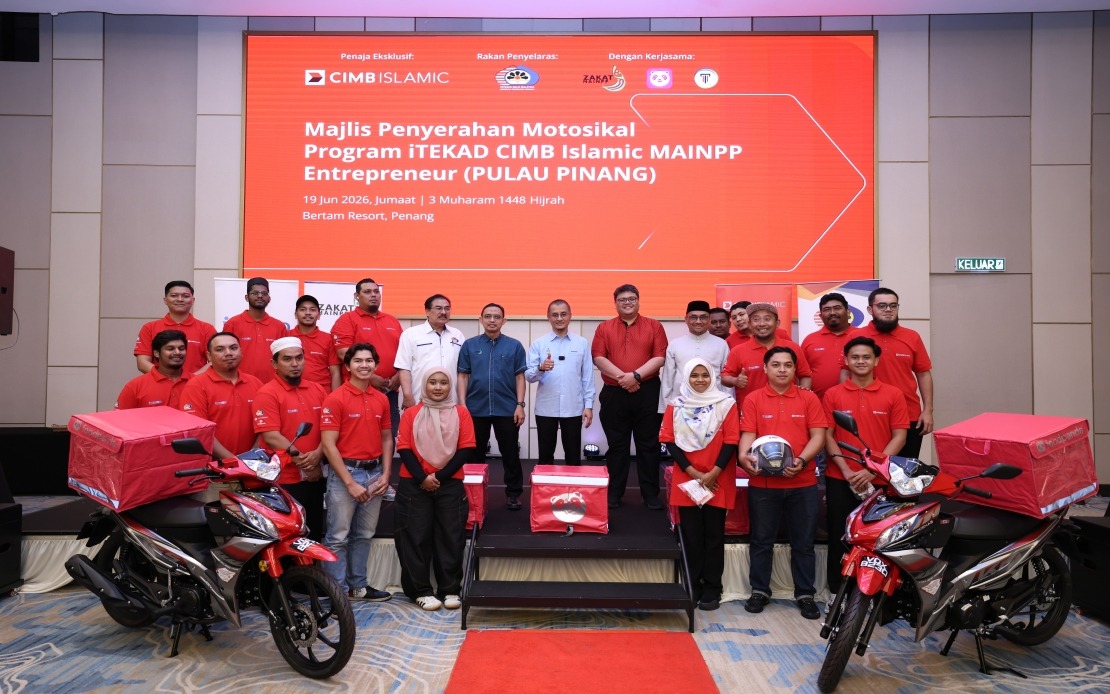
Twenty individuals in Penang have been handed motorcycles as part of the iTEKAD CIMB Islamic-MAINPP Entrepreneur programme, marking a significant milestone in efforts to uplift vulnerable communities through structured employment and income-generating opportunities. The handover ceremony, held at Bertam Resort in Kepala Batas on June 19, underscores a growing recognition among financial institutions and state governments across Malaysia that poverty alleviation requires multi-stakeholder collaboration and asset-based support beyond traditional cash transfers.
The initiative represents a partnership forged between CIMB Islamic Bank Berhad and the Penang Islamic Religious Council, known locally as MAINPP, working through the Zakat MAINPP fund. Implementation partners including the Malaysian Youth Foundation, Taylor's Community and foodpanda Malaysia have provided complementary expertise and market access. This consortium approach reflects a strategic shift in how zakat funds—a cornerstone of Islamic social finance—are being deployed with measurable targeting and professional oversight to maximise long-term impact among asnaf groups, the Islamic designation for those eligible to receive zakat assistance.
Penang Deputy Chief Minister I Datuk Dr Mohamad Abdul Hamid, who also heads MAINPP, explained that the programme extends far beyond simply distributing motorcycles. Each participant receives not only the vehicle and delivery equipment compatible with foodpanda's logistics network, but also foundational training in financial management, workplace discipline and entrepreneurial practices. This holistic design reflects lessons learned from earlier poverty-alleviation efforts that discovered asset transfers without accompanying capacity building often fail to produce sustained income improvements. The emphasis on structured training and ongoing mentorship signals confidence that participants possess genuine potential to transition into reliable self-employment.
The funding architecture reveals careful calibration of resources. The programme operates on a seed capital of RM400,000 structured as a matching grant—RM200,000 sourced from CIMB Islamic Bank's Wakalah Zakat fund, which operates as a third-party zakat management vehicle, and an equal RM200,000 contribution from Bank Negara Malaysia. This dual-source funding demonstrates the central bank's strategic interest in innovative poverty-reduction models and suggests potential for replication across other Malaysian states where similar partnerships could be established.
The selection process itself was notably rigorous. Zakat MAINPP fielded 151 applications from interested candidates, a response rate that underscores significant demand for structured self-employment pathways in Penang. Applicants underwent comprehensive screening including formal interviews and a mandatory four-day Entrepreneurship Camp held from May 31 to June 3, 2024. This residential bootcamp format allows evaluators to assess motivation, adaptability and interpersonal skills under real conditions, filtering for individuals most likely to succeed as independent delivery entrepreneurs. The fact that only 20 of 151 candidates—roughly 13 percent—were selected indicates stringent quality controls and acknowledgment that sustainable success requires careful matching between opportunity and individual capability.
The motorcycle-as-livelihood model aligns with existing gig economy infrastructure in Malaysia, particularly foodpanda's established delivery network. This creates immediate market entry for recipients without requiring them to build customer bases from scratch. The delivery sector, which has expanded dramatically post-pandemic, offers flexible scheduling compatible with participants potentially managing family responsibilities or supplementary income needs. By anchoring the programme to an established platform rather than encouraging isolated microenterprises, programme designers have reduced operational risk and simplified cash flow management for participants still acquiring business skills.
Datuk Dr Mohamad articulated a crucial principle underlying the initiative: that asnaf development cannot occur through isolated interventions but demands synergy across multiple sectors. This philosophy directly challenges siloed approaches where different government agencies or charitable organisations work independently. The iTEKAD programme's success will ultimately depend on sustained coordination between MAINPP's financial oversight, foodpanda's logistics management, YBM's mentoring capacity and Taylor's Community's on-ground support—a coordination challenge that Malaysian social programmes historically have struggled to maintain beyond initial launch phases.
The initiative aligns with Penang's broader Islamic Religious Development Agenda 2030, known as APAI2030, which explicitly prioritises holistic ummah development spanning education, economic participation, family stability and youth engagement. This positioning situates the motorcycle programme within a comprehensive state strategy rather than presenting it as an isolated charity initiative. For Malaysian policymakers observing from other states, the Penang model demonstrates how zakat institutions can evolve from passive distribution mechanisms into strategic partners in economic empowerment, leveraging their pooled resources and donor base to catalyse systemic change in specific communities.
The programme's emphasis on income stabilisation through structured support addresses a fundamental challenge in Malaysian poverty reduction. Asnaf communities often experience volatile income due to job insecurity, limited social protection and restricted access to credit for business investment. By providing productive assets coupled with training and market access, the initiative attempts to reduce this volatility and create foundations for accumulated savings and future investment. The motorcycle represents both immediate livelihood opportunity and potential collateral for future financial services as participants establish credit history and business track records.
From a regional perspective, the CIMB Islamic-MAINPP model offers a template relevant to other Southeast Asian economies grappling with informal employment and vulnerable populations. Malaysia's sophisticated Islamic finance architecture and coordinated social protection frameworks position it to pioneer approaches that other Muslim-majority nations in the region might adapt. The success or challenges encountered by the 20 Penang participants will generate operational intelligence valuable for scaling comparable programmes across Peninsular Malaysia and potentially the wider region.
The stated hope that assistance serves as a catalyst for lasting improvements rather than temporary relief reflects a outcomes-oriented mindset increasingly common in institutional social spending. Measuring success will require tracking employment stability, income trajectories and household asset accumulation among participants over the coming years. Zakat MAINPP and its partners will need to maintain robust data collection and impact assessment infrastructure to demonstrate whether the RM400,000 investment generates proportional returns in poverty reduction and asnaf household economic mobility.
Ultimately, the iTEKAD programme embodies a sophisticated approach to Islamic social finance: combining regulatory capital from Bank Negara Malaysia, institutional zakat resources from CIMB Islamic, community-embedded delivery from MAINPP, and market connectivity through foodpanda. Success depends not merely on distributing motorcycles but on maintaining the ecosystem that supports 20 individuals in translating productive assets into genuine, sustained livelihood security.

