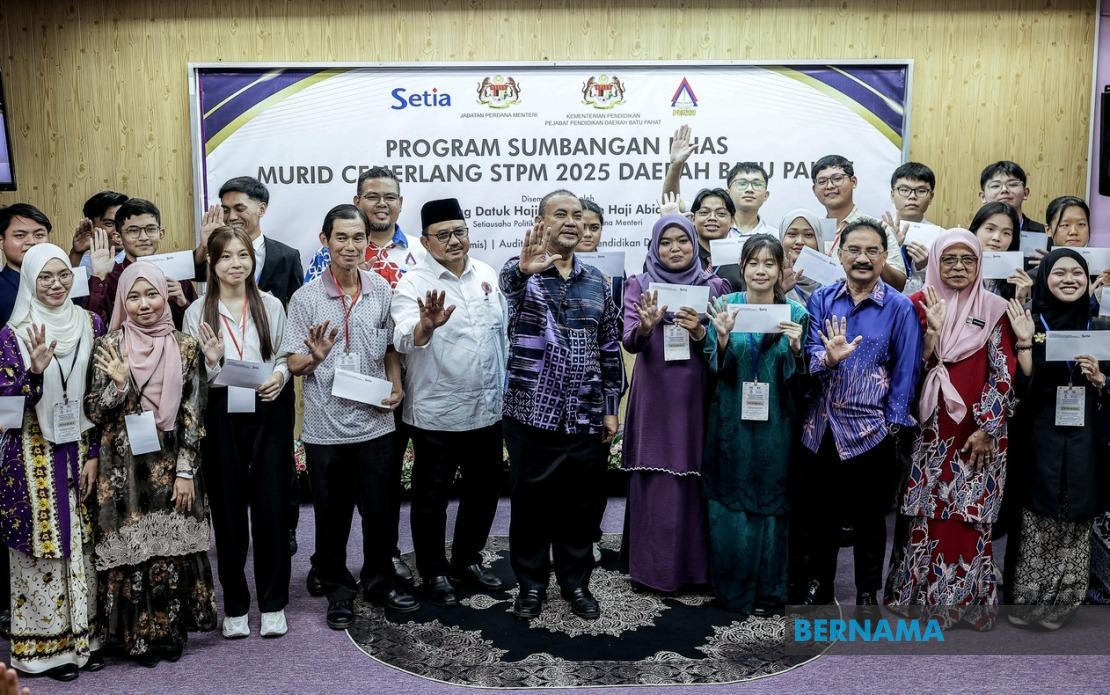
The Prime Minister's Office has distributed special financial contributions to 214 high-performing STPM students across Batu Pahat district, marking a government initiative aimed at honouring academic achievement and bolstering access to tertiary education. The presentation ceremony took place at the Batu Pahat District Education Office, where recipients from 16 secondary institutions in the area were formally recognised for their excellence in the 2025 Sijil Tinggi Persekolahan Malaysia examination.
Datuk Azman Abidin, Political Secretary to the Prime Minister, underscored the broader purpose of the scheme during his remarks at the awards ceremony. The contribution programme serves not only to celebrate outstanding student performance but also to inspire recipients to maintain their academic trajectory and pursue further education at the tertiary level. By distributing these awards, the government seeks to create a ripple effect within the student community, encouraging peers to aspire toward similar levels of scholarly achievement.
The initiative reflects a government commitment to supporting educational pathways during a critical juncture in students' academic journeys. The transition from secondary to tertiary education often involves financial pressures on families, and targeted assistance programmes can significantly ease this burden. Abidin indicated that the recognition extends beyond the monetary component; it symbolises official acknowledgement of individual merit and dedication to studies, which can prove psychologically valuable for young achievers navigating competitive educational landscapes.
Abidin conveyed optimism regarding the programme's expansion, noting that continuation and geographic growth would depend on budgetary allocations. Such conditional framing is typical of government initiatives in Malaysia, where funding availability shapes the scope and reach of educational support schemes. The statement suggests the government views this as a potentially recurring programme rather than a one-off gesture, though the absence of guaranteed budget commitments leaves future cohorts in other districts uncertain about programme permanence.
One of the awardees, 20-year-old Afida Auni Airulnizam from Sekolah Menengah Kebangsaan Tun Sardon in Rengit, articulated how the recognition resonated on both practical and emotional levels. Beyond the tangible financial assistance, she described the award as meaningful validation of her academic efforts—a sentiment common among high-achieving students who have invested substantial time and sacrifice into their studies. Her aspiration to pursue sports science at university level demonstrates how recognition awards can affirm students' chosen academic pathways and boost confidence in their tertiary applications.
Airulnizam's family context provides insight into the motivational structures operating within Malaysian households. As the youngest of two children, she draws inspiration from her older brother's university experience, illustrating how family precedent in higher education shapes younger siblings' expectations and aspirations. This dynamic underscores why government recognition matters: it validates both individual achievement and the family's educational investment, while potentially normalising tertiary education across generational lines within families.
Muhd Ammar Firdaus Mohd Fadzil, a 20-year-old former student of SMK Tun Ismail, offered a complementary perspective that emphasises the practical economic dimension. His acknowledgment that the contribution eases financial preparation for higher education highlights a reality often overlooked in purely celebratory narratives around academic excellence: high-achieving students frequently come from families of modest means, and the costs associated with university applications, entrance examinations, and initial enrolment can pose genuine hardship. Financial relief at this juncture can determine whether motivated students proceed to tertiary education or delay entry.
The programme's geographic focus on Batu Pahat in Johor is noteworthy, as it concentrates resources on a specific district with particular educational demographics. The fact that 16 secondary schools contributed awardees suggests relatively widespread distribution of high achievement across the district rather than concentration in one or two elite institutions. This pattern may reflect both the quality of teaching across Batu Pahat's educational infrastructure and the aspirational orientation of families within the district.
The timing of the awards in June 2025 aligns with the STPM results cycle, when high-achieving students are actively preparing tertiary applications and evaluating options. Award presentation at this moment maximises motivational impact, as students prepare for the next phase. The public ceremony amplifies the recognition beyond individual recipients to their families, schools, and broader communities—a multiplier effect that government communications strategies deliberately leverage.
Looking at the broader context, this initiative reflects Malaysian government priorities around human capital development and meritocratic recognition. While education funding remains a complex policy area with competing demands, programmes specifically honouring top achievers signal governmental commitment to excellence and talent development. However, the reliance on discretionary funding allocations rather than statutory entitlements means such schemes remain vulnerable to budget cycles and shifting political priorities.
For Malaysian students navigating the STPM examination and tertiary education landscape, such recognition programmes offer dual value: immediate financial assistance and public acknowledgement of merit. The expansion potential flagged by Abidin suggests this scheme may become more widespread, though schools and students in districts awaiting such programmes may wonder about equity implications when similar recognition remains unavailable to their cohorts.
The awards also reflect evolving government messaging around education in Malaysia. Beyond infrastructure and curriculum discussions, recognition of individual student achievement maintains focus on the human dimension of education. As Malaysia competes regionally for talent retention and globally for knowledge economy positioning, celebrating top academic performers serves both immediate motivational purposes and longer-term nation-building objectives. The students recognised today represent Malaysia's emerging intellectual capital, and their successful transition to tertiary education and ultimately professional careers carries implications for national competitiveness and development trajectories.

