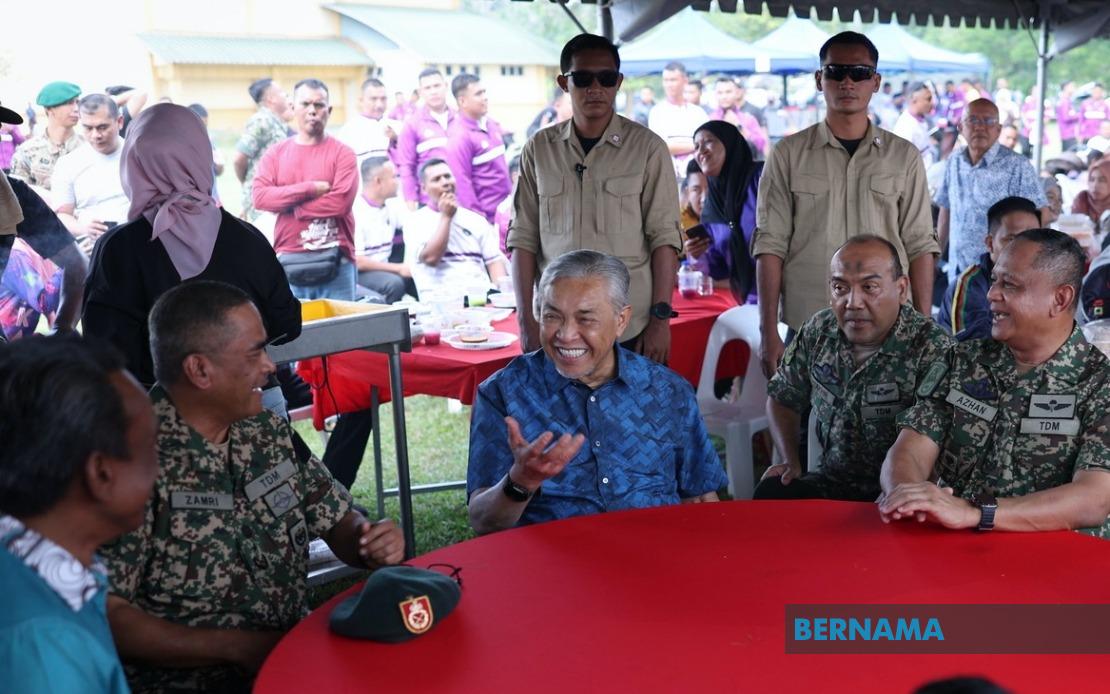
Deputy Prime Minister Datuk Seri Dr Ahmad Zahid Hamidi has made clear that accountability will be applied uniformly across all individuals should their names surface in connection with wrongdoing outlined in the Royal Commission of Inquiry report on Lembaga Tabung Haji, rejecting any notion that public office provides immunity from legal scrutiny. Speaking at a military family day event in Gemas, the BN chairman and UMNO president underscored the government's commitment to transparent disclosure of the RCI's investigative findings, signalling a significant shift in how Malaysia's leadership intends to handle the politically sensitive pilgrimage fund matter.
The Deputy Prime Minister elaborated on the procedural safeguards that would follow any revelation of irregularities, emphasising that formal investigative mechanisms exist to address potential misconduct. He outlined a cascade of potential responses, ranging from lodging official police reports to launching formal investigations focused on commercial crimes and broader legal violations. This structured approach reflects an attempt to position the government as simultaneously transparent and procedurally rigorous, though observers have noted the sensitive timing given ongoing electoral contests at the state level. Ahmad Zahid's remarks suggest confidence that the institution responsible for managing the savings of Malaysian pilgrims can withstand public scrutiny without sustaining irreparable reputational damage.
The timing of this announcement coincides with escalating momentum towards releasing the RCI report, a document that has remained under wraps following its completion. Prime Minister Datuk Seri Anwar Ibrahim previously signalled that Cabinet approval would likely be forthcoming, indicating a consensus within the current administration that continued suppression of the findings would generate greater suspicion than transparent disclosure. Anwar, who doubles as Finance Minister, has articulated a pragmatic rationale for the shift in approach, noting that earlier hesitation stemmed from concern that premature publication might undermine confidence in Tabung Haji at a vulnerable stage of institutional recovery.
The Finance Minister's assessment that circumstances have materially improved bears examination, particularly given the broader context of corporate governance reform in Malaysia. Anwar pointed to international recognition and strengthened institutional frameworks as justification for proceeding with public disclosure, suggesting that Tabung Haji has sufficiently stabilised to absorb potential negative revelations without triggering a crisis of confidence among the 9.3 million account holders who depend on the fund. This represents a calculated bet that transparency will ultimately reinforce rather than diminish institutional credibility, a thesis that may face testing in the coming weeks.
The political landscape surrounding this decision cannot be divorced from Malaysia's current electoral calendar. The Negeri Sembilan state election, scheduled for August 1 with early voting commencing the preceding Tuesday, provides an immediate arena where the Tabung Haji inquiry findings may influence voter behaviour. Ahmad Zahid characteristically downplayed potential electoral consequences, suggesting that voters in Negeri Sembilan possess sufficient political sophistication to compartmentalise institutional accountability matters from their voting preferences. This optimistic assessment may underestimate the degree to which governance failures erode public confidence in coalitions across multiple elections.
The substance of what the RCI report contains remains a matter of considerable speculation within Malaysian political circles. Historical precedent suggests that major institutional inquiries in Malaysia frequently uncover evidence of mismanagement, abuse of authority, or breach of fiduciary duty—matters that typically implicate multiple stakeholders across government and private sectors. The decision to release findings now, rather than continuing indefinite suppression, implies that the government either possesses sufficient political capital to absorb negative revelations or has determined that further delay poses greater reputational risks than transparent disclosure accompanied by swift corrective action.
For Malaysian investors and savings account holders, the imminent release of the RCI report carries particular significance. Tabung Haji manages approximately RM80 billion in assets on behalf of depositors planning for Hajj pilgrimages, making it one of the nation's largest faith-based financial institutions. Any evidence of systematic mismanagement or asset misappropriation would directly threaten the security of these life savings, potentially triggering legislative reforms and management restructuring. The government's apparent confidence that the institution can weather scrutiny suggests senior officials have already reviewed the report's contents and deemed them manageable within existing governance frameworks.
The broader implications for Malaysian governance merit consideration. Ahmad Zahid's emphatic statement that no one stands above the law, delivered by the nation's second-highest ranking official, reflects a rhetorical commitment to equal justice that has been challenged by Malaysia's historical track record on high-level accountability. The assertion must be measured against actual enforcement outcomes once the RCI report identifies specific individuals or organisations responsible for alleged misconduct. The credibility of Malaysia's anti-corruption apparatus depends substantially on whether allegations detailed in the report translate into prosecutions or remain confined to administrative remedies.
Institutional memory of previous Malaysian inquiries suggests that statements regarding accountability often exceed actual enforcement. The Port Klang Free Zone audit, the 1MDB investigation, and the Tabung Haji situation itself demonstrate patterns where initial inquiries identify serious irregularities, but ultimate consequences for high-ranking officials frequently remain limited through various procedural mechanisms or political considerations. Ahmad Zahid's pledge will therefore be tested by whether the Cabinet demonstrates comparable commitment when specific individuals surface as subjects of investigation, particularly if those individuals enjoy significant political protection or maintain strategic importance to governing coalitions.
The decision to prioritise transparency on Tabung Haji coincides with broader international scrutiny of Malaysia's governance frameworks. Financial institutions managing substantial public resources face increasing pressure from international bodies and investor communities to maintain rigorous standards. The release of the RCI report, accompanied by credible enforcement responses, would position Malaysia as progressively serious about institutional accountability. Conversely, if the report surfaces but generates no meaningful consequences, Malaysia risks reinforcing perceptions of inconsistent application of governance standards based on political considerations.
Looking ahead, the public release of the RCI findings will likely become a benchmark for assessing the current government's commitment to transparency and accountability. Ahmad Zahid's unequivocal statement that no one enjoys exemption from legal consequences provides a clear metric against which the administration's subsequent actions will be evaluated. The Negeri Sembilan election represents an immediate test of whether voters reward or penalise government coalitions for institutional failures identified in major inquiries, regardless of reassurances regarding future accountability. The outcome may signal broader patterns in how Malaysian electorates respond to governance concerns in coming elections.

