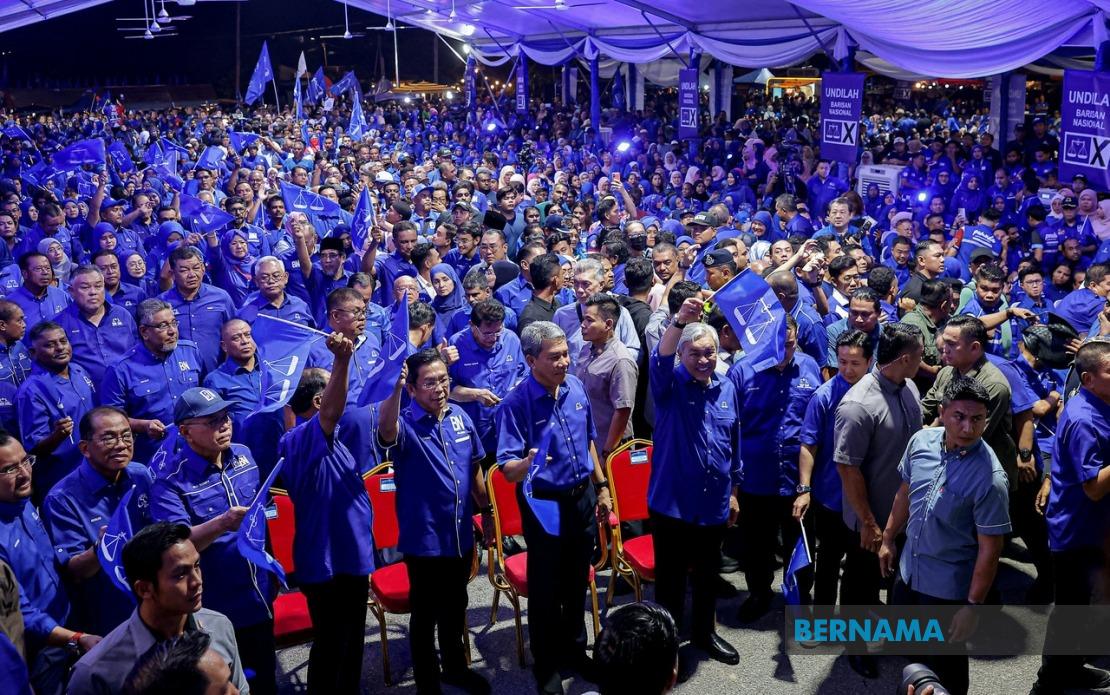
Barisan Nasional's dominant performance in the Johor state election represents a pivotal moment for the coalition's political fortunes, and Datuk Seri Dr Ahmad Zahid Hamidi believes it must serve as the springboard for success in the forthcoming 16th Negeri Sembilan state election. Addressing party machinery and announcing candidates at the campaign launch in Seremban on July 15, the UMNO president and BN chairman stressed that consolidating gains in one state while pressing forward in another demands meticulous execution and unwavering internal cohesion. The message was unambiguous: the window of electoral opportunity has opened wide, and BN must act decisively to capitalize on renewed public confidence.
Johor's outcome provides both quantifiable proof of BN's electoral viability and a template for replication across other states. The coalition captured 48 of the 56 state assembly seats, an extraordinary haul that reflects not merely a victory but a near-total mandate from voters. With nearly 60 per cent of the popular vote, BN achieved what officials describe as the party's largest state-level triumph in Johor's electoral history. These figures matter beyond mere scorecard comparisons; they signal to fence-sitting voters in Negeri Sembilan that BN possesses the organizational capacity and public backing to govern effectively. For a coalition that has endured years of internal turbulence and competing factional interests, such validation proves invaluable psychologically and operationally.
Ahmad Zahid articulated a sophisticated understanding of why Johor succeeded, attributing the result not to any single personality or faction but rather to the collective discipline of the entire BN apparatus. The coalition's diverse membership—spanning UMNO, MCA, MIC, and smaller component parties—functioned as a unified force, with individual party leaders subordinating personal ambitions to the overarching electoral objective. This emphasis on team cohesion carries particular significance for Negeri Sembilan, a state where BN's performance deteriorated to just 14 seats in the 2023 election. The implication is transparent: whatever internal disputes or candidacy disagreements may exist within BN ranks must be resolved swiftly and subordinated to the common cause of reclaiming ground lost in the previous contest.
The challenge Ahmad Zahid posed to BN's grassroots machinery extends beyond electoral mechanics to encompass a cultural shift in how party activists approach campaigning. His injunction that members engage voters directly through door-to-door canvassing reflects recognition that Negeri Sembilan requires intensive ground-level mobilization. The state's electoral dynamics differ from Johor's; voters may harbor distinct grievances or policy preferences that demand localized responses rather than centralized messaging. By tasking party machinery with extensive voter contact, BN aims to rebuild the personal relationships and community-level trust that sustained its dominance in earlier decades. This labor-intensive approach contrasts with reliance on mass media or top-down directives, suggesting that leadership recognizes the need to re-establish BN's traditional strength: a vast network of connected activists embedded within communities.
A critical subtext in Ahmad Zahid's remarks concerns the perennial tension between candidate selection processes and collective electoral success. Party members naturally covet nomination to contest seats, and the winnowing process invariably generates disappointment and potential resentment among those passed over. The BN chairman directly addressed this friction, cautioning against allowing frustration over candidacy outcomes to undermine commitment to the broader campaign. His warning suggests that past elections have witnessed instances where disappointed candidates or their supporters either reduced their efforts or actively worked at cross-purposes with nominated candidates. The Negeri Sembilan campaign cannot afford such divisiveness if BN is to substantially improve on its 14-seat haul from 2023.
Geographically and politically, Negeri Sembilan occupies a distinctive position within Malaysia's electoral landscape. The state serves as a hinterland to greater Kuala Lumpur, with an electorate influenced by national political currents but also responsive to state-specific concerns regarding development, economic opportunity, and responsive governance. BN's slip to just 14 seats in 2023 reflected broader challenges the coalition faced nationwide, yet the subsequent Johor recovery suggests that given appropriate conditions and sufficiently energetic campaigning, BN retains capacity to recapture lost support. Negeri Sembilan voters may have been testing opposition alternatives in 2023; the Johor outcome could persuade them that BN merits reinstatement, particularly if the coalition demonstrates renewed unity and articulates a compelling vision for state development.
Ahmad Zahid's invocation of political stability, economic growth, and responsible governance as defining BN attributes positions the coalition's campaign within an explicitly performance-based framework. Rather than appealing primarily to ethnic or communal loyalties—the traditional bedrock of BN politics—this messaging emphasizes competence and delivery. For Malaysian voters increasingly sophisticated in evaluating electoral choices, such emphasis carries weight. Negeri Sembilan's electorate, like those nationwide, has experienced economic pressures, and any BN campaign succeeding in demonstrating that the coalition possesses both the capability and commitment to address these challenges will gain traction. The implicit comparison to opposition governance elsewhere provides additional argumentative ammunition.
The ceremonial dimensions of the campaign launch at Tuanku Abdul Rahman Stadium in Paroi carried significance beyond theatrical spectacle. By assembling BN deputy chairman Datuk Seri Mohamad Hasan alongside Ahmad Zahid and other coalition leaders, the party visibly demonstrated the unity its chairman preached. The location's choice—a substantial venue capable of hosting the party machinery—sent a message about BN's organizational prowess and logistical capacity. These symbolic elements matter in politics; they reinforce messaging with visual evidence and project confidence that permeates the broader campaign environment.
With nomination day scheduled for the Saturday following Ahmad Zahid's address and polling set for August 1, the Negeri Sembilan campaign compressed into a remarkably tight timeframe. The Election Commission's early voting provision on July 28 accommodates certain voter categories but simultaneously emphasizes that the intensive campaign period spans mere weeks. This brevity places premium value on initial momentum and effective machinery deployment. BN cannot afford sluggish activation or delayed messaging; the party must translate the chairman's directives into sustained, coordinated activity across constituencies. Every day of the campaign represents precious opportunity in such a constrained window.
For Malaysia's broader political dynamics, the Negeri Sembilan election provides an important data point in evaluating whether BN's Johor recovery represents a genuine resurgence or a localized phenomenon. A decisive Negeri Sembilan victory would strengthen Ahmad Zahid's position within the party and validate his leadership approach; conversely, a disappointing result would raise questions about whether Johor's success depended on state-specific factors rather than transferable factors. Opposition parties will watch the results closely, as will Sabah and Sarawak's leadership, which must assess BN's electoral viability as they contemplate their own political positioning. The state-level elections thus acquire significance extending far beyond Negeri Sembilan's boundaries.
The Deputy Prime Minister's confidence that BN will substantially improve on its 2023 performance reflects either genuine conviction based on internal polling or the pragmatic optimism leaders customarily project publicly. Achieving even 24 or 26 seats—roughly doubling the 2023 tally—would represent substantial progress and validate the narrative of BN's recovery. Such a result would reposition the coalition as a competitive force capable of winning statewide contests, a perception that has eroded during years of opposition dominance in certain states. The mathematics of Malaysian politics suggest that if BN can string together victories across multiple states, the path to federal-level dominance becomes considerably clearer.
Ultimately, Ahmad Zahid's address encapsulates both BN's current opportunity and its persistent vulnerability. The coalition possesses structural advantages: substantial financial resources, entrenched administrative apparatus, and demonstrated organizational capacity as evidenced by Johor. Yet these advantages translate into electoral victories only when party unity remains intact and grassroots activists operate with genuine enthusiasm rather than grudging obligation. The coming weeks will test whether Negeri Sembilan's BN machinery can sustain the discipline and focus Ahmad Zahid demands, transforming the Johor momentum into additional state-level gains and gradually reconstructing BN's fractured national political dominance.

