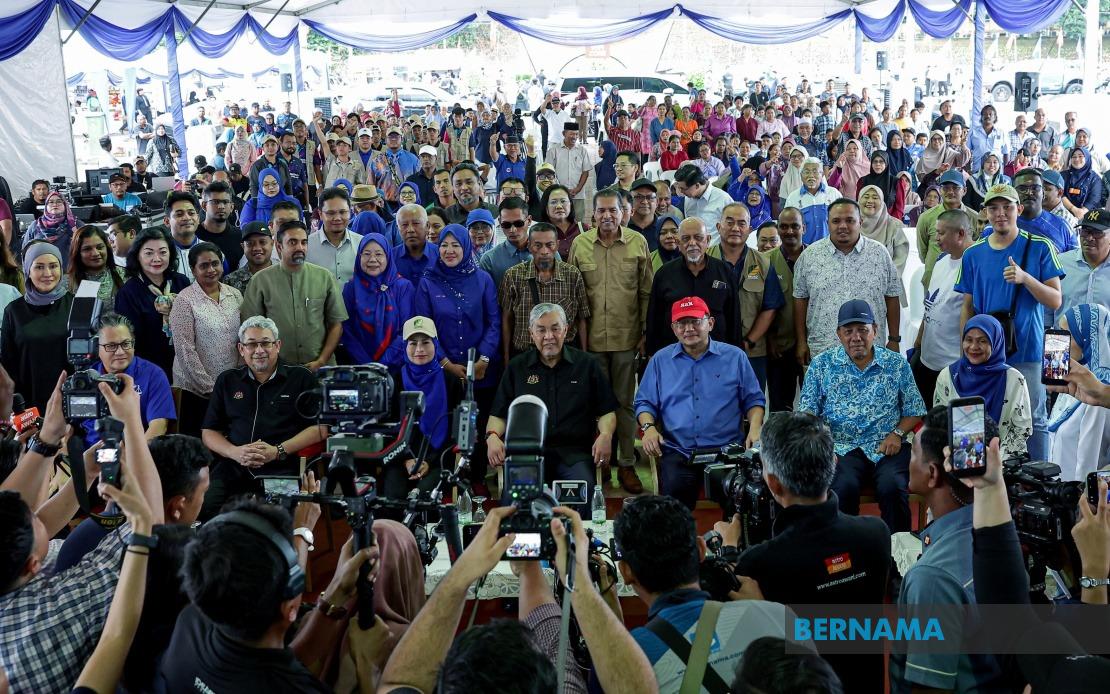
Deputy Prime Minister Datuk Seri Dr Ahmad Zahid Hamidi has called on all political contenders in the 16th Negeri Sembilan State Election to steer clear of inflammatory language centred on race, religion, culture and social divisions, signalling a push for more constructive electoral discourse ahead of voting day. Speaking in Kuala Pilah on July 25, the Barisan Nasional chairman stressed that political actors at every level must uphold professional conduct and integrity while campaigning, prioritising substantive policy discussions that genuinely address public concerns rather than resorting to personal invective or identity-based appeals.
The call reflects broader concern within Malaysia's political establishment about maintaining stability and decorum as state elections proceed within the framework of the federal Unity Government. Ahmad Zahid emphasised that while political parties inevitably hold differing viewpoints, there exists a responsible methodology for articulating those disagreements without breaching ethical boundaries or dredging up contentious historical grievances. This messaging signals an effort to prevent the Negeri Sembilan contest from becoming a flashpoint for the kind of communal tensions that have historically marked Malaysian electoral cycles and threatened national cohesion.
As the BN leader, Ahmad Zahid underlined the importance of preserving the cooperative spirit underpinning the current federal coalition arrangement. The Deputy Prime Minister stressed that BN remains committed to supporting Prime Minister Datuk Seri Anwar Ibrahim's administration through its full term, rejecting any characterisation of the coalition as fragile or vulnerable to destabilisation. He explicitly denied suggestions that BN might pursue backroom political manoeuvres to undermine the MADANI Government, positioning the coalition as a stable and principled partner in national governance.
The timing of Ahmad Zahid's remarks carries significance for Malaysia's evolving political landscape. The Negeri Sembilan election represents a meaningful test of the Unity Government's coherence and the ability of historically rival parties to compete within a shared institutional framework without descending into acrimony. For Malaysian voters accustomed to campaigns that exploit communal anxieties, an election fought primarily on competing policy platforms rather than inflammatory identity appeals would represent a notable departure from recent electoral patterns.
Accompanying Ahmad Zahid at the Dataran Melang event was Plantation and Commodities Minister Datuk Seri Dr Noraini Ahmad, underscoring the administrative prominence of the occasion. The Deputy Prime Minister used the platform of the Salam Agrikomoditi MADANI programme—a rural development initiative—to amplify his message about campaign standards, linking governance ethics to practical service delivery concerns that resonate with constituents across Negeri Sembilan's diverse constituencies.
In a related development, UMNO vice-president Datuk Seri Mohamed Khaled Nordin addressed speculation about BN and Perikatan Nasional cooperation in the state election, characterising the arrangement as a pragmatic understanding designed to prevent wasteful multi-way contests in specific constituencies. Speaking at a press conference in Johor following the Pasir Gudang UMNO Division meeting, Khaled Nordin explicitly ruled out any merger or deeper institutional integration between the two coalitions, framing the coordination as a tactical measure to optimise electoral efficiency rather than a fundamental political realignment.
This clarification proves important for regional observers monitoring Malaysian coalition dynamics. The BN-PN understanding in Negeri Sembilan demonstrates that competition and selective cooperation can coexist without necessarily signalling broader structural changes to Malaysia's party system. For Southeast Asian democracies watching how mature political systems manage coalition complexity, this distinction between tactical seat-sharing and ideological consolidation offers instructive lessons about maintaining electoral competition while avoiding destructive fragmentation.
The electoral calendar for Negeri Sembilan now moves toward critical milestones, with early voting scheduled for July 28 and general polling on August 1. This compressed timeline means that campaigns are entering their final phase, making Ahmad Zahid's exhortation toward ethical conduct particularly timely. Parties must now demonstrate whether their public commitments to standard-based campaigning translate into actual practice during these final weeks when electoral pressure typically intensifies.
For Malaysian voters, particularly those in Negeri Sembilan, the quality of campaign discourse will shape not only immediate electoral choices but also broader expectations about political conduct. If the state election proceeds with substantive policy debate rather than divisive rhetoric, it could establish precedent for future state and national contests. Conversely, if candidates revert to identity-based appeals despite leadership exhortations against such tactics, it would signal that institutional calls for civility carry limited enforcement power within Malaysia's decentralised party structures.
The emphasis on maintaining Unity Government coherence carries implications beyond Negeri Sembilan's borders. As the first state election since the federal coalition's formation, this contest serves as a barometer for whether the arrangement can function effectively across different electoral contexts. Parties that abandon measured campaigning in pursuit of short-term state-level advantage risk damaging the federal partnership upon which their ministerial positions and influence ultimately depend, creating structural incentives for restraint that reinforce Ahmad Zahid's ethical appeals.
The initiative also reflects international pressure on Malaysian political institutions to demonstrate electoral maturity and institutional strength. In an increasingly polarised regional environment where several Southeast Asian democracies face questions about institutional resilience, Malaysia's ability to conduct competitive elections within frameworks of professional conduct carries symbolic weight beyond immediate political outcomes. Ahmad Zahid's message thus addresses not only Negeri Sembilan voters but also international observers assessing whether Malaysia's democratic institutions can evolve toward more substantive, less divisive political competition.

