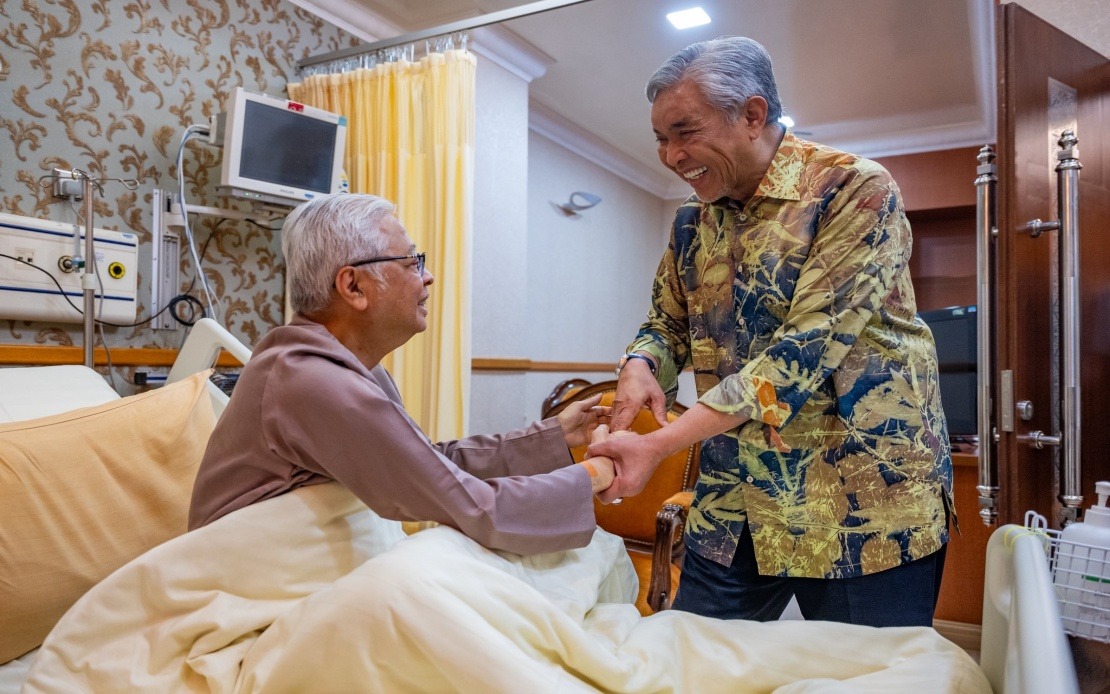
Deputy Prime Minister Datuk Seri Dr Ahmad Zahid Hamidi made a personal visit to the National Heart Institute in Kuala Lumpur to see former Prime Minister Datuk Seri Ismail Sabri Yaakob, who is currently receiving medical care at the facility. The visit underscores the continued bonds within Malaysia's political establishment during a health crisis affecting one of the country's recent leaders, reflecting the tradition of cross-party solidarity in matters of personal wellbeing among senior government figures.
In remarks posted on social media, Ahmad Zahid conveyed his prayers for Ismail Sabri's complete recovery and restoration to full health. He expressed hope that the former premier would regain his strength, overcome his current medical challenges with ease, and ultimately return to his regular routines and responsibilities without lasting complications. Such public displays of support from sitting government leaders serve to reassure the public about the condition of prominent political figures while reinforcing institutional continuity.
Ismail Sabri, who represents Bera as a Member of Parliament, encountered health difficulties on August 6 while attending the Malaysian Anti-Corruption Commission headquarters to provide a recorded statement. The unexpected medical episode prompted immediate intervention, with medical personnel transporting him urgently to the National Heart Institute, where specialists could provide comprehensive cardiac care. This incident marked a significant moment in the political calendar, given Ismail Sabri's recent tenure as Prime Minister from August 2021 to November 2022.
At the institute, Ismail Sabri underwent a specialized procedure to implant a wireless pacemaker designed to manage an irregular heartbeat condition. This minimally invasive intervention represents modern cardiology's response to arrhythmia management, offering advantages in terms of reduced infection risk and patient mobility compared to traditional pacemaker systems. The procedure's success depends on precise placement and programming to ensure the device appropriately regulates heart rhythm and maintains adequate blood circulation throughout the body.
The health setback affecting Ismail Sabri comes at a notable juncture in Malaysian politics. His tenure as Prime Minister, though relatively brief, occurred during a period of significant political realignment and factional tensions within the ruling coalition. The incident has naturally drawn attention to the demands and pressures inherent in serving at the highest levels of government, where stress, extended working hours, and intense scrutiny can contribute to health vulnerabilities among senior officials.
Wireless pacemakers represent a technological advancement in cardiac device therapy, eliminating the need for a traditional pulse generator beneath the collarbone and instead relying on a miniature device implanted directly within the heart chamber. This innovation reduces the visibility of the device, minimizes tissue trauma during implantation, and potentially simplifies future replacements or upgrades. For patients like Ismail Sabri, such technology enables continued engagement in public and professional duties with minimal physical restriction or lifestyle disruption.
The timing of Ismail Sabri's health complications during a MACC interview has attracted particular scrutiny given Malaysia's ongoing efforts to investigate and address corruption allegations. The incident demonstrates how health emergencies can intersect with legal proceedings, raising questions about the coordination between government institutions when senior officials require urgent medical attention while engaged in official investigations. Such intersections highlight the complex web of institutional relationships within Malaysia's governance structure.
Ahmad Zahid's hospital visit carries additional significance given the contested political dynamics between the United Malays National Organisation faction that elevated Ismail Sabri to the premiership and the Democratic Action Party-influenced government that succeeded him. The gesture of visiting and publicly expressing concern demonstrates that despite policy disagreements and political competition, Malaysia's senior political leadership maintains protocols of mutual respect during personal crises affecting former office-holders.
The National Heart Institute, as Malaysia's premier cardiac care facility, has treated numerous high-profile patients over decades, maintaining rigorous standards of medical excellence. Its capacity to handle complex cardiac procedures such as wireless pacemaker implantation reflects the advancement of Malaysian healthcare infrastructure and the availability of cutting-edge treatment options within the domestic system, reducing the necessity for political leaders to seek care abroad.
For Malaysians observing this situation, the incident underscores the physical toll that high-level political office can exact on individuals. The months and years leading up to Ismail Sabri's tenure involved intense political maneuvering, factional disputes, and the challenges of governing during a pandemic recovery period. The health crisis serves as a reminder that political actors remain human beings subject to the same medical vulnerabilities as any citizen, regardless of their institutional position or decision-making power.
Moving forward, Ismail Sabri's recovery trajectory will likely influence public discourse around the pace and demands of Malaysian politics. His return to parliamentary duties and community representation will be watched closely, both as a measure of the procedure's success and as an indicator of his continued commitment to public service. The support expressed by Ahmad Zahid and presumably other political figures demonstrates that despite the fierce competitions characterizing Malaysian politics, there exists an underlying consensus regarding the importance of health and wellbeing among the nation's leadership.

