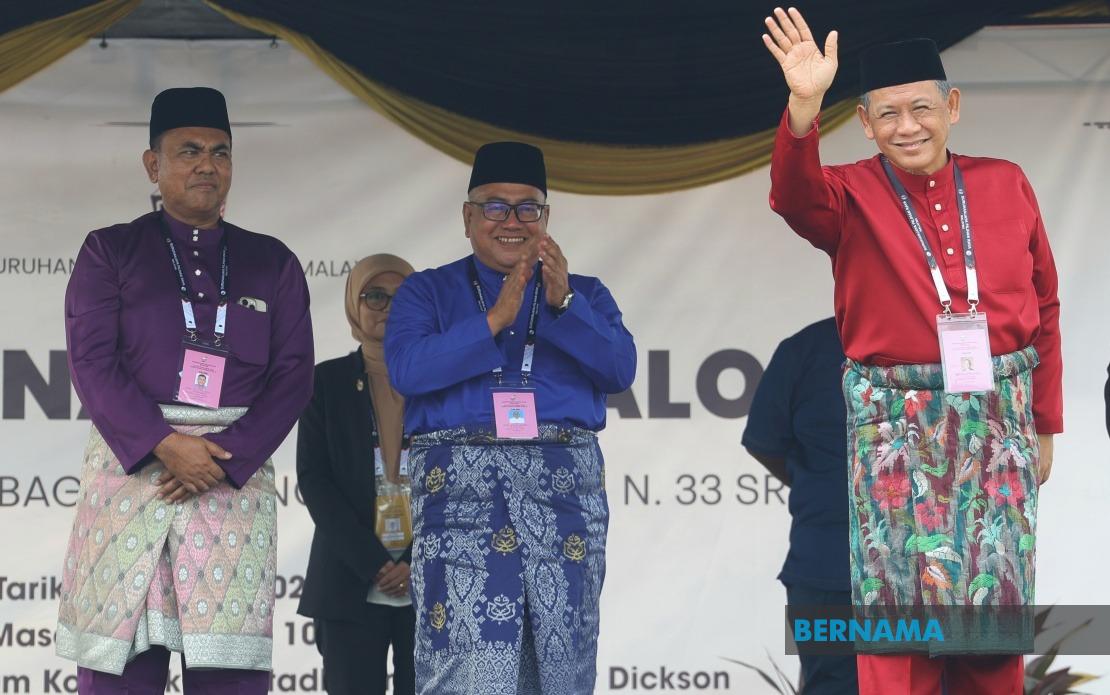
The stage is set for a bruising contest in Negeri Sembilan as Menteri Besar Datuk Seri Aminuddin Harun of Pakatan Harapan prepares to defend the Linggi seat against two formidable challengers in what promises to be one of the most closely watched battles of the 16th state election. The three-cornered race will pit the incumbent PH leader against Barisan Nasional's Datuk Mohd Faizal Ramli, a seasoned political operator, and Bersatu's Datuk Zamri Md Said, marking a significant fragmentation of the anti-PH vote in a constituency that has traditionally been competitive.
The nomination process concluded on July 18 at the Port Dickson District Administration Complex, with returning officer Nurhazelin Makli announcing the final slate of candidates across the state's contested seats. The Linggi contest encapsulates broader political dynamics playing out across Negeri Sembilan, where the opposition and splinter groups are attempting to dislodge Pakatan Harapan from its position of strength. For Aminuddin, retaining the seat is not merely a matter of personal political survival but a crucial anchor to his authority as Menteri Besar, making this particular race laden with symbolic importance beyond the constituency's boundaries.
The three-way split in Linggi reflects the increasingly fragmented opposition landscape in Malaysia's ninth state. Barisan Nasional, which governed Negeri Sembilan for decades before losing power in 2018, remains a substantial force but no longer commands the unified backing it once enjoyed. Bersatu's decision to field a candidate suggests the party believes it can carve out space in the anti-PH coalition, though such divisions risk allowing Aminuddin to slip through the middle with a plurality rather than a majority. This fractionalisation may inadvertently benefit the incumbent, depending on how the anti-PH sentiment distributes itself among voters.
Elsewhere in the state, the contests follow a similar pattern of competitive races. In Sri Tanjung, PH's Dr G. Rajassekaran, the sitting representative, will defend against BN's A. Achutan and Bersatu's Leevineshwaraan Murugan, another three-cornered affair that mirrors the fragmentation evident in Linggi. The seat represents a microcosm of how Bersatu's presence is complicating the traditional two-coalition arithmetic that long defined Malaysian electoral politics. Similarly, the Lukut seat will feature PH incumbent Choo Ken Hwa facing off against Perikatan Nasional's Sathes Kumar Nilameham and independent candidate Teo Seng Lee, indicating that factional politics extends across multiple constituencies.
Bagan Pinang presents a notably different configuration, with PAS incumbent Abd Fatah Zakaria seeking re-election against Nasir Raman of PH and Bersatu's Sheikh Junaidy Jamaludin. The presence of a PAS representative defending a seat reflects the complex history of coalition-building in Negeri Sembilan, where different parties have held sway across time. The contest here will test whether voters view PAS as an acceptable custodian of the seat or whether they prefer either PH's or Bersatu's vision for the constituency. In Chuah, by contrast, the field has narrowed to a direct contest between PH's Yew Boon Lye and BN's Pau Jeou Ching, suggesting that in some areas, the old bipolar arrangement between the two major coalitions persists.
The Election Commission has scheduled polling for August 1, with early voting opportunities on July 28 for military and police personnel and their families. These dates provide a compressed campaign period that favours well-organised machinery and candidates with high visibility. The commission estimates that 889,490 voters will participate across the state, comprising 867,151 ordinary registered voters plus 16,884 military personnel and their spouses, and 5,455 police personnel and their spouses. The military and police voting bloc, while not substantial in absolute terms, can prove decisive in close races, particularly in constituencies where security forces maintain significant family populations.
For Malaysian observers and regional analysts, the Negeri Sembilan election serves as a crucial barometer of political sentiment in the peninsula's central heartland. The state has often functioned as a bellwether of national political trends, making its results potentially indicative of broader movements within the electorate. The emergence of Bersatu as a genuine force contesting multiple seats marks a departure from earlier assumptions that the party would remain peripheral after its initial split from UMNO. How voters respond to this challenge to the PH government will offer insights into the durability of the current Pakatan coalition and the appetite among Malaysian voters for alternative configurations.
The strategic calculations facing each major player are evident in candidate selection patterns and seat assignments. Aminuddin's positioning in Linggi places the party leadership squarely in the fray, signalling confidence in PH's ability to navigate a three-way race, though such contests carry inherent risk if anti-PH sentiment unifies around a single challenger. Barisan Nasional's decision to field candidates across multiple constituencies indicates its intention to present a comprehensive alternative government, seeking to rebuild its political apparatus following years in opposition. Bersatu's participation across several seats suggests the party is testing its appeal as a credible third force capable of appealing to voters dissatisfied with both the incumbent government and the traditional opposition.
The compressed campaign timeline works to the advantage of parties with established ground organisations and existing voter databases. Pakatan Harapan's tenure in office provides access to state machinery and administrative resources, though such advantages can prove double-edged if public perception of governance performance is negative. Barisan Nasional retains lingering organisational networks and traditional voter support bases in some areas, though the party must overcome perceptions of entitlement and complacency that contributed to its earlier defeats. Bersatu enters the race as a relative newcomer to this particular electoral arena, requiring rapid mobilisation and brand differentiation to secure meaningful support.
The Negeri Sembilan election ultimately reflects the evolving maturity of Malaysian democracy, where voters increasingly demonstrate willingness to engage with multiple political options rather than simply oscillating between two monolithic blocks. The three-cornered contests evident across numerous constituencies demonstrate that Malaysian electoral politics has transitioned from simple bipolarity toward greater fragmentation and complexity. How candidates and parties navigate this more intricate landscape will shape not only the immediate outcome of the August 1 poll but also provide guidance for understanding broader patterns of political realignment that may extend into subsequent national elections. The stakes for Aminuddin in Linggi are therefore both local and broadly significant, making the contest a compelling lens through which to examine contemporary Malaysian electoral dynamics.

