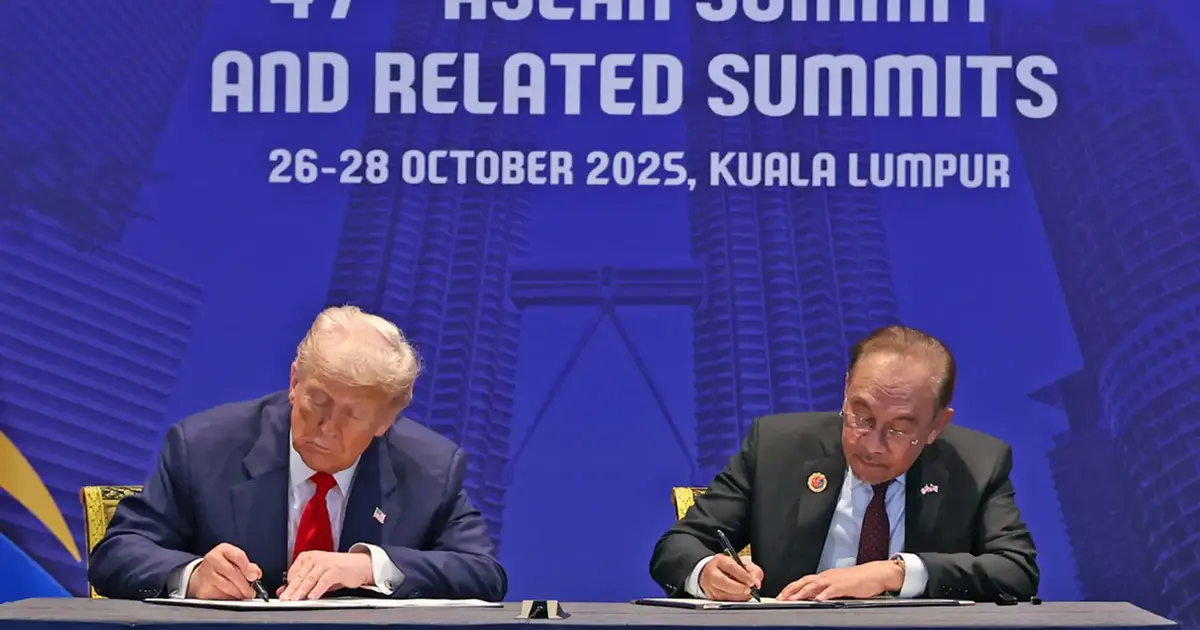
Prime Minister Anwar Ibrahim and the government have lodged applications to dismiss a lawsuit filed by opposition parliamentarians contesting the framework of the reciprocal trade agreement between Malaysia and the United States. The legal manoeuvre represents a significant escalation in the political and constitutional tension surrounding the bilateral trade pact, which has become a focal point of parliamentary scrutiny and public debate.
The opposition members of parliament have simultaneously advanced a separate application requesting that certain constitutional questions arising from the trade accord be referred directly to the Federal Court for adjudication. This dual approach reflects the complexity of the dispute, which extends beyond the conventional bounds of parliamentary disagreement into questions about the constitutional authority to negotiate and ratify international commercial agreements without comprehensive legislative approval.
The Malaysia-US reciprocal trade agreement has been a source of considerable political friction since its announcement. Opponents argue that the government has exceeded its constitutional mandate by pursuing trade negotiations without sufficient parliamentary oversight or public consultation. The dispute centres on whether agreements affecting Malaysian commerce and regulatory frameworks require express parliamentary approval or whether the executive branch possesses sufficient autonomy under Malaysia's constitutional structure to conclude such arrangements independently.
The government's application to strike out the case suggests confidence that the legal challenge lacks sufficient merit to proceed to substantive hearing. However, the simultaneous request by opposition MPs for constitutional referral indicates they believe fundamental questions about the distribution of executive and legislative power in Malaysia's system of government remain unresolved. Such referrals to the Federal Court are typically granted only when cases involve genuinely novel or unsettled constitutional interpretation.
This legal standoff carries broader implications for Malaysia's approach to international trade negotiations and the role of parliament in foreign economic policy. For decades, Malaysian administrations have negotiated commercial agreements with relatively limited legislative debate, treating such matters primarily as executive functions. The current challenge signals a shift toward more assertive parliamentary engagement with trade policy, a trend increasingly visible across Southeast Asia and globally.
The timing of these applications is significant given Malaysia's economic circumstances and its position within regional trading networks. The US remains a crucial export market for Malaysian electronics, semiconductors, and agricultural products, making the terms of any bilateral trade arrangement consequential for domestic industries and employment. Any uncertainty surrounding the agreement's legal status could complicate implementation and potentially affect investor confidence in Malaysian regulatory stability.
The outcome of these applications will likely establish precedent for future trade negotiations. Should the court determine that parliament must explicitly approve major trade agreements, the government's capacity to conclude rapid negotiations may be constrained. Conversely, if the court upholds the government's right to proceed without specific parliamentary approval, it may validate executive-led trade policy but potentially strengthen parliamentary demands for enhanced consultation mechanisms.
From a Southeast Asian perspective, Malaysia's experience carries lessons for regional countries navigating between bilateral trade relationships with major powers and concerns about maintaining democratic oversight of economic policy. Several ASEAN nations face similar tensions between the need for rapid, flexible trade negotiation and expectations that their legislatures maintain meaningful input over agreements affecting national interests. How Malaysia's courts resolve this dispute may influence broader regional patterns of governance in trade policy.
The opposition's invocation of constitutional questions signals their belief that the matter transcends ordinary political disagreement and touches upon fundamental principles of constitutional governance. The Federal Court will need to examine whether the Malaysian constitution implicitly requires parliamentary approval for reciprocal trade agreements, or whether the government's authority to conclude such arrangements is sufficiently broad to permit action without specific legislative sanction for each agreement.
Political observers note that the dispute reflects deeper divisions about the pace and scope of Malaysia's international economic engagement. The government appears committed to pursuing bilateral and multilateral trade arrangements as tools for economic growth and regional positioning. Opposition figures, meanwhile, argue that such strategies require greater democratic legitimacy and public accountability, particularly when agreements potentially affect regulatory autonomy, labour standards, or environmental policies.
The legal proceedings also occur against Malaysia's broader efforts to manage relationships with major trading partners, including the United States, China, and ASEAN members. The uncertainty surrounding the reciprocal trade agreement's status may influence how other countries assess Malaysia's capacity to reliably implement bilateral arrangements, potentially affecting future negotiation dynamics and Malaysia's credibility as a trading partner.
As both applications progress through Malaysia's court system, the government faces pressure to demonstrate that its approach to international trade negotiations adheres to constitutional requirements while maintaining the flexibility necessary for effective economic diplomacy. The opposition, meanwhile, must articulate a coherent framework for parliamentary oversight that balances democratic accountability with the practical necessities of modern trade negotiation.

