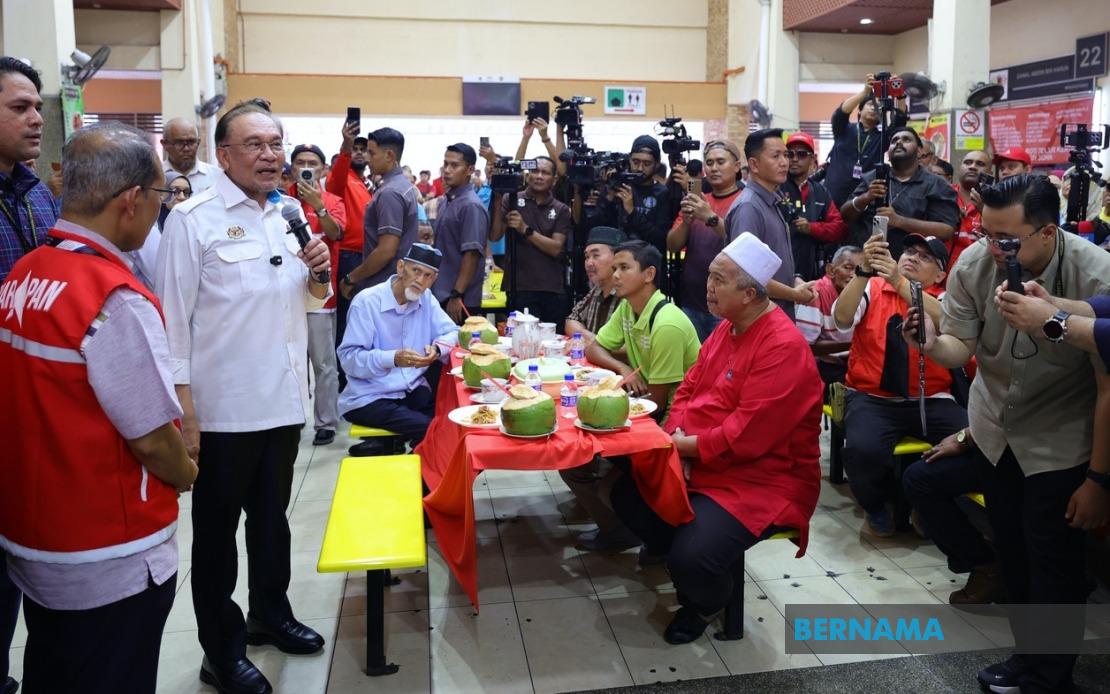
Prime Minister Datuk Seri Anwar Ibrahim has made a direct appeal to voters in Negeri Sembilan to reaffirm their backing for Pakatan Harapan, framing the upcoming state election as a test of commitment to political continuity and institutional strength. Speaking at campaign events in Seremban on July 22, Anwar stressed that returning PH to power with a robust electoral endorsement would provide the necessary foundation for addressing the state's development priorities while maintaining harmonious relations between Putrajaya and the Negeri Sembilan state administration.
The Prime Minister's intervention in the campaign underscores the strategic importance of the August 1 election to the federal coalition. Beyond the immediate electoral stakes, Anwar's messaging reflects a broader concern within PH's leadership that political fragmentation at the state level could undermine the coalition's ability to implement its national agenda coherently. A divided or unstable Negeri Sembilan administration, the logic suggests, would complicate resource allocation and project coordination between different tiers of government, ultimately disadvantaging residents.
Anwar, who also chairs Pakatan Harapan, sought to position the election not as a routine ballot but as a referendum on three years of PH stewardship under Menteri Besar Datuk Seri Aminuddin Harun. He pointed to the state's relative political tranquility during this period as evidence that cross-party cooperation had yielded tangible results. This framing is significant because it attempts to transform the election from a competition between rival factions into a choice between continuity and uncertainty, a rhetorical strategy designed to motivate incumbent supporters while discouraging swing voters from experimenting with opposition alternatives.
The Prime Minister acknowledged, with notable candour, that the PH-led administration is far from flawless. Rather than glossing over implementation gaps or policy shortcomings, Anwar invited voters to view imperfection as an invitation for constructive engagement. He urged Negeri Sembilan residents to provide feedback and hold elected representatives accountable, framing the electoral process as part of an iterative cycle of improvement. This approach attempts to distinguish PH from political opponents by suggesting that the coalition is amenable to criticism and course correction, a potentially powerful narrative in an electorate that may be fatigued by defensive posturing.
The Pakatan Harapan slate for the election reflects a carefully calibrated power-sharing arrangement among its three main components. The coalition is fielding 36 candidates across all state seats, with Parti Keadilan Rakyat supplying 16 nominees, Democratic Action Party contributing 11, and Amanah fielding nine. This distribution reveals the internal dynamics of the coalition, with PKR's numerical dominance reflecting its status as the largest partner, while DAP's significant representation underscores its crucial role in maintaining the multi-ethnic character of PH governance. The configuration also suggests that coalition negotiations were contentious but ultimately successful in producing a lineup designed to appeal across communal and socioeconomic divides.
For Malaysian political analysts, the Negeri Sembilan election assumes importance as an early indicator of voter sentiment toward the federal government roughly two years into Anwar's premiership. By July 2023, the coalition had weathered multiple challenges, including persistent accusations of political manoeuvring and economic management concerns. A convincing victory would provide Anwar with fresh political capital heading into the potentially difficult second half of his term, while a marginal result could invite fresh questions about the coalition's electoral appeal beyond its core supporters.
The Election Commission's scheduling of polling day for August 1, with advance voting on July 28, follows established protocols for Malaysian state elections. The relatively compact campaign window gives candidates and parties limited time to mobilise supporters and communicate their messages, placing a premium on pre-existing organisational infrastructure and media presence. For PH, which has consolidated its position in Negeri Sembilan over three years, this compressed timeline might favour the incumbent, whereas opposition parties must work rapidly to rebuild momentum and regain momentum in constituencies where they previously held ground.
Negeri Sembilan's political trajectory over the preceding three years had been marked by comparative stability when measured against some other Malaysian states. The state government's ability to avoid the internal defections, leadership crises, and institutional paralysis that have afflicted other jurisdictions suggests that Aminuddin's stewardship has been reasonably effective, or at minimum, that PH's coalition partners have maintained sufficient party discipline to prevent open rupture. This record, which Anwar repeatedly invoked, represents valuable political capital that the incumbent can deploy against opponents who might promise change but cannot offer evidence of effective delivery.
For Southeast Asian observers, the Negeri Sembilan election offers a microcosm of broader democratic challenges in the region. Malaysian voters are being asked to evaluate incumbent performance, weigh promises of stability against desires for renewal, and navigate multiple identities and interests through a single vote. The election also reflects the evolution of Malaysian politics since 2018, when the first change of federal government in six decades created space for new political coalitions and voter movements that disrupted previously stable patterns. The extent to which voters in Negeri Sembilan now reward or punish PH will carry signals about the broader trajectory of Malaysian electoral politics.
Anwar's emphasis on political stability deserves careful examination. In a region where economic volatility, social polarisation, and interstate competition create pressures on domestic institutions, Malaysian politicians across the spectrum have increasingly invoked stability as a value proposition to voters. However, stability is neither value-neutral nor universally beneficial. It can facilitate necessary reforms or preserve unjust arrangements, depending on whose interests are being stabilised and at whose expense. Anwar's framing implicitly assumes that voters prioritise institutional continuity, but this assumption may not hold universally, particularly among younger or economically marginalised constituencies that have experienced stability as stagnation.
The broader campaign context also includes Anwar's acknowledgement that PH's governance record, while solid in some respects, has not fully satisfied voter expectations or eliminated sources of dissatisfaction. This candid admission distinguishes his approach from more combative incumbent strategies that dismiss criticism as uninformed or malicious. By positioning PH as a coalition willing to learn and adapt, Anwar attempts to construct a political identity that is both confident in its achievements and humble about its limitations. Whether this rhetorical stance translates into electoral support will depend partly on whether voters believe that PH has genuinely internalised lessons from previous setbacks and implemented meaningful reforms.
The Negeri Sembilan election ultimately reflects broader tensions in Malaysian politics between continuity and change, stability and dynamism, centralised federal coordination and state-level autonomy. Anwar's campaign message prioritises the former term in each pair, betting that voters value institutional coherence and predictable governance over the uncertainties that electoral upheaval might introduce. However, Malaysian voters have demonstrated in successive elections that they are sophisticated political actors capable of simultaneously rewarding effective administration while demanding accountability and change. The outcome on August 1 will provide fresh evidence about how voters balance these competing imperatives.

