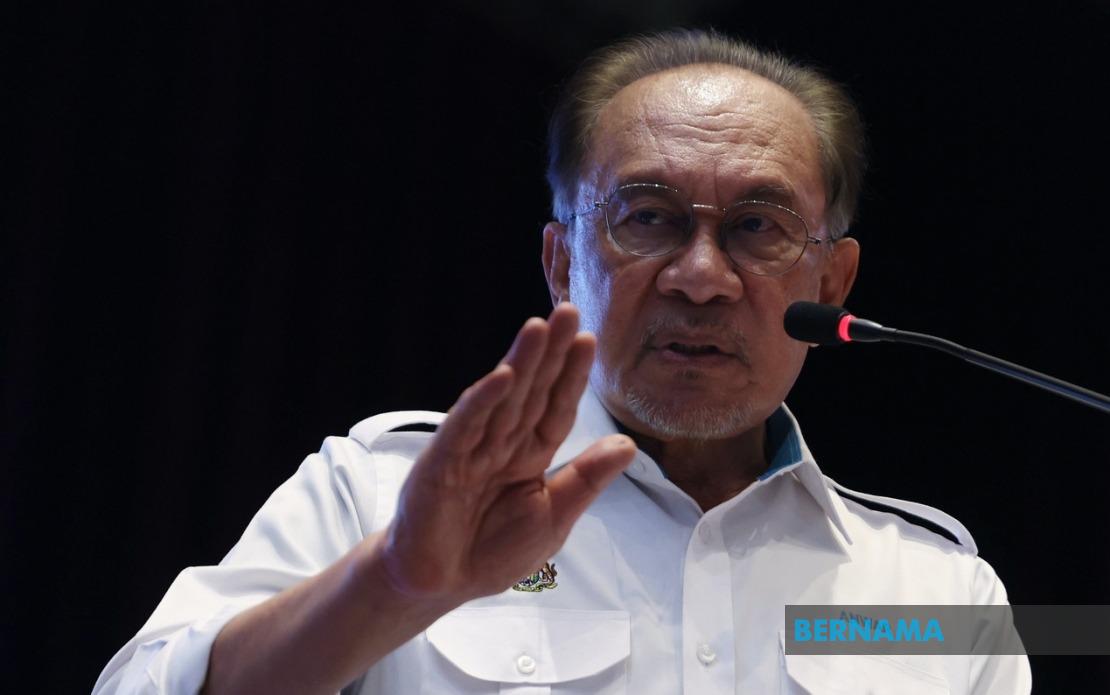
Prime Minister Datuk Seri Anwar Ibrahim delivered a stern reminder to Malaysia's political establishment on June 24, cautioning against the practice of enlisting royal institutions into partisan electoral disputes. Speaking during a public engagement in Alor Gajah with senior government officials, Anwar underscored the importance of maintaining the sanctity of the Malay Rulers, particularly during heated campaign seasons when political temperatures typically run high.
The Prime Minister's intervention appears directly responsive to statements attributed to Pakatan Harapan's coalition partner Amanah during a candidate announcement event held in Johor on Monday. Reports suggest remarks made by Amanah president Datuk Seri Mohamad Sabu at that occasion were interpreted by some observers as containing implicit references to the royal institution. While Anwar did not elaborate on the specific nature of these comments, his public rebuke signals concern within the federal leadership about the direction of campaign discourse.
Anwar's message carried a clear institutional boundary: political disagreements, no matter how fundamental or contentious, must remain confined to the political arena and be resolved through measured dialogue rather than appeals to or criticism of the constitutional monarchy. His phrasing—"This is an election. Let those involved engage in politics"—suggests an implicit acceptance that robust electoral competition is inevitable, but the rules of engagement should explicitly exclude attempts to weaponise or delegitimise respected national institutions.
The timing of these remarks is significant given Malaysia's political landscape. The country has historically maintained a constitutional settlement whereby the Malay Rulers occupy a position of institutional deference, with strict conventions governing public commentary about their actions or statements. Dragging royalty into partisan disputes threatens this delicate balance and risks creating precedent for future erosion of those norms, potentially destabilising political culture more broadly.
The gathering where Anwar made these comments itself underscored the collaborative nature of governance messaging. Present alongside him were Melaka Chief Minister Datuk Seri Ab Rauf Yusoh and Deputy Higher Education Minister Adam Adli Abd Halim, alongside Chief Secretary to the Government Tan Sri Shamsul Azri Abu Bakar and other senior public service leadership. The event, originally convened as a meet-and-greet session with civil servants at the Public Works Department's Centre of Excellence for Engineering and Technology, became an opportunity for unified messaging from government on institutional protocols.
For Malaysian observers, Anwar's intervention reflects an attempt to establish guardrails around campaign conduct before electoral momentum builds further. Elections inherently generate friction between competing visions and interests, yet successful democracies typically succeed by limiting which institutions and actors become targets for that friction. By publicly reminding politicians of this principle, the Prime Minister signalled that government takes seriously its responsibility to protect constitutional frameworks even—or perhaps especially—during periods of partisan competition.
The incident also reveals potential strains within the Pakatan Harapan coalition itself. Amanah, as a smaller coalition partner, may face internal pressures to differentiate itself from other components or to appeal to specific voter constituencies through rhetorical positioning. Yet such positioning, if it crosses into territory involving royal institutions, immediately attracts correction from the central government. This dynamic suggests ongoing negotiations within the ruling coalition about acceptable campaign boundaries.
From a Southeast Asian perspective, Malaysia's approach contrasts with democratic systems elsewhere in the region where institutional deference is less rigorously maintained. Thailand, for instance, has experienced periodic crises partly because political actors have been willing to involve the monarchy in partisan disputes. Indonesia's democracy operates under less restrictive norms regarding religious and institutional commentary. Malaysia's relatively stable electoral and constitutional system appears to depend significantly on implicit acceptance that certain institutions remain above or outside the normal bounds of political contestation.
Anwar's comments also carry implications for how the government may approach regulation of campaign speech going forward. If major coalition partners interpret the Prime Minister's warning as a directive backed by potential enforcement mechanisms—whether through party discipline, media management, or other means—we may see a tightening of campaign discourse norms. Conversely, if the statement functions primarily as rhetorical guidance without enforcement, its practical impact on behaviour may prove limited.
The challenge facing Malaysia's political leadership involves protecting institutional integrity while respecting democratic principles of free political speech. This tension is not unique to Malaysia but manifests distinctively here given the constitutional position of the Malay Rulers and widespread social acceptance of their protected status. Successful navigation requires that political actors internalise respect for these boundaries rather than rely on external enforcement, and Anwar's intervention appears designed to reinforce that norm-based approach.
As electoral season progresses, Anwar's June 24 statement will likely serve as a reference point for assessing whether other political figures and parties maintain appropriate deference to institutional boundaries. The effectiveness of his intervention ultimately depends not on the clarity of his message—which is unambiguous—but on whether competing political actors across the electoral spectrum choose to accept and honour it in their own campaign conduct.

