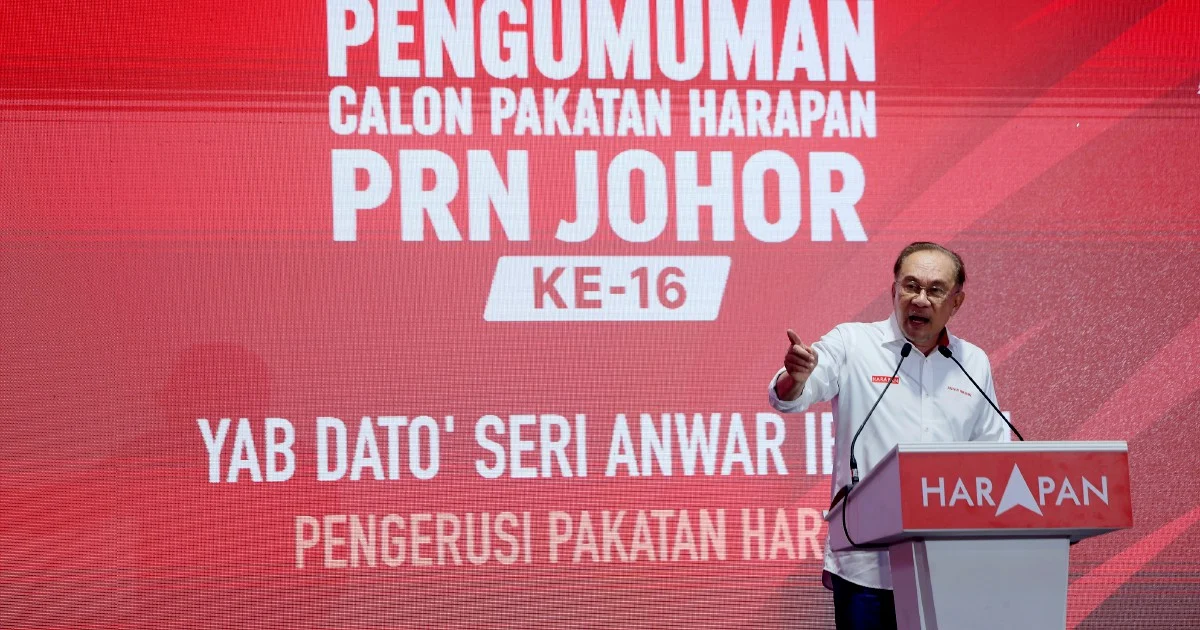
Prime Minister Anwar Ibrahim has urged Johor's state executive council to take a more confrontational stance towards the previous federal administrations, particularly regarding long-standing grievances over the state's allocation of federal revenue. Speaking in Tangkak, Anwar suggested that officials should demand clarification and accountability from the Barisan Nasional and Perikatan Nasional governments that preceded the current administration, questioning whether Johor received equitable treatment in revenue distribution.
The Prime Minister's remarks underscore a persistent tension between resource-rich states and the federal centre in Malaysia's federal system. Johor, as one of the nation's most economically significant states with substantial petroleum and other natural resources, has historically maintained that it does not receive a fair proportion of revenue from those resources at the federal level. This grievance has become a recurring political talking point across different administrations and coalitions, reflecting deeper anxieties about fiscal federalism in Malaysia.
Anwar's intervention suggests that the current federal government under his Pakatan Harapan-led administration is positioning itself as more responsive to state-level concerns than its predecessors. By explicitly directing Johor officials to challenge earlier governments' revenue policies, the Prime Minister appears to be building political capital with the state while simultaneously distancing his administration from unpopular federal fiscal practices. This move also reflects the delicate political balance in Johor, where the federal government must maintain credibility with state leaders and the broader electorate.
The Barisan Nasional, which governed Malaysia for six decades until 2018 and again regained federal power in 2023, has long been associated with centralized fiscal control. During its tenure, the federal government retained significant revenue streams, including from petroleum and other extractive industries, with states receiving fixed grants and allocations determined largely by the centre. Johor, despite its economic importance and resource wealth, chafed under these arrangements, with state officials frequently complaining about inadequate compensation for the resources extracted from state territory.
The Perikatan Nasional administration, which governed Malaysia from 2020 to 2022, inherited and perpetuated these same fiscal arrangements. Despite initially positioning itself as more decentralized and state-friendly than its predecessors, the PN government made limited structural changes to federal-state revenue sharing mechanisms. For Johor specifically, this meant continued frustration with what state leaders viewed as insufficient returns for the state's contribution to national economic output and resource wealth.
Anwar's call for greater scrutiny of these past arrangements reflects a broader trend of the current federal administration attempting to address accumulated grievances while managing fiscal constraints. By empowering Johor's executive council to demand answers, the Prime Minister provides a mechanism for airing long-standing complaints without the federal government directly committing to major fiscal restructuring. This strategy allows the administration to appear responsive to state concerns while avoiding immediate commitments that could strain federal finances.
The timing of Anwar's remarks also carries political significance. Johor remains a battleground state in Malaysian politics, with no single coalition holding overwhelming dominance. While Barisan Nasional maintains a strong presence at both state and parliamentary level, other coalitions compete for influence. By engaging directly with Johor's executive council on revenue issues, Anwar seeks to strengthen his administration's appeal across political lines and demonstrate attentiveness to genuine state interests that transcend partisan divisions.
The revenue allocation dispute touches on fundamental questions about Malaysia's federal structure. The Constitution grants the federal government substantial fiscal authority, but the principle of federalism implies that states should benefit equitably from resources located within their boundaries. Petroleum revenue, in particular, has been a contentious issue, with oil-producing states like Johor, Pahang, and Sabah consistently arguing that they deserve greater returns. The formula for distributing petroleum royalties and other resource revenues remains one of the most fraught aspects of Malaysian fiscal federalism.
For ordinary Malaysians, these debates have practical implications. States with strong revenue streams can invest more substantially in infrastructure, education, healthcare, and social services. When revenue is concentrated at the federal level, state governments must depend on federal allocations for development projects, potentially limiting their autonomy and slowing local development. Johor, as a major economic engine for the country, represents both the potential benefits and the frustrations of this system.
The call for greater questioning of past revenue practices also invites scrutiny of the current administration's own fiscal policies. While Anwar encourages accountability from predecessors, observers will watch carefully to see whether his government implements meaningful changes to revenue-sharing formulas or if this remains primarily a rhetorical exercise designed to build political support. The test will come when concrete fiscal policy decisions are announced and implemented.
Moreover, Johor's experience reflects patterns replicated across other states. From Sabah's oil disputes to Terengganu's past conflicts with the federal government over oil and gas revenues, the question of fair resource distribution remains persistently divisive. By framing this as a matter requiring sustained pressure and accountability rather than merely technical economic management, Anwar acknowledges the political depth of state-federal revenue tensions.
The Prime Minister's intervention may also signal preparation for future negotiations over fiscal arrangements. As Malaysia grapples with debt management and infrastructure financing challenges, discussions about revenue allocation will likely intensify. By encouraging Johor's leadership to articulate their grievances forcefully, Anwar may be laying groundwork for broader federal-state fiscal discussions that could reshape how Malaysia distributes public resources in coming years.

