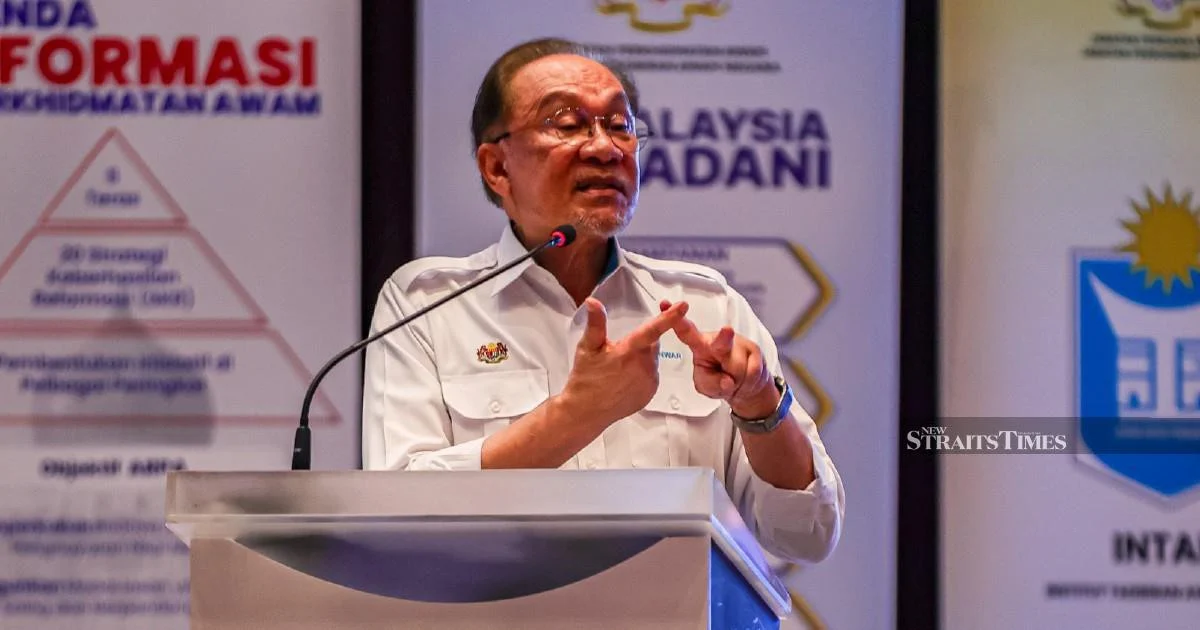
Prime Minister Datuk Seri Anwar Ibrahim stepped in to defuse mounting tensions over statements made by Parti Amanah Negara president Datuk Seri Mohamad Sabu during a Pakatan Harapan candidate announcement event held in Tangkak on Friday, asserting that the remarks were not intended as ridicule of any political adversary. The intervention reflects the delicate balance the prime minister must maintain within the ruling coalition while managing perceptions among Malaysia's fractious political landscape, where rhetoric from senior figures can quickly escalate into broader disputes that threaten coalition stability.
Anwar's statement, made in Alor Gajah, represents an attempt to lower the political temperature after Sabu's speech at the PH gathering sparked immediate criticism and debate. Such moments frequently arise during campaign events when party leaders deploy pointed language or employ rhetorical flourishes designed to energize supporters, yet which opposition figures swiftly interpret as personal attacks or contemptuous commentary. The PM's need to publicly defend a coalition partner's statements underscores how sensitive the current political environment remains, with multiple parties quick to seize upon any perceived slight as evidence of disrespect or bad faith.
The backdrop to this exchange illuminates broader tensions within Malaysian politics as the nation moves toward electoral contests that will shape parliamentary representation and provincial governance. The PH coalition, which brought substantial change to Malaysian politics when it captured federal power in 2018 before losing ground in 2023, remains intent on rebuilding momentum and challenging Prime Minister Muhammad Yazid Mahmud's administration. Amanah, as a significant component of this opposition grouping, must navigate complex electoral mathematics while maintaining internal party discipline and managing relationships with other PH members.
Matthew Sabu's position within Amanah leadership carries particular weight given his background and public profile. His statements at political gatherings receive scrutiny not merely because of the words themselves, but because senior party figures in Malaysia's intense political culture recognize that media outlets, opposition commentators, and social media networks will immediately amplify any language deemed controversial or confrontational. This reality creates a constant tension between the rhetorical energy necessary to mobilize party supporters and the diplomatic language required to maintain coalition harmony and avoid providing ammunition to political rivals.
Anwar's explicit defense of Sabu carries subtle implications about coalition management and the prime minister's authority within PH structures. By directly intervening to clarify that no mockery occurred, Anwar positioned himself as an authoritative interpreter of coalition members' intentions while simultaneously signaling that he expects such disputes not to derail broader political objectives. This approach reflects a calculation that internal coalition friction, if permitted to fester, poses greater danger than publicly addressing misconceptions about individual statements.
The episode also reveals how Malaysian politics continues to operate within parameters where direct personal criticism carries heightened significance. Unlike some democracies where political ribaldry and sarcasm form accepted components of public discourse, Malaysia's political culture remains sensitive to perceived disrespect toward individuals and institutions. This sensitivity partly reflects Malaysia's diverse society where political communication must navigate religious, ethnic, and regional sensitivities, and partly reflects historical patterns where political leadership has expected considerable deference from lower-ranking figures.
Pakatan Harapan's broader strategic position makes coalition unity particularly crucial at this juncture. The coalition's electoral prospects depend substantially on presenting a unified front capable of offering coherent alternatives to current governance while avoiding the internal bickering that previously damaged its credibility. Any perception that senior figures lack confidence in one another's judgment or communication skills potentially undermines voter confidence in the coalition's capacity to govern effectively if returned to power.
The Tangkak candidate announcement itself represents standard campaign activity, yet in Malaysia's current polarized environment, even routine political events carry heightened stakes. Candidates selected for electoral contests become focal points for party messaging and public expectations, and the speeches accompanying their announcement often contain coded references to broader policy directions and leadership positions within party hierarchies. The controversy surrounding Sabu's remarks, whether substantiated or exaggerated, threatens to overshadow the substantive message about PH's electoral vision and candidate quality.
Anwar's intervention suggests that the prime minister views this matter as sufficiently serious to require direct involvement despite his other substantial responsibilities overseeing national governance. His decision to personally defend Sabu rather than allowing the controversy to develop organically indicates strategic concern about allowing negative narratives about coalition infighting to take hold in public consciousness. This approach treats the matter as a perception problem requiring proactive management rather than an actual substantive disagreement meriting extended debate.
Looking forward, this episode illustrates recurring challenges facing Malaysian coalition politics. Diverse parties operating under shared electoral umbrellas must manage both internal ideological differences and external political competition, all while operating in a media environment where selective quotation and inflammatory framing can rapidly transform routine political disagreement into perceived crisis. Anwar's calm, clarifying response offers a model for de-escalation, yet whether such approaches can consistently defuse tensions as campaign periods intensify remains uncertain.
The broader significance extends beyond immediate PH concerns to the health of Malaysian democratic discourse more broadly. Political systems function most effectively when participants can engage in vigorous debate without constant misinterpretation and where senior figures demonstrate capacity to distinguish between legitimate disagreement and calculated disrespect. Anwar's implicit message—that robust political engagement need not degenerate into personal animosity—carries value extending beyond coalition management to the tenor of national political dialogue itself, particularly as Malaysia navigates recurring cycles of electoral competition.

