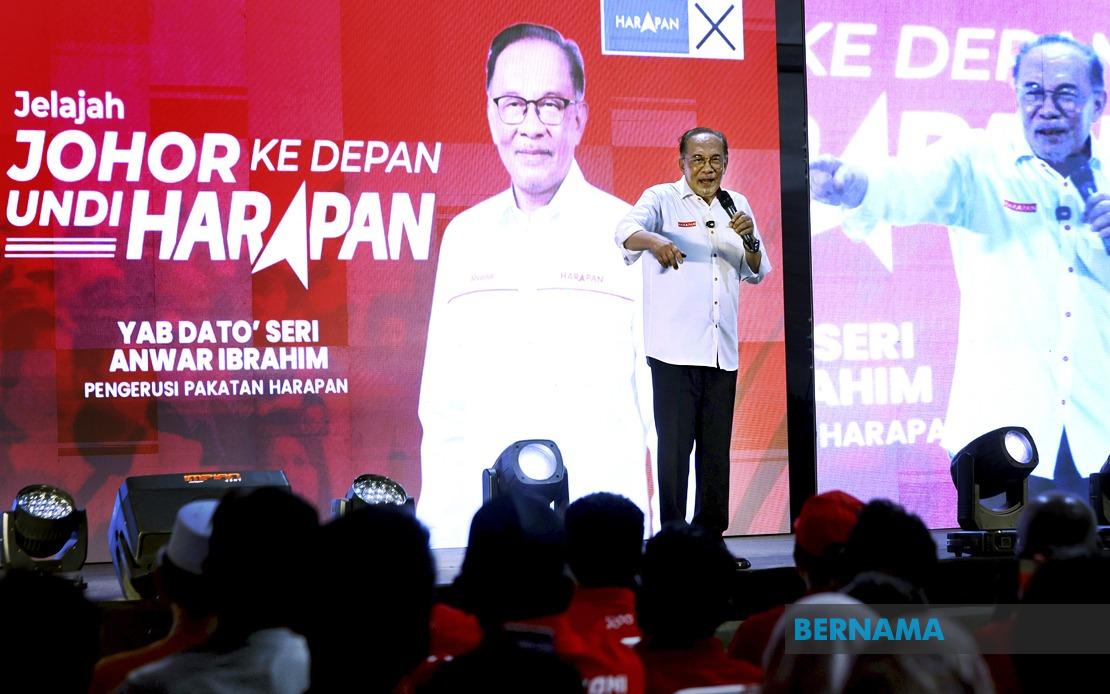
Prime Minister Datuk Seri Anwar Ibrahim has delivered an unequivocal message that Malaysia's days of systematic plunder and self-enrichment through public office are finished. Speaking at a campaign rally in Sungai Mati, Muar, the Prime Minister framed anti-corruption as the defining principle of his administration, positioning integrity as the primary measure by which leaders should be evaluated rather than race, religion, or partisan loyalty.
Anwar's remarks came as the MADANI government intensifies its focus on dismantling what he characterised as entrenched corrupt practices that have long infected Malaysia's administrative machinery. He emphasised that the government's central mission now centres on reclaiming every ringgit of state resources, ensuring that public wealth serves the broadest population rather than enriching connected elites. This repositioning of anti-corruption from a rhetorical campaign promise to an operational priority reflects mounting pressure from both domestic constituencies and international observers concerned with Malaysia's governance standards.
The Prime Minister's comments directly challenged the notion that leadership quality should be determined by ethnic or religious identity. In a pointed statement, Anwar declared his preference for virtuous Malay leaders over corrupt ones, and honest Chinese leaders over dishonest alternatives, explicitly rejecting the premise that race should serve as a substitute for character assessment. This framing represents an attempt to redefine Malaysian political discourse around meritocratic principles and personal conduct rather than demographic categories—a significant shift in a nation where identity-based politics has traditionally dominated electoral competition.
Anwar reserved particular criticism for what he termed the "old culture" of instrumentalising government power to channel state contracts toward family members and business associates. He identified the practice of officials leveraging their positions to accumulate personal wealth as fundamentally corrosive to national development and international reputation. By characterising such behaviour as both economically damaging and morally indefensible, the Prime Minister sought to establish moral clarity on an issue that has previously been treated with ambiguity in Malaysian politics.
The Prime Minister's pledge of absolute non-protection for corrupt officials marks a notable commitment. In prior administrations, allegations of selective prosecution and political protection for certain accused figures created widespread scepticism about anti-corruption enforcement. Anwar's assurance that no individual would receive governmental shelter if implicated in graft—regardless of political standing or personal proximity to leadership—represents either a genuine operational shift or a calculated messaging strategy aimed at rebuilding public confidence in institutional impartiality.
Anwar attributed opposition political activity during this period to personal ambitions to reclaim federal power, effectively framing resistance to his administration as driven by self-interest rather than principled governance concerns. This characterisation serves to delegitimise critics while simultaneously positioning his government as defending broader national interests against factional power-seeking. The rhetorical strategy attempts to convert anti-corruption messaging into implicit support for the MADANI coalition's continued tenure.
The campaign event itself formed part of Anwar's intensive engagement with Johor voters ahead of the 16th Johor State Election scheduled for July 11. The Prime Minister's participation in eight separate campaign engagements on a single day, culminating in fifteen total events across two days, underscores the strategic importance of Johor to the coalition's electoral prospects. The state election will determine control of 56 seats contested by 172 candidates, with early voting commencing July 7.
For Malaysian and broader Southeast Asian observers, Anwar's statements reflect an attempt to recalibrate the relationship between political leadership and public resource stewardship. The explicit rejection of patronage networks and crony capitalism addresses concerns that have periodically triggered international investment hesitation and damaged Malaysia's governance reputation. Whether such commitments translate into sustained institutional reform or remain aspirational campaign messaging will substantially influence both domestic political dynamics and external perceptions of Malaysia's developmental trajectory.
The presence of Penang Chief Minister Chow Kon Yeow and Ledang MP Syed Ibrahim Syed Noh at the Sungai Mati event reinforced coalition unity messaging, suggesting coordinated messaging across constituent parties around anti-corruption principles. This unity framing aims to present the MADANI government as cohesive and principled, contrasting with potential narratives of factional rivalry or ideological tension within the coalition.
Anwar's emphasis on voter responsibility in selecting leaders based on integrity rather than demographic categories or partisan rhetoric represents an attempt to elevate electoral discourse beyond traditional identity-based competition. By urging Johor voters to reject leaders lacking integrity to "safeguard the future of the next generation," the Prime Minister framed the state election as a consequential decision affecting long-term national development rather than merely a partisan contest.
The repeated articulation of clean governance principles during intensive campaign activity suggests that anti-corruption has become central to the MADANI coalition's electoral positioning. Whether this messaging resonates with voters or faces scepticism based on past governance experiences will significantly influence both the outcome of the Johor election and broader perceptions of the government's credibility on this core issue.

