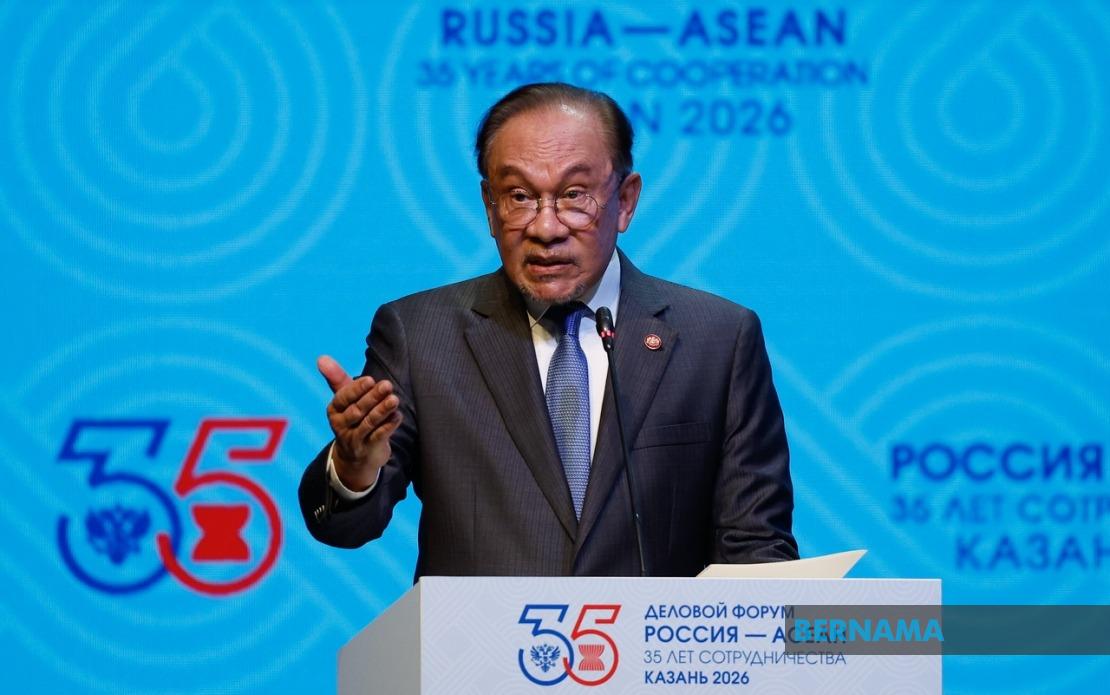
Prime Minister Datuk Seri Anwar Ibrahim has articulated an ambitious blueprint for strengthening ASEAN-Russia relations during his participation in the ASEAN-Russia Business Forum in Kazan, positioning cultural and intellectual exchange alongside traditional economic partnerships. Speaking to international media during his two-day working visit to the Tatarstan capital, Anwar emphasised that the scope for bilateral and regional cooperation with Moscow remains vastly underexplored compared to ASEAN's established economic architecture with the United States, China and India.
The Prime Minister's remarks reflect a strategic shift in how Malaysia and the broader Southeast Asian community view engagement with Russia. While acknowledging the historic relationships that bind ASEAN to Western and Asian powers, Anwar stressed that platforms such as the ASEAN-Russia Business Forum serve as essential mechanisms for constructing mutual understanding and identifying concrete collaboration opportunities. His assertion that the potential for deepening ties is "enormous" signals Malaysia's willingness to challenge traditional alignment patterns and pursue pragmatic engagement with Moscow across multiple domains.
Energy security emerged as a central pillar of Anwar's vision for enhanced cooperation. This focus carries particular resonance for Southeast Asia, where diversifying energy sources and supply chains has become increasingly critical amid geopolitical tensions and the global transition toward sustainable development. Beyond energy, the Prime Minister outlined potential avenues for joint work in cybersecurity, agricultural innovation, digital technology advancement, scientific research and higher education. These sectors represent areas where ASEAN's developing economies could benefit substantially from Russian expertise and technological transfer, while Russian firms gain access to dynamic Southeast Asian markets and research capabilities.
Anwar specifically highlighted Tatarstan's competitive advantages, particularly its demonstrated capabilities in technology, scientific research, defence systems and educational infrastructure. This recognition underscores Malaysia's strategic interest in building bilateral relationships between individual ASEAN nations and specific Russian regions, rather than limiting engagement to Moscow-only frameworks. Such a decentralised approach could unlock regional development opportunities that benefit both parties while strengthening people-to-people connections across the Eurasian continent.
The Prime Minister's recent meeting with Russian President Vladimir Putin was characterised as productive, with discussions concentrating on economic cooperation and energy security arrangements. Though details remained limited, this engagement signals high-level political will on both sides to translate broader ASEAN-Russia aspirations into concrete agreements and institutional mechanisms. For Malaysian policymakers, such high-level endorsement suggests a window of opportunity for bilateral initiatives that might otherwise face bureaucratic obstacles.
In a notable departure from conventional diplomatic discourse, Anwar brought cultural and literary appreciation into his public remarks, revealing a personal engagement with Russian artistic traditions that extends beyond strategic calculation. His appreciation of Russian poetry, and his family's enjoyment of traditional Russian songs including "Matushka", "Zemlya" and "Kalinka Malinka", demonstrated how soft power and cultural affinity can complement formal diplomatic channels. This dimension proved particularly noteworthy given Anwar's extensive references to the literary works of Leo Tolstoy, Anton Chekhov and Boris Pasternak—all authors whose contributions have been translated into Malay and remain influential across Southeast Asia.
Anwar's opening remarks at the forum, which featured a recitation from Tatar poet Abdullah Tukay, embodied his conviction that cultural exchange constitutes an essential foundation for sustained international cooperation. His assertion that poetry, literature and the arts foster "better affection and understanding of people and human beings" reflects a philosophical approach to diplomacy that recognises technology and commerce alone cannot sustain deep partnerships. For Malaysia's diplomatic corps and regional analysts, this perspective suggests a more holistic framework for engagement that integrates humanitarian and intellectual dimensions alongside traditional foreign policy instruments.
The conversation shifted toward pressing international challenges, with Anwar acknowledging his diplomatic contacts with Iranian President Masoud Pezeshkian, Pakistani Prime Minister Shehbaz Sharif, Egyptian President Abdel Fattah El-Sisi and Turkish President Recep Tayyip Erdogan regarding tensions involving Iran and the United States. These references illustrated Malaysia's positioning as a non-aligned nation capable of maintaining dialogue across multiple poles of geopolitical tension. The emphasis on collective advocacy for peaceful resolution highlighted ASEAN's traditional commitment to dialogue-based diplomacy, even when addressing intractable regional conflicts.
The discussion culminated with Anwar's characteristically forthright commentary on the humanitarian crisis in Gaza, where he articulated deep frustration with what he termed a "failure of the international community." His criticism of perceived double standards in the application of democratic values and human rights principles—particularly regarding international responses to violence against civilians—resonated with broader sentiment across Southeast Asia. The Prime Minister's blunt assertion that the international system cannot tolerate daily killings and torture of children and women whilst remaining silent articulated moral outrage that reflects significant pressure from Malaysian civil society and Muslim-majority constituencies demanding principled stances on Palestinian issues.
For Malaysian observers and policymakers, Anwar's dual-track diplomatic messaging in Kazan conveyed a sophisticated strategy: advancing pragmatic economic and security partnerships with Russia whilst maintaining moral clarity on humanitarian concerns that resonate deeply across Southeast Asia. This approach suggests Malaysia's intent to navigate complex geopolitical currents by pursuing substantive cooperation with diverse partners whilst refusing to subordinate human rights advocacy to strategic convenience. The emphasis on ASEAN-Russia potential, when combined with unwavering criticism of international hypocrisy on Gaza, positions Malaysia as determined to chart an independent course aligned neither with Western nor Russian preferred positions, but rather guided by regional interests and universal humanitarian principles.