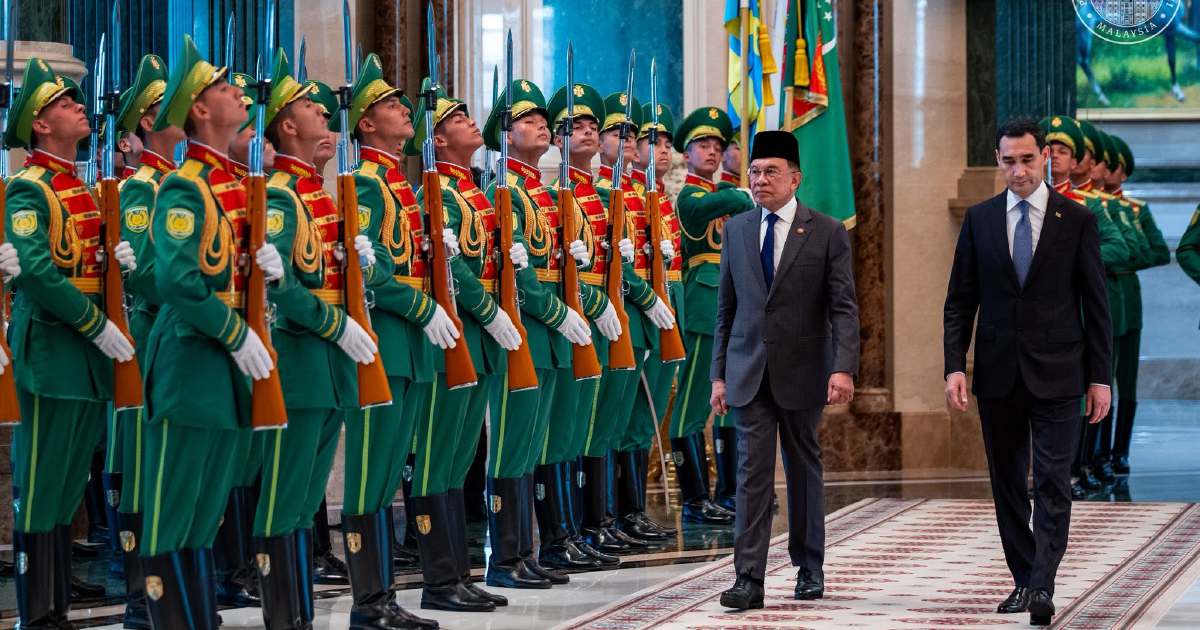
Prime Minister Datuk Seri Anwar Ibrahim touched down in Ashgabat for a landmark diplomatic mission, receiving full ceremonial honours at the Presidential Palace in recognition of his position as Malaysia's leader. The formal reception underscores the significance both nations are placing on bilateral relations at a time when Malaysia is actively broadening its international footprint beyond traditional Southeast Asian and Middle Eastern partnerships.
This inaugural official visit since Anwar's assumption of office represents a strategic pivot in Malaysia's foreign policy approach. The Central Asian region, long positioned on the periphery of Malaysian diplomatic consciousness, is increasingly attracting attention from Kuala Lumpur as policymakers recognise the economic and geopolitical opportunities available across the former Soviet republics. Turkmenistan, strategically situated along ancient Silk Road trade routes, holds particular interest given its substantial natural gas reserves and developing infrastructure projects.
The presidential welcome ceremony—a diplomatic ritual laden with symbolic weight—signals mutual respect and genuine intent to foster substantive engagement between the two nations. Such formal protocols are typically reserved for state visits or visits of considerable political importance, suggesting that Turkmenistan's leadership views this interaction as a potential inflection point for deeper bilateral cooperation. The staging of the reception at the highest echelons of Turkmenistan's governmental architecture demonstrates official commitment to elevating Malaysia's profile within Central Asian policy circles.
Malaysia's outreach into Central Asia aligns with broader patterns of strategic diversification evident across the region's major economies. With regional powers like China and Russia already deeply embedded in Central Asian affairs, Malaysia's entry into this diplomatic space offers a non-aligned, Islamic-majority perspective that could prove valuable to nations seeking balanced partnerships. For Malaysian readers, this visit represents an expansion of the country's diplomatic bandwidth at a moment when economic interdependence with non-traditional partners is reshaping regional trade patterns.
The timing of Anwar's visit carries additional significance given the evolving dynamics within the Organisation of Islamic Cooperation, of which both Malaysia and Turkmenistan are members. As Malaysia seeks to position itself as a bridge between the Islamic world and the broader international community, cultivation of relationships with Central Asian Islamic nations becomes strategically prudent. Turkmenistan's religious landscape and Malaysia's Islamic identity create a natural foundation for dialogue, though both nations maintain secular governance structures emphasising pragmatic policymaking.
Turkmenistan's energy sector presents immediate commercial attractions for Malaysian companies and investors. The nation possesses some of the world's largest natural gas reserves, and Malaysian energy corporations with expertise in extraction and liquefaction technologies could potentially engage in joint ventures or partnership arrangements. Such economic dimensions often underpin the architecture of high-level diplomatic visits, suggesting that commercial discussions likely featured prominently within the broader agenda of Anwar's mission.
From a geopolitical perspective, Anwar's visit reflects Malaysia's sophisticated understanding that influence and relevance in an increasingly multipolar world demands active engagement across multiple regions and civilisational spheres. Rather than remaining anchored solely to Southeast Asian concerns, Malaysian leadership is demonstrating awareness that economic corridors, security architectures, and diplomatic networks increasingly operate at continental scales. Central Asia's position along emerging trade routes—particularly those connecting China with Europe and the Middle East—makes the region's stability and development trajectory consequential for Malaysian commercial interests.
The formal reception also carries domestic political implications within Malaysia. Anwar's ability to command respect from leaders across diverse geopolitical zones reinforces his credentials as a statesman capable of navigating complex international terrain. For the Malaysian electorate, images and accounts of the Prime Minister being feted at the highest levels of foreign governments serve to enhance national prestige and underscore Malaysia's continued relevance in global affairs during a period of significant structural economic transformation.
Moving forward, the foundation laid by this inaugural visit could facilitate expanded institutional linkages between Malaysia and Turkmenistan across multiple domains—educational exchanges, cultural programming, security cooperation, and scientific collaboration. Central Asian universities and research institutions increasingly seek international partnerships, and Malaysian academic institutions could find valuable collaboration opportunities. Such people-to-people connections, nurtured through official channels, often generate long-term mutual benefit and understanding that transcends immediate political calculations.
The visit also positions Malaysia advantageously within emerging discussions around regional connectivity and economic integration within Central Asia. As nations across the region contemplate infrastructure development and trade facilitation initiatives, Malaysia's experience in port development, financial services, and logistics technology becomes a potentially attractive asset for partnership discussions. The ceremonial welcome thus represents not merely a courtesy between heads of state, but a potential opening for systematic, multifaceted engagement that could reshape bilateral relations substantially over the coming years.

