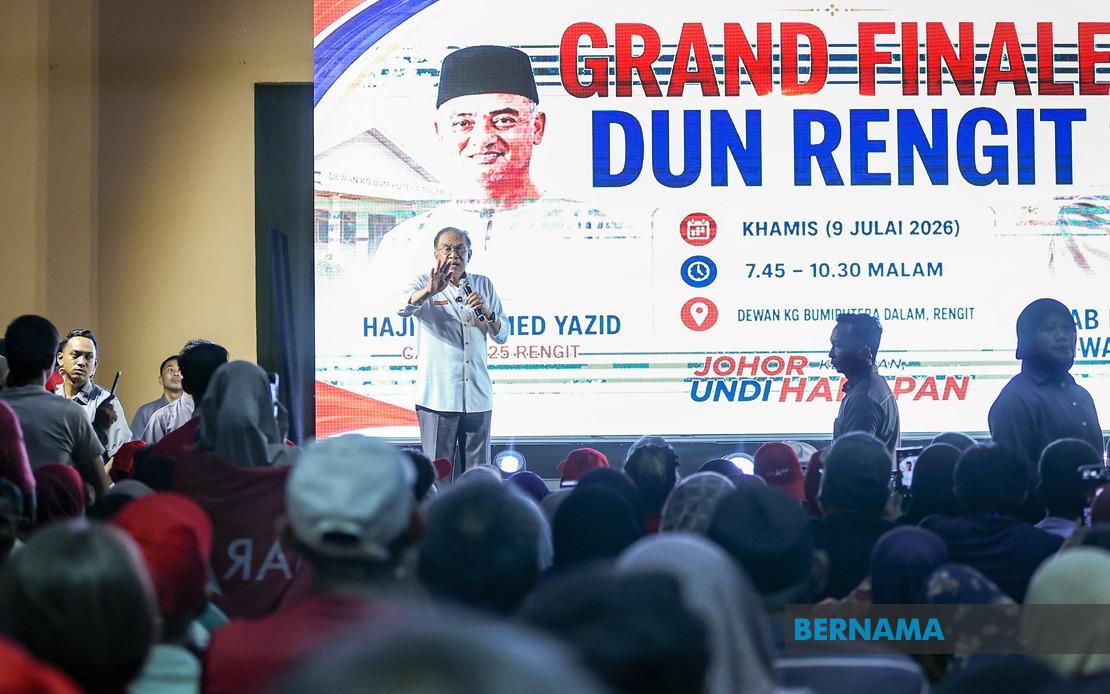
Prime Minister Datuk Seri Anwar Ibrahim has committed to tackling infrastructure deficiencies that have plagued the Rengit constituency, promising residents that dilapidated health facilities and recurring water supply disruptions will be treated as urgent priorities. Speaking at a Pakatan Harapan campaign event in Batu Pahat on July 9, Anwar emphasised that such basic amenities cannot be sacrificed in a state with Johor's economic standing and development trajectory. The remarks underscored how opposition coalitions are attempting to mobilise voters around tangible service delivery failures ahead of Saturday's 16th Johor state election.
The prime minister's framing of infrastructure as a fundamental entitlement rather than a luxury reflects broader tension in Malaysian politics over how developed and developing regions are treated. Anwar stated plainly that healthcare facilities must function to treat patients rather than deteriorate into structures requiring treatment themselves—a pointed criticism implying administrative neglect in the constituency. Access to clean water and functional medical services represent non-negotiable governance responsibilities, he argued, and their provision defines whether a government meets its core mandate to citizens.
Rengit's infrastructure challenges are symptomatic of service delivery gaps that extend across several Johor constituencies, particularly in districts where federal and state governments operate under different political control. The water supply interruptions affecting residents suggest ageing distribution networks or maintenance failures that accumulate when accountability becomes diffuse across administrative levels. Similarly, deteriorating clinic infrastructure points to underfunded healthcare delivery at the grassroots level, a common complaint in constituencies where local representatives lack influence over federal health ministry budget allocations.
For Pakatan Harapan, the campaign event represented an opportunity to position the coalition as responsive to constituent grievances that state-level governance alone cannot resolve. Anwar's presence at the Rengit campaign signalled that addressing such issues requires federal-state coordination, implying that PH's dominance at the federal level could unlock resources for local improvement. This messaging aims to convince voters that supporting PH candidates in state elections creates synergy with federal initiatives, making development projects more achievable than they would be under fragmented political control.
The event itself, termed the 'Serumpun Kasih Sejiwa Harmoni Grand Finale' programme, formed part of a broader campaign push across three separate Johor venues on a single evening. This intensive schedule reflects the coalition's resource mobilisation ahead of polling day and indicates where PH believes competitive races remain. The attendance of Sri Gading MP Aminolhuda Hassan, who simultaneously serves as Johor Amanah chairman, underscored how state and federal party structures are coordinating their campaign machinery, with senior figures deployed to constituencies where they can influence outcomes.
PH's candidate for Rengit, Yazid Abu Bakar, is competing in a contest where local service failures become electoral liabilities for the incumbent administration. By centering his campaign on infrastructure repair and citizen entitlements, Yazid's candidacy frames the election partly as a referendum on whether existing arrangements can deliver basic goods. This strategy resonates where voter frustration with visible, everyday problems—water outages, clinic closures—translates into electoral punishment for those voters perceive as responsible.
Anwar's broader exhortation that government officials and community leaders must exercise integrity and resist abusing their positions signals an anti-corruption dimension to PH's campaign message. In Johor, where economic patronage networks have historically been dense, emphasising institutional ethics and duty appeals to voters sceptical that power produces accountability. The prime minister's reminder to elect representatives aligned with the Federal Government appears calculated to overcome voter hesitation about whether state-level change matters when bureaucratic culture remains unchanged.
The coalition's contest strategy across all 56 Johor seats reflects confidence in its electoral machinery and messaging capacity. By fielding candidates in every seat—comprising 20 from PKR, 19 from Amanah, and 17 from DAP—PH commits resources to races it may not win while maintaining presence across diverse constituencies. This saturation approach differs from previous elections where larger coalitions sometimes ceded seats to avoid cannibalising votes, suggesting PH believes it can absorb such efficiency losses while capturing swing constituencies.
With 172 candidates contesting the 16th Johor election overall, the race represents a competitive contest where no party commands a legislative supermajority automatically. Infrastructure grievances like those in Rengit function as pressure points where incumbent administrations appear vulnerable to electoral replacement. Anwar's campaign intervention brings federal prestige and messaging authority to constituencies where local campaigns alone may lack resources to compete effectively against entrenched state-level machines.
The emphasis on water and healthcare reflects how Malaysian electoral politics increasingly centres on material service delivery rather than ideological platforms. Voters in constituencies like Rengit evaluate governance primarily through whether they have functioning clinics and reliable water supply—immediate, tangible measures of state capacity. Anwar's commitment to address these issues, backed by federal government credibility, attempts to translate voter frustration with service deficits into support for PH candidates.
Looking forward, whether PH can translate such pledges into rapid infrastructure improvements after the election will substantially influence voter perceptions of campaign promises versus implemented governance. In constituencies where service failures have become politically salient, early visible projects—clinic repairs, water supply upgrades—become crucial to validating Anwar's commitments and reinforcing electoral coalitions for future contests. Infrastructure repair therefore functions simultaneously as governance imperative and electoral necessity for the federal government.

