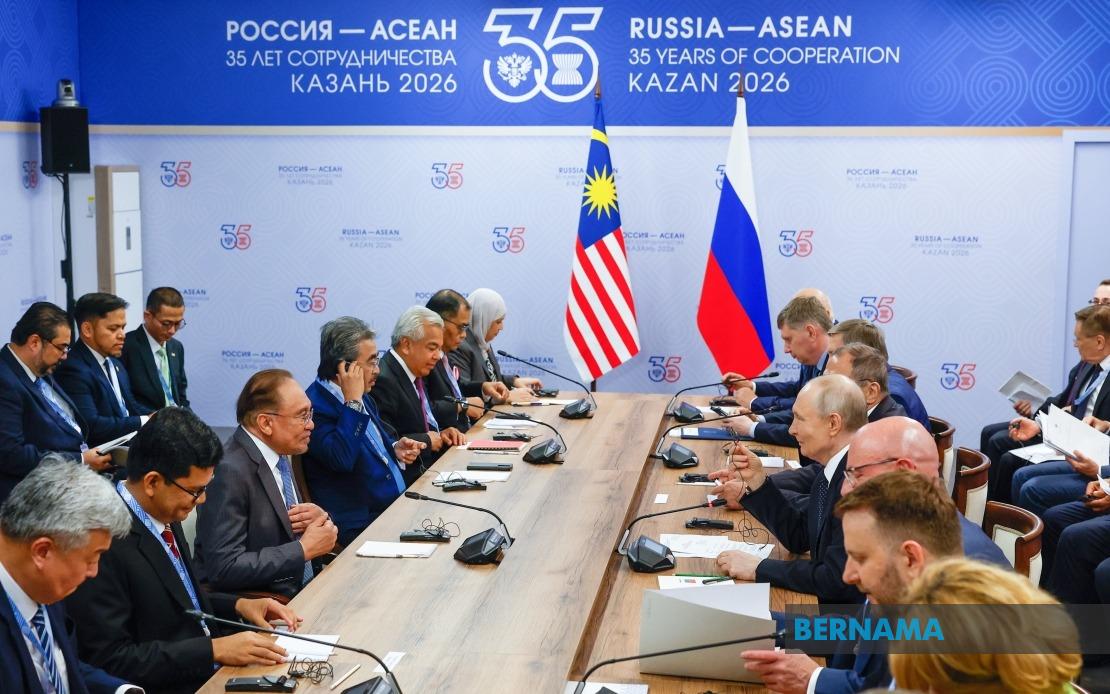
During an official visit to Kazan to mark the 35th anniversary of ASEAN-Russia relations, Prime Minister Datuk Seri Anwar Ibrahim has expressed strong appreciation for the positions taken by Russia and China on Middle Eastern conflicts, particularly regarding Gaza, Iran and Lebanon. Speaking to Russian international television network RT, Anwar articulated Malaysia's principled approach to global affairs, distinguishing between neutrality and what he terms "centrality"—a framework that allows the nation to take independent stances without aligning with any superpower while remaining engaged on matters of human rights and international justice.
The Malaysian leader detailed his government's consistent opposition to what he described as the "Zionist regime's" military actions, citing parliamentary decisions made on a bipartisan basis that reflected broad national consensus. Anwar emphasised that Malaysia had maintained this position despite international pressure and geopolitical considerations, demonstrating a commitment to principle over expediency. He highlighted that this stance emerged not from ideological alignment with any major power but from Malaysia's core values regarding sovereignty, territorial integrity and the protection of civilian populations in conflict zones.
Anwar's commendation of Putin and Xi centred on their willingness to publicly condemn what he characterised as atrocities perpetrated against populations in Gaza, Iran and Lebanon. He framed this diplomatic alignment as reflecting a broader pattern whereby certain nations prioritise humanitarian concerns and international law over strategic partnerships. The Prime Minister's remarks suggested that Malaysia views Russia and China's positions as more aligned with principles of justice than those of Western powers, particularly the United States, which he argued had enabled Israeli military operations through both financial and political support.
The concept of ASEAN centrality, as articulated by Anwar, represents a sophisticated framework for managing the region's complex geopolitical environment. Unlike neutrality, which implies indifference, centrality allows Southeast Asian nations to exercise agency in addressing violations of international norms while maintaining diplomatic relations across ideological divides. This approach reflects the reality that ASEAN members, including Malaysia, maintain economic and security partnerships with both Western and non-Western powers and cannot afford absolute alignment with either bloc without compromising their autonomy and regional interests.
Anwar directed particular criticism at what he termed Western hypocrisy in international relations, specifically the inconsistent application of principles regarding state sovereignty and the protection of civilians. He questioned how the international community could condemn aggression selectively, appearing to tolerate Israeli military actions while remaining silent on Iranian retaliation. This double standard, Anwar suggested, undermined the credibility of Western nations that claim to champion universal values and international law. He argued that such selective application of principles corroded global stability and generated justified grievances among nations subjected to unequal treatment.
The Prime Minister's extensive diplomatic engagement on Middle Eastern issues reflects Malaysia's broader strategy of positioning itself as a voice for developing nations and Muslim-majority countries within international forums. By conducting consultations with leaders from the Gulf states, Pakistan, Turkey and Iran, Anwar demonstrated Malaysia's commitment to facilitating dialogue and seeking negotiated resolutions to regional conflicts. These multiple engagements indicated that Malaysia views itself not merely as an observer of international affairs but as an active stakeholder capable of contributing to conflict resolution and peace-building efforts.
Anwar's emphasis on human rights and the protection of minorities extends beyond the immediate context of Gaza and Lebanon. He stressed that Malaysia's commitment to centrality encompasses a broader mandate to oppose violations of human dignity regardless of which party commits them. This framing allows Malaysia to criticise both Israeli military operations and conduct it views as problematic from other quarters, maintaining consistency in its values while avoiding the appearance of selective outrage. Such an approach resonates with Malaysia's domestic commitment to pluralism and minority protections.
The Prime Minister's visit to Kazan and his statements to RT underscore Malaysia's strategic recalibration of its international relations. By granting prominence to Russian media and publicly engaging on topics of concern to Moscow and Beijing, Anwar signalled Malaysia's interest in deepening ties with non-Western powers while maintaining existing partnerships. This reflects a broader Southeast Asian trend of seeking strategic autonomy and refusing to be locked into Cold War-style alignments, though Malaysia's emphasis remains on principle-based engagement rather than great power rivalry.
For Malaysian and Southeast Asian observers, Anwar's statements carry implications extending beyond rhetorical positioning. His articulation of centrality rather than neutrality provides a template for how developing nations might navigate multipolar geopolitics while maintaining principles and protecting national interests. The emphasis on parliamentary consensus for major foreign policy positions also reflects Malaysia's domestic constitutional framework, where Parliament plays a significant role in legitimising major international commitments, distinguishing Malaysia's approach from pure executive decision-making in some regional peers.
The timing of these remarks—during a commemoration of ASEAN-Russia relations—also carries significance for Malaysia's role within the regional organisation. By articulating clear principles while maintaining engagement across the global spectrum, Malaysia contributes to ASEAN's collective effort to preserve regional centrality and avoid being subordinated to great power competition. This approach aligns with long-standing ASEAN principles but requires constant articulation to remain credible as external powers seek to pull the region into their orbits.