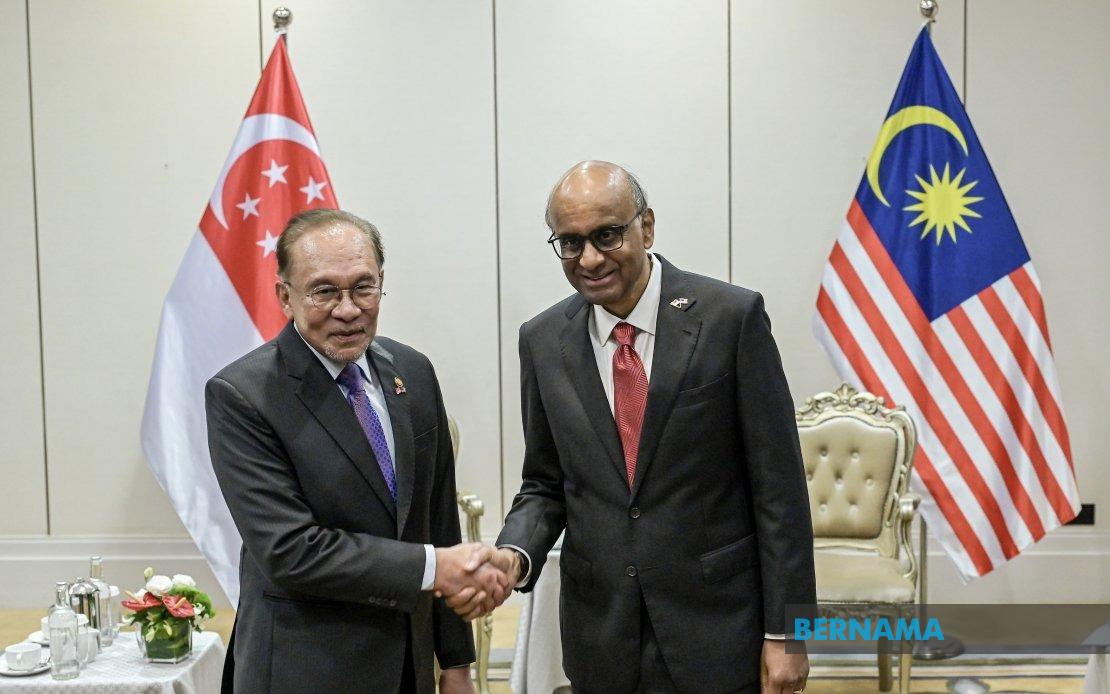
Prime Minister Datuk Seri Anwar Ibrahim received Singapore President Tharman Shanmugaratnam in a formal courtesy meeting on Monday as the island republic's leader began a three-day visit to Malaysia. The 40-minute session, held in Kuala Lumpur, brought together key economic and foreign policy figures from both nations, signalling the continued importance both governments place on their relationship.
The delegation accompanying the Prime Minister reflected Malaysia's commitment to deepening cooperation across multiple sectors. Foreign Minister Datuk Seri Mohamad Hasan joined the discussions, alongside Investment, Trade and Industry Minister Datuk Seri Johari Abdul Ghani and Entrepreneur and Cooperatives Development Minister Steven Sim Chee Keong. Senior government officials from Singapore were also present, indicating this was substantive engagement rather than mere ceremonial protocol.
President Tharman's visit carries ceremonial weight within the framework of bilateral relations. Upon arrival, he was formally received by Yang di-Pertuan Agong Sultan Ibrahim at Istana Negara, afforded the full honours of a state visit. This three-day programme, spanning July 13 to 15, was extended at the personal invitation of the Malaysian King, reflecting the respect both nations accord to their counterpart leadership.
The timing of this visit operates within a broader pattern of high-level engagement. President Tharman's current journey represents a reciprocal gesture, responding to His Majesty Sultan Ibrahim's own state visit to Singapore just over a year earlier, which took place from May 6 to 7, 2024. Such exchanges reinforce the diplomatic bonds between Kuala Lumpur and Singapore and underscore the continuity of their relationship at the highest constitutional levels.
The economic dimension underlying these diplomatic pleasantries cannot be understated. Singapore occupies a position of singular importance in Malaysia's trade architecture. Beyond its status as the second-largest trading partner globally for Malaysia, Singapore ranks as the foremost trade partner among all ASEAN member states—a reflection of the depth and breadth of their integrated economic relationship.
Recent trade figures demonstrate sustained momentum in bilateral commerce. Total bilateral trade reached RM402.35 billion, equivalent to approximately US$93.97 billion, in 2025, representing a growth rate of 1.5 per cent compared with the previous year. More encouraging is the trajectory observed in the first five months of 2025, when bilateral trade expanded by 14.5 per cent to RM189.90 billion (US$47.87 billion), substantially outpacing the growth rate for the full year.
This acceleration in the earlier months of 2025 carries significance for regional economic observers. The double-digit growth recorded between January and May suggests underlying strength in demand across sectors spanning both economies. Comparing favourably against the RM165.93 billion (US$37.65 billion) achieved during the same period in the previous year, this trajectory indicates that Malaysia-Singapore commerce is not merely maintaining its footing but expanding its reach and value.
For Malaysian businesses and policymakers, the implications are multifaceted. Singapore's role as a financial hub, a manufacturing centre, and a gateway to global markets means that partnership deepening carries cascading benefits throughout Malaysia's economy. The presence of three ministerial-level officials alongside the Prime Minister demonstrates awareness that economic ties require active cultivation across investment, trade, and entrepreneurial development domains simultaneously.
Moreover, this state visit occurs within a regional context where ASEAN cohesion and intra-regional trade assume heightened importance amid evolving global trade dynamics. Malaysia and Singapore, as two of ASEAN's most economically developed members, set patterns of engagement that ripple throughout the broader community. Their bilateral framework serves as a model for how neighbouring economies can simultaneously maintain healthy competition whilst deepening mutual dependence and prosperity.
The visit also provides opportunity for discussion on contemporary challenges and shared interests. Regional security, digital economy development, and supply chain resilience likely featured in discussions between officials, even if formal statements emphasise ceremonial aspects. As both nations navigate transformations in global trade architecture and technological disruption, their engagement reflects pragmatic partnership grounded in mutual benefit rather than sentimentality.
For Malaysian readers and observers of regional affairs, President Tharman's visit underscores that diplomatic relations backed by strong economic fundamentals possess durability and depth. The consistent expansion of bilateral trade, coupled with high-level political engagement, suggests that Malaysia-Singapore ties will continue influencing regional economic policy and development priorities for years ahead.

