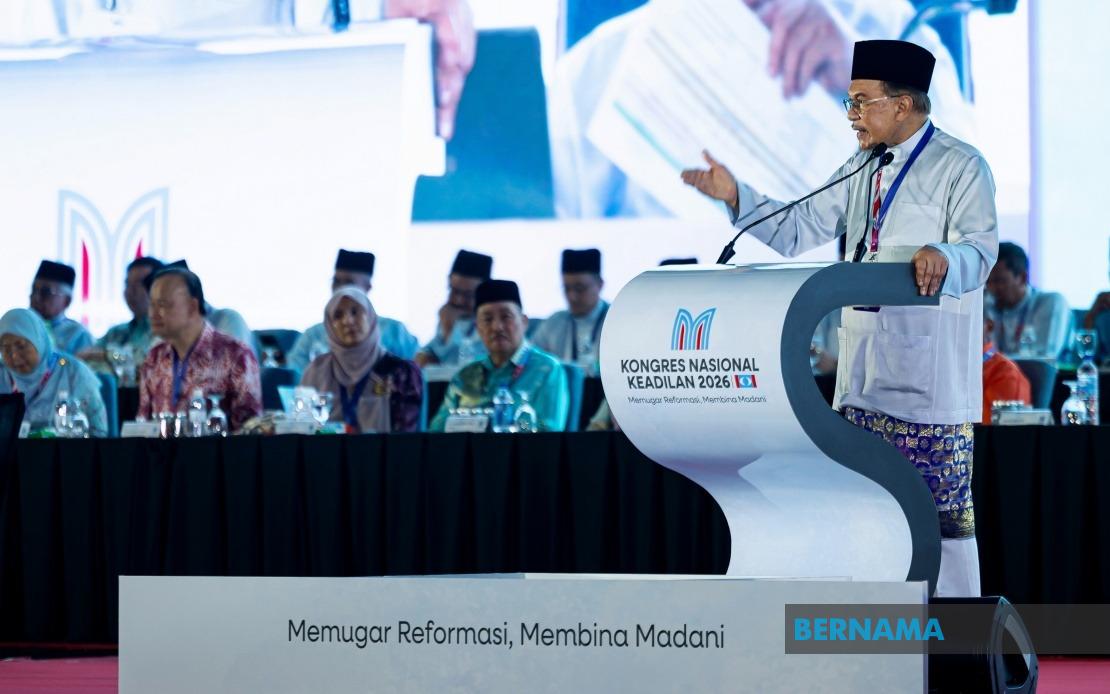
Prime Minister Datuk Seri Anwar Ibrahim has flatly rejected assertions that his working relationship with Deputy Prime Minister Datuk Seri Dr Ahmad Zahid Hamidi has deteriorated, characterising such claims as a reflection of personal disposition rather than factual reality. Speaking at the 2026 PKR National Congress in Melaka on Thursday, Anwar underscored that his partnership with Ahmad Zahid remains constructive and functional, despite recent political tensions within the Unity Government coalition. The remarks came in direct response to former UMNO Youth chief Khairy Jamaluddin's public suggestion that trust between the premier and his deputy has eroded to historic lows since the governing alliance took office in 2022.
Anwar's defensive posture signals the lingering sensitivity surrounding questions about internal coalition stability at a time when external pressures have already strained the Unity Government's cohesion. The Prime Minister framed the disagreement not as a policy dispute or personal tension, but rather as a fundamental difference in how political actors interpret events. He suggested that Khairy's propensity to view situations through a lens of conflict stands at odds with his own commitment to resolving differences peacefully and through dialogue. This rhetorical approach allows Anwar to acknowledge recent controversies without conceding that real damage has occurred to his relationship with Ahmad Zahid.
The timing of Anwar's statement carries particular significance given recent developments within the coalition. Barisan Nasional's strategic decision to cooperate with Perikatan Nasional during the Negeri Sembilan state election has created visible fault lines between the two major pillars of the Unity Government. This move, made without apparent coordination with Pakatan Harapan, represents a notable divergence from the unified front that the coalition has attempted to project to the public. Such tactical independence by BN raised questions about whether the partnership between Anwar and Ahmad Zahid could withstand the pressure of competing political interests at the state level.
During his presidential address at the Melaka International Trade Centre, Anwar seized the opportunity to publicly recognise Ahmad Zahid's contribution to establishing the Unity Government in its nascent stages following the 15th General Election. This acknowledgement serves a dual purpose: it demonstrates respect for his deputy's role in facilitating the initial coalition formation, while simultaneously reinforcing the narrative that their relationship remains fundamentally sound. By emphasising Ahmad Zahid's significance in BN's initial cooperation with PH and the formation of the government, Anwar subtly reinforces that the Deputy Prime Minister remains an essential partner in governing Malaysia.
The broader context of coalition management in Malaysia reveals why such public denials matter strategically. The Unity Government represents an unprecedented arrangement bringing together rival coalitions that spent years in fierce opposition. Maintaining the appearance of harmony at the leadership level is essential for preventing further erosion of public confidence and averting opportunistic challenges from opposition forces. Any perception that the Prime Minister and Deputy Prime Minister are working at cross-purposes could embolden critics and destabilise parliamentary support for key legislation. Anwar's emphasis on a peaceful, dialogue-based approach to resolving differences serves as reassurance to both coalition partners and international observers.
Khairy's intervention in this debate, however, reflects genuine anxieties within political circles about the sustainability of the current arrangement. The former Rembau parliamentarian's claims that trust has reached its lowest point since 2022 are not baseless speculation but rather observations grounded in observable shifts in coalition dynamics. The increasing frequency of divergent positions taken by BN and PH on state-level issues, combined with UMNO's apparent willingness to explore alternative partnerships with Perikatan Nasional, suggests real pressure points in the relationship. Whether Anwar's characterisation of Khairy as inherently confrontational is entirely fair or represents a deflection from substantive concerns remains a matter of interpretation.
The challenge facing the Unity Government extends beyond the personal relationship between Anwar and Ahmad Zahid to encompass fundamental questions about coalition longevity. Both leaders represent parties with distinct constituencies and policy preferences, and the compromises required to maintain the partnership inevitably create friction. The Negeri Sembilan decision by BN illustrates how state-level politics can disrupt national-level coordination, particularly when one component seeks to leverage partnerships with non-coalition actors to gain tactical advantage. This pattern may repeat in other state elections, creating cumulative stress on the Unity Government's internal bonds.
Anwar's invocation of a peaceful, dialogue-based approach to resolving intra-coalition disputes suggests a willingness to accommodate divergent strategies from partner parties, at least within certain boundaries. This flexibility may be necessary for the coalition's survival, but it also risks sending mixed signals about the depth of the partnership. If BN can pursue independent political strategies without triggering severe consequences, other partners may feel emboldened to do likewise, potentially leading to a gradual hollowing out of the coalition's unity. The delicate balancing act required to manage such an arrangement explains why Anwar felt compelled to publicly reassert the soundness of his relationship with Ahmad Zahid.
Looking forward, the trajectory of Anwar and Ahmad Zahid's working relationship will likely determine the Unity Government's capacity to govern effectively through Malaysia's next significant electoral cycle. Regional observers and business leaders closely monitor coalition stability as an indicator of Malaysia's political and economic governance. Any sustained perception of deteriorating ties between the Prime Minister and Deputy Prime Minister could weaken Malaysia's standing in regional forums and investor confidence. The stakes for maintaining at least the public appearance of partnership accord therefore extend beyond domestic political calculations to encompass broader national interests in regional engagement and economic performance. Anwar's vigorous dismissal of Khairy's claims should be understood within this wider strategic context.

