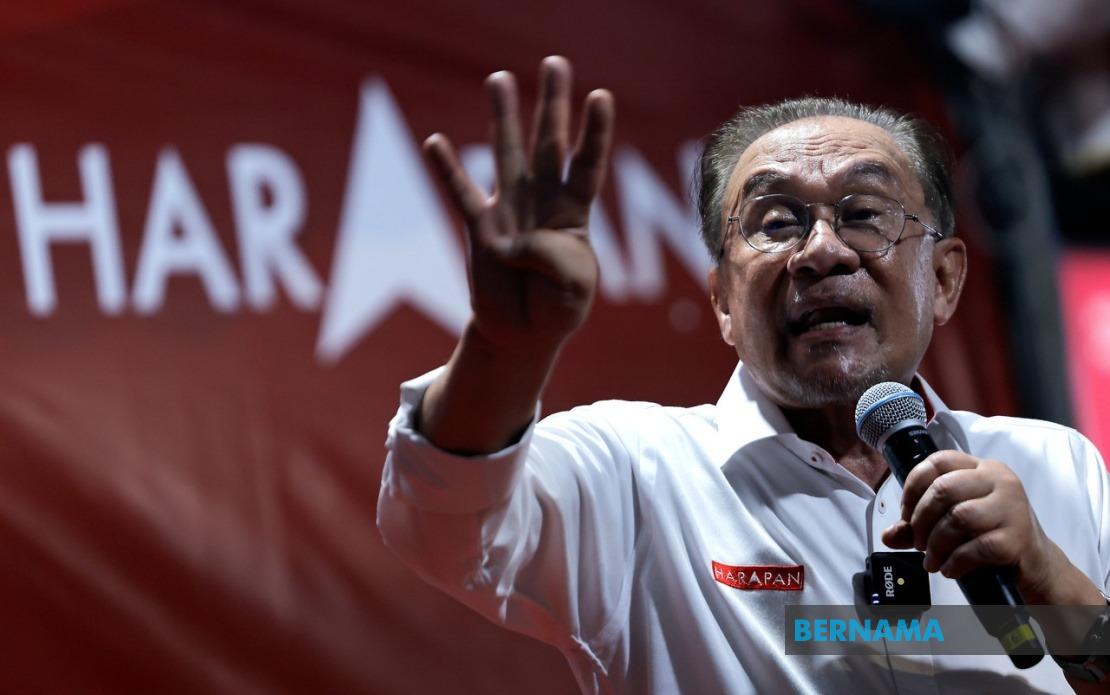
Prime Minister Datuk Seri Anwar Ibrahim has made a direct appeal to Johor voters to elect leaders demonstrating genuine integrity and humility, cautioning against politicians who leverage racial sentiments to gain electoral advantage only to abandon public duties once in office. Speaking at a Pakatan Harapan rally in Muar on June 15, the PH chairman emphasised that the calibre of leaders chosen by the electorate fundamentally shapes a state's trajectory and the wellbeing of its most vulnerable residents.
Anwar's remarks reflect growing concern within the coalition about political behaviour that prioritises divisive messaging over substantive governance. He explicitly warned voters against supporting candidates who exploit communal tensions as a campaign tactic, framing such approaches as fundamentally damaging to the nation's social fabric and future prospects. The Prime Minister stressed that responsible political leadership demands focus on tangible policy outcomes—functioning schools, adequate healthcare, economic security—rather than rhetoric designed to inflame existing grievances between communities.
The timing of Anwar's intervention carries particular significance ahead of the Johor State Election scheduled for July 11. His call for elected representatives to demonstrate humility after winning office signals concern that some politicians may prioritise personal power consolidation over constituent service. Anwar underscored that genuine leadership requires resisting the temptation toward arrogance following electoral success, instead channelling energy into resolving the concrete problems facing ordinary citizens, particularly those struggling economically.
Central to Anwar's campaign message is the argument that alignment between state and federal governments directly benefits ordinary Malaysians. He contended that when both levels of government operate in coordination, infrastructure investments, economic initiatives, and social assistance programmes achieve their full potential at grassroots level. Conversely, misalignment creates inefficiencies that prevent ordinary citizens from fully benefiting from major development projects and economic opportunities.
Anwar highlighted the Johor-Singapore Special Economic Zone (JS-SEZ) and the expansion of Port Tanjung Pelepas as concrete examples of federal initiatives requiring coordinated state-level support for optimal implementation. While acknowledging that the current Johor state government contributed to these projects, he emphasised that the Federal Government bore primary execution responsibility. His implicit message to voters is that voting for a PH-aligned state government would ensure better coordination of such major economic initiatives, enabling broader distribution of benefits throughout Johor's communities.
The Prime Minister's emphasis on state-federal coordination reflects broader PH strategy across Malaysia, where the coalition controls the federal apparatus but faces mixed results in state-level contests. This dynamic creates real challenges for implementing national development agendas when state governments operate independently or under opposition control. Anwar's call for greater alignment thus serves both a practical governance purpose and a political objective of encouraging voters to consolidate PH control across government levels.
Anwar directly appealed to Johor voters living outside the state to return home for the July 11 election, framing participation as a civic responsibility with direct implications for Johor's future direction. This mobilisation effort acknowledges that diaspora voters, particularly those working in Selangor or Kuala Lumpur, represent a significant electoral bloc whose participation could influence outcomes in marginal constituencies. His emphasis on the invaluable nature of every vote underscores the competitive dynamics at play in the contest.
The Prime Minister's positioning of this election as fundamentally about policy direction reveals the substantive stakes his coalition perceives. Rather than treating the poll as merely a routine state election, Anwar framed it as an opportunity for comprehensive policy change benefiting ordinary Johoreans. His specific focus on ensuring state government representatives and exco members prioritise caring for ordinary citizens reflects calculation that many voters feel neglected by existing political arrangements and seek representatives genuinely committed to their welfare.
Anwar's rhetoric, emphasising material improvements in schooling and healthcare alongside warnings about exploitative political manipulation, targets multiple voter concerns simultaneously. This approach acknowledges that while some voters remain susceptible to divisive messaging, others are primarily motivated by desire for better public services and economic opportunity. By positioning PH as the force capable of delivering such improvements through coordinated governance, Anwar attempts to assemble a coalition spanning different voter motivations and demographic groups.
The broader regional context shapes interpretation of Anwar's message. Malaysia's persistent challenges with communal tensions and political polarisation create receptive audiences for warnings against exploitative racial politics. Yet genuine voter frustration with political leaders perceived as prioritising personal gain over public service remains widespread. Anwar's framing taps this sentiment while positioning PH as offering an alternative approach centred on integrity and competent service delivery rather than communal division.
For Malaysian observers, this election carries implications beyond Johor's borders. The state is economically significant and strategically important for national development initiatives. Moreover, outcomes may influence calculations by other state-level opposition governments regarding potential coalition shifts or political realignments. PH's performance will signal whether the federal government can effectively mobilise voters around governance narratives in state contests where local issues often dominate voter calculations.
Anwar's specific warning against politicians who fail to fulfil responsibilities after taking office suggests PH strategists believe incumbent performance vulnerabilities exist. Whether focused on service delivery shortcomings, perceived arrogance by state-level leaders, or specific policy failures, the coalition appears confident that reframing the election around leadership integrity and actual governance performance creates favourable terrain. The July 11 vote will indicate whether voters respond to these appeals or prioritise other considerations in determining their electoral choices.