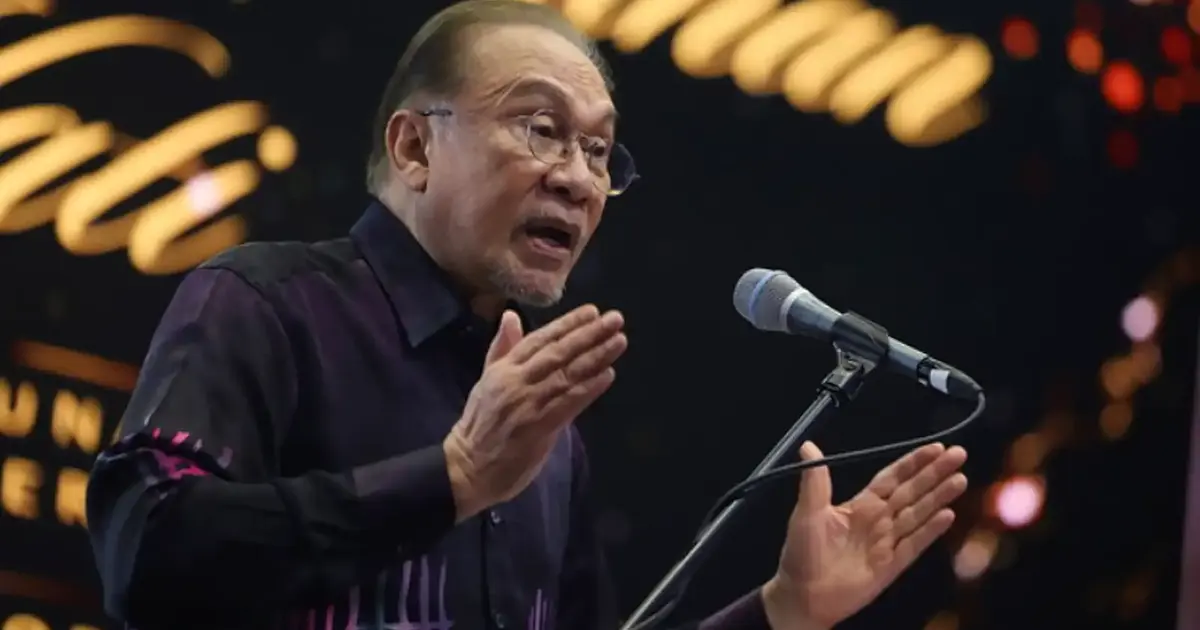
Prime Minister Anwar Ibrahim has appealed to the Malaysian public to move beyond destructive rhetoric being spread by certain political and community leaders, emphasizing that the country's ethnically and religiously diverse population constitutes a fundamental source of national strength and competitive advantage.
Anwar's remarks come at a time when Malaysia faces persistent challenges related to communal tensions and polarizing discourse. By framing diversity not merely as a challenge to be managed but as a strategic asset to be celebrated, the Prime Minister has sought to reorient the national conversation away from grievance-based narratives toward a more forward-looking vision of cohesion and shared prosperity.
The emphasis on diversity as a strength reflects a deliberate political strategy to counter the influence of hardline voices within both the Malay-Muslim majority and minority communities. Throughout Malaysia's post-independence history, the country has built its political settlement on the principle of constitutional protections for different groups, enshrined in the Federal Constitution. Yet periodic attempts by various political actors to weaponize identity issues have repeatedly threatened this delicate equilibrium, necessitating regular appeals from senior leadership to restore a broader consensus.
Anwar's intervention carries particular weight given his own political trajectory. As someone who has navigated Malaysia's complex racial and religious landscape across decades of public service, his calls for unity carry an authenticity that purely technocratic appeals might lack. His framing also implicitly critiques a segment of political leadership willing to sacrifice national cohesion for short-term electoral or ideological gains.
The Prime Minister's assertion that certain leaders peddle hatred suggests a recognition that divisive messaging is not merely spontaneous social friction but a deliberate strategy employed by identifiable actors within the political ecosystem. This attribution of intentionality marks an important shift in how senior government figures publicly characterize communal tensions, moving beyond blaming abstract forces or external actors toward holding domestic political actors accountable.
For Malaysia's business community and civil society organizations, Anwar's remarks provide political cover for initiatives promoting inter-ethnic understanding and economic integration. Companies operating across different communities, and non-governmental organizations working on bridge-building programmes, can now cite the Prime Minister's authority when advocating against identity-based discrimination or advocating for inclusive practices.
Regionally, Malaysia's approach to managing diversity holds significance beyond its borders. Neighbouring countries including Indonesia and Thailand grapple with similar tensions between majoritarian political movements and minority rights. Malaysia's continued commitment to constitutional pluralism, despite periodic pressures, offers both a model and a cautionary tale about how fragile hard-won accommodations can become when political incentives shift.
The appeal also reflects international context. On the global stage, Malaysia has positioned itself as a moderate voice in Muslim-majority Asia, and allowing domestic discourse to be captured by hardline voices would undermine that positioning. Anwar's emphasis on diversity thus serves both domestic cohesion and international credibility simultaneously.
Implementing the Prime Minister's vision requires more than rhetorical appeals. Concrete policy measures—from educational curricula that present Malaysian diversity positively, to economic policies ensuring equitable opportunities across communities, to law enforcement responses that prevent hate crimes—remain essential for translating principle into lived experience. The gap between what leaders say about unity and what institutional structures actually deliver remains one of Malaysia's persistent challenges.
Anwar's challenge to certain leaders to cease peddling hatred implies a broader expectation that political actors should exercise restraint in how they mobilize their constituencies. In a democracy where elections depend on securing voter support, the temptation to deploy identity-based messaging remains perpetually strong. Yet the Prime Minister's suggestion that such tactics ultimately weaken rather than strengthen the nation appeals to longer-term thinking about Malaysia's viability as a multicultural state competing in an increasingly interconnected world.
The sustainability of Malaysia's model depends significantly on whether successive generations of leaders across the political spectrum internalize the argument that diversity strengthens rather than weakens national capacity. Anwar's reiteration of this principle, delivered from the highest office, serves to reestablish expectations for responsible political conduct even as he tacitly acknowledges that such expectations are not universally respected within the current leadership cohort.
Moving forward, the effectiveness of Anwar's appeal will likely be measured not in immediate shifts in public discourse—which tend to be glacial—but in whether the statement establishes sufficient political consensus that divisive rhetoric becomes progressively costly for those who employ it. In a competitive political environment where marginal movements of voter sentiment determine electoral outcomes, public pressure against hate-peddling could gradually alter the calculus of what messages politicians deem strategically useful to broadcast.

