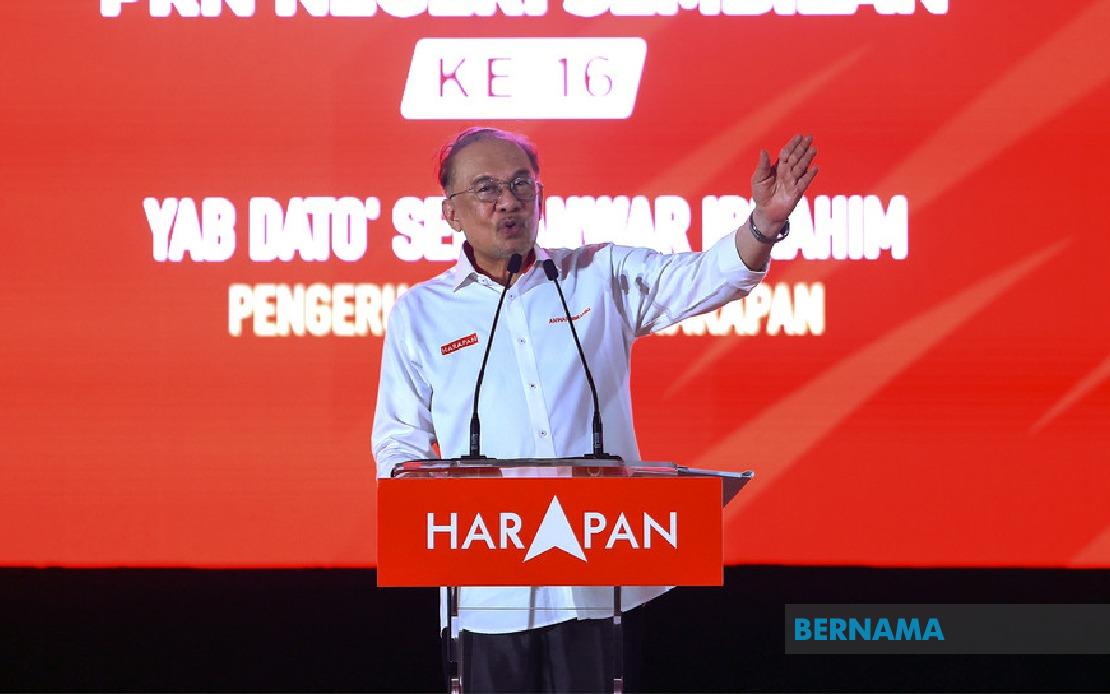
Prime Minister Datuk Seri Anwar Ibrahim has made a direct appeal to voters in Negeri Sembilan to maintain their backing for Pakatan Harapan (PH) in the state's forthcoming election, framing the vote as a choice between continuity and disruption of development programmes. In a statement released on social media, Anwar, who leads PH as its chairman, emphasised that sustaining the coalition's mandate was essential for accelerating progress that benefits ordinary residents across the state.
The timing of Anwar's intervention underscores the stakes involved in the 16th Negeri Sembilan state election, scheduled for August 1, with nominations closing on Saturday and early voting taking place on July 28. By personally wading into the campaign, the Prime Minister has signalled that PH views the contest as consequential not merely for the state but for the broader national political landscape. His endorsement of continued PH governance reflects a strategy to leverage federal-level popularity and achievements to bolster the coalition's standing at the state level.
At the heart of Anwar's message lies an argument about institutional continuity and proven governance. He highlighted the collaboration between the state administration led by Menteri Besar Datuk Seri Aminuddin Harun, colloquially known as Tok Min, and the federal government, pointing to multiple infrastructure and development projects that this partnership has delivered since 2018. This federal-state alignment has been instrumental in channelling resources and implementing initiatives that would have been more difficult under a divided or adversarial arrangement.
The Prime Minister's praise for Aminuddin Harun was notably effusive, describing the Menteri Besar as leading with integrity, humility, and a pronounced sense of accountability. These characterisations matter beyond mere political flattery—they constitute an implicit contrast with alternative leadership options and suggest that PH views Aminuddin as embodying the values the coalition wishes to project. In Malaysian political culture, such personal endorsements carry weight and can influence undecided voters who associate the Menteri Besar's performance with broader assessments of PH's fitness to govern.
Anwar's emphasis on clean administration addresses a concern that has animated Malaysian politics for years, particularly following the 1Malaysia Development Berhad scandal and subsequent political upheaval. By stressing that a continued PH mandate would preserve governance rooted in transparency and public interest, he is attempting to differentiate PH from opposition parties, many of which remain tainted by associations with financial impropriety or patronage networks. For Negeri Sembilan voters weary of corruption narratives, this pitch may carry considerable persuasive force.
However, Anwar's argument also contains an implicit acknowledgment that substantial work remains incomplete. His statement that "more remained to be done" suggests that PH's record, while positive, falls short of comprehensive transformation. This candid framing could be read as either refreshingly honest or as an admission that five years of PH governance have not yet fully realised its aspirations. Opposition parties will likely seize on this language to argue that voters should consider an alternative that might deliver faster results or different priorities.
The electoral calendar itself reflects Malaysia's unique political structure. By scheduling nominations, early voting, and polling across multiple dates, the system allows for extended campaigning and provides administrative clarity, but also extends the period of intense political activity. For a state like Negeri Sembilan, which has not historically commanded the same media attention as Selangor or Johor, Anwar's direct intervention elevates the election's profile and may mobilise voters who might otherwise abstain.
From a Southeast Asian perspective, Negeri Sembilan's election carries broader significance. Malaysia's federal system means that state elections serve as barometers of national political sentiment, and results can reshape parliamentary arithmetic if they strengthen or weaken particular coalitions. A strong PH performance would validate Anwar's leadership and provide momentum for potential federal initiatives, while an opposition victory would raise questions about the stability of federal arrangements and potentially embolden efforts to challenge PH's national dominance.
The appeal to continuity that Anwar articulates must also be understood against the backdrop of Malaysian voters' historical pattern of splitting ballots—supporting different parties at federal and state levels. This fragmentation reflects both genuine policy preferences and a desire for checks and balances. Anwar's task is to persuade Negeri Sembilan voters that in this instance, continuity across both levels of governance offers superior outcomes compared to mixed outcomes.
Regarding development specifically, Malaysian states pursue divergent priorities based on their economic profiles and demographic needs. Negeri Sembilan, as a mid-sized state with both urban and rural constituencies, requires balanced investment in both infrastructure modernisation and agricultural support. Anwar's mention of federal-state cooperation suggests that the current arrangement has enabled targeted development, though he does not detail specific projects, leaving room for interpretation about what precisely has been accomplished.
Looking ahead, the electoral outcome will likely influence how PH calibrates its state-level messaging more broadly. If Negeri Sembilan returns PH with a commanding majority, it validates Anwar's approach of national-level figures actively campaigning in state contests. Conversely, a narrow victory or loss would prompt reassessment of whether federal prominence translates effectively to sub-national politics. For Malaysian observers, the result offers a snapshot of how Anwar's federal administration is perceived at the grassroots level.

