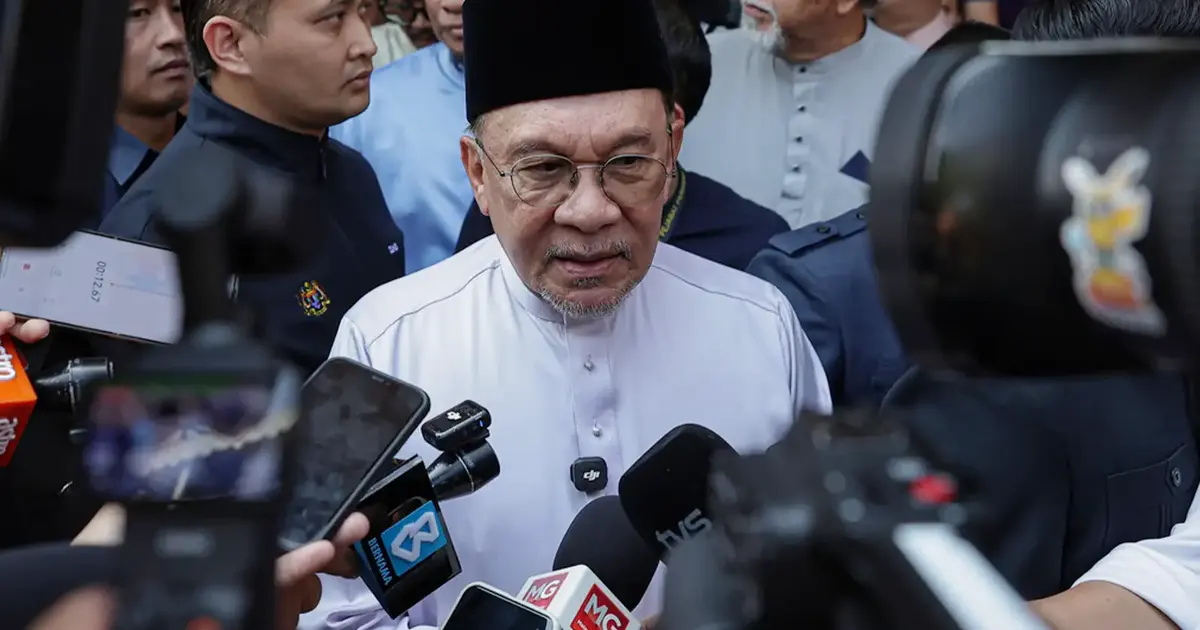
Prime Minister Anwar Ibrahim has signalled that strong public approval metrics will not diminish the administration's determination to accelerate policy delivery and reform initiatives. Speaking in response to the latest Merdeka Center survey results, which placed his government favourably among Malaysian voters, Anwar rejected the notion that positive sentiment should translate into reduced urgency or complacency within ministerial ranks.
The Merdeka Center survey, a respected independent polling organisation with longstanding credibility in assessing public opinion across Malaysia, appears to have validated some of the administration's early performance markers. Rather than treating these results as a plateau or point of completion, Anwar reframed the findings as a mandate for intensified effort. This positioning reflects a broader political strategy of maintaining momentum and preventing internal drift during periods of electoral goodwill.
For Malaysian observers monitoring government performance, this statement carries significance beyond mere rhetoric. The prime minister's explicit warning against complacency suggests awareness of historical patterns in Malaysian politics, where governments have occasionally lost public confidence through perceived policy drift or ministerial disengagement following initial honeymoon periods. By publicly committing to heightened rather than reduced effort, Anwar attempts to establish accountability benchmarks for his cabinet colleagues.
The timing of such statements often matters in Malaysian political cycles. Survey results that register high approval ratings can paradoxically create pressure within administrations, as ministers may question whether continued strain justifies marginal improvements in already-positive numbers. Anwar's framing directly addresses this potential pitfall by arguing that sustained effort remains essential precisely when public backing exists. This approach aims to prevent the psychological easing that can accompany political success.
For the broader Southeast Asian region, Malaysia's experience with public approval metrics and governmental response offers lessons. Many newly-formed or recently reshuffled governments across the region face similar challenges in maintaining momentum beyond initial public enthusiasm. The way Anwar's administration navigates this phase may influence how other regional leaders approach public confidence and ministerial discipline during periods of popularity.
The government's policy agenda remains substantial and politically consequential. Key reform initiatives across fiscal management, civil service efficiency, corruption prevention, and economic restructuring continue to demand intensive ministerial engagement. Any reduction in focus or effort during a period when public backing exists would presumably hamper these programmes' effectiveness. Anwar's public comments thus serve both as genuine commitment and as administrative discipline tool.
Merdeka Center surveys have historically proven influential in Malaysian political discourse because the organisation maintains research independence and methodological credibility. When such polls show positive governmental ratings, they acquire weight that administration claims cannot. This means Anwar's response to the latest results—emphasising duty rather than celebration—resonates differently than if the message came without polling validation.
The statement also implicitly addresses concerns among observers who question whether Malaysia's political complexities might slow reform progress. By publicly anchoring the government's commitment to continuous improvement even when approval ratings suggest stable public confidence, Anwar attempts to establish a performance standard independent of fluctuating survey numbers. This approach recognises that sustainable governance requires consistent effort regardless of short-term approval variations.
Within cabinet structures, such signals from prime ministerial leadership typically cascade as expectations setting. Ministers reading these public statements understand that approval ratings provide no excuse for reduced diligence. This message becomes particularly relevant for ministerial portfolios directly affecting quality of life—health, education, transportation, and economic opportunity—where public expectations remain consistently high regardless of approval surveys.
The broader political context in Malaysia remains dynamic, with multiple constituencies holding distinct policy preferences and priorities. While a single survey may show positive aggregate approval, the granular distribution of support across demographic and geographic segments often reveals complexity. Anwar's emphasis on continued effort acknowledges this reality: maintaining broad coalition support requires sustained attention to diverse constituencies rather than assuming survey results indicate consolidated support across all segments.
Historically, Malaysian administrations have faced challenges sustaining policy momentum through full electoral cycles. Initial enthusiasm can erode through combination of implementation difficulties, shifting public priorities, external economic conditions, and political friction within governing coalitions. By establishing a rhetorical commitment to heightened rather than reduced effort during periods of public approval, Anwar positions his government against these historical patterns.
The emphasis on work intensification rather than satisfaction with current standing suggests strategic thinking about the administration's medium-term trajectory. Governments that consolidate power most effectively often do so by expanding public confidence through visible delivery of additional benefits and reforms, rather than merely managing existing support levels. Anwar's approach aligns with this political calculus.
Looking forward, the critical test will be whether the government's actual policy execution and ministerial engagement levels match the rhetorical commitment to intensified effort. Public statements about avoiding complacency carry credibility only when accompanied by measurable increases in reform pace, programme implementation, and institutional improvements. Malaysian observers and international analysts will likely monitor subsequent months for evidence of whether Anwar's pronouncement translates into substantive administrative changes or remains primarily political messaging.

