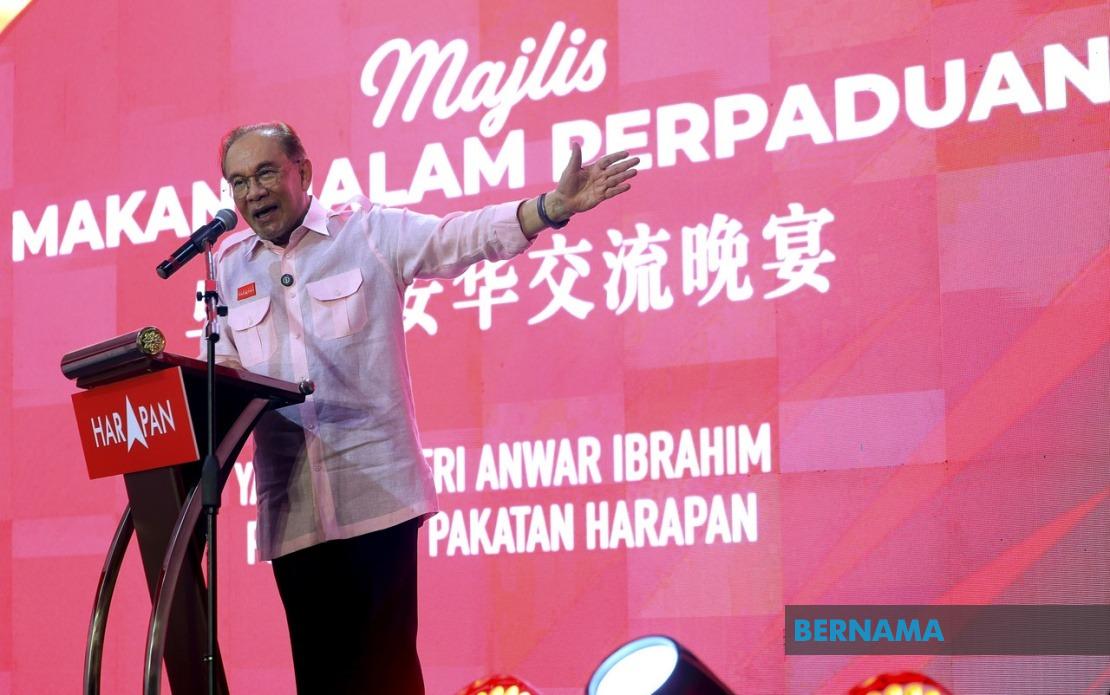
Prime Minister Datuk Seri Anwar Ibrahim has launched a pointed critique of rival political factions in Negeri Sembilan, zeroing in on their apparent rush to claim the state's top administrative post even as campaigning for the August 1 election is underway. Speaking at an election rally in Sikamat on July 22, the Pakatan Harapan chairman framed the competition for the menteri besar's office as symptomatic of a deeper organisational malaise that should concern voters considering where to cast their ballots.
The implicit argument Anwar made targets a perennial weakness in Malaysian opposition coalitions: the tendency for component parties to prioritise internal power struggles over coherent governance platforms. By highlighting how opposition figures are already sparring over succession before votes are even counted, Anwar sought to position PH not merely as an alternative government but as a mature, disciplined political force prioritising public interest over factional advantage. This messaging strategy proves particularly potent in state elections where leadership transitions are concrete, immediate concerns rather than abstract possibilities.
Anwar used the occasion to reinforce his case for retaining incumbent Menteri Besar Datuk Seri Aminuddin Harun, drawing on a familiar playbook in PH's electoral armoury: emphasising administrative competence and freedom from graft. The prime minister credited Aminuddin with maintaining clean governance and upholding integrity standards across state operations, characteristics he presented as direct counterpoints to the dysfunction he attributed to opposition ranks. By anchoring voter choice in tangible metrics of performance rather than abstract ideology, Anwar appealed to a pragmatic electorate concerned with effective service delivery.
The election in Negeri Sembilan carries significance beyond its relatively modest scale as a contest for 36 state assembly seats. As a swing state with historically competitive electoral margins, results here often signal broader sentiment that can reverberate through subsequent contests and influence perceptions of the Unity Government's political strength. A strong PH performance would validate Anwar's governance narrative; conversely, losses could embolden opposition parties and complicate PH's calculations ahead of federal elections. Stakes for party morale and internal cohesion across the coalition are accordingly elevated.
PH's candidate allocation across its three component parties reveals the distribution calculus that coalition partners constantly navigate. PKR, the largest bloc within PH, fields 16 candidates, while DAP contests 11 seats and Amanah nine. This arrangement reflects PKR's numerical predominance within the coalition while maintaining the alliance structure that proved successful in the 2022 federal election. However, such distributions occasionally generate tension within coalitions, particularly when localised party strengths suggest alternative allocations might yield better results. The Negeri Sembilan configuration appears relatively balanced, suggesting internal negotiations proceeded without major friction.
Anwar also seized the opportunity to push back against what he characterised as racial narratives being weaponised by certain quarters during the campaign. This criticism addresses a recurrent pattern in Malaysian elections where identity politics are deployed to mobilise support, sometimes at the expense of substantive policy debate. By explicitly naming racial narratives as a campaign tactic he opposes, Anwar positioned the Unity Government as above such divisive messaging, though critics might counter that this positioning itself constitutes a campaign strategy designed to appeal to multiracial urban constituencies concerned about communal tensions.
The prime minister's emphasis on inclusive governance and equitable resource distribution across all communities reflects PH's broader positioning within Malaysian politics. References to socio-economic allocations, housing programmes, and civil service salary adjustments frame the Union Government's appeal in concrete material terms rather than ideological abstractions. For voters evaluating competing visions, such specificity provides tangible benchmarks against which to assess claims. Whether actual implementation matches these commitments remains a separate question, but rhetorically Anwar positions his government as actively investing across demographic lines.
The campaign rally in Taman Sri Penaga brought together three PH candidates contesting different constituencies, allowing Anwar to present unified party messaging while acknowledging local grassroots representation. Nor Azman Mohamad contesting Sikamat and Datuk Muhammad Nazri Kassim running in Ampangan represent the local face of PH's state campaign, grounding national party leadership within specific community contexts. This organisational approach mirrors PH's broader model of coupling high-profile central leadership with credible local candidates, recognising that state elections ultimately hinge on voter perceptions of individual candidates and local representatives.
Early voting scheduled for July 28, three days before the main election, reflects attempts to accommodate diverse voter needs and potentially increase overall turnout. This scheduling particularly benefits voters with mobility constraints or competing commitments on the main polling day. Higher turnout generally favours governing coalitions with stronger organisational machinery, though weather, political momentum, and mobilisation effectiveness ultimately determine whether early voting translates into quantifiable advantages.
The August 1 election occurs amid broader political realignments in Malaysia following the 2022 federal election that installed Anwar as prime minister. Negeri Sembilan's results will provide important signals about the durability of the Unity Government coalition and the strength of PH's electoral position heading toward future contests. Opposition parties, particularly UMNO-led Barisan Nasional which remains the dominant force in several states, will view Negeri Sembilan as an opportunity to demonstrate viability and competitiveness despite their reduced role at federal level.
For Malaysian voters and political observers, the Negeri Sembilan election underscores how state-level contests serve as important testing grounds for competing governance models and coalition arrangements. Anwar's campaign message—presenting PH as internally cohesive, administratively capable, and committed to inclusive governance—directly targets voter anxieties about governance quality and political stability. Whether this messaging resonates sufficiently to translate into electoral victory remains the central question as polling day approaches.

