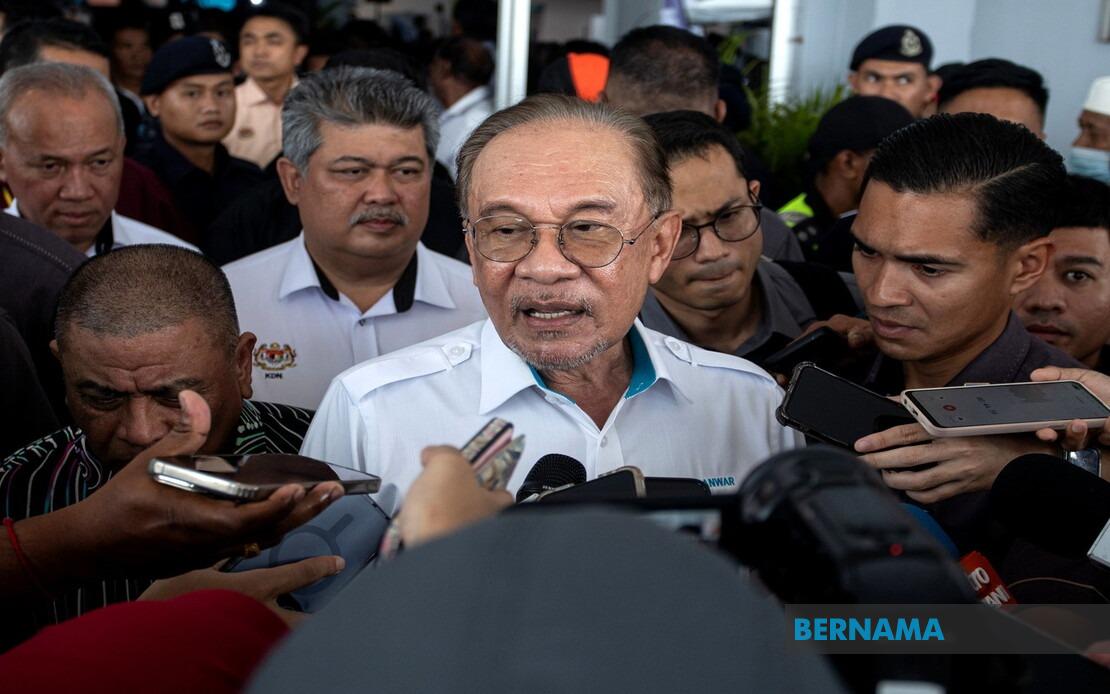
Prime Minister Datuk Seri Anwar Ibrahim has issued a stern directive to government officials to exercise restraint and refrain from attacking their federal coalition partners while campaigning in state elections. Speaking in Ipoh after attending the MADANI KITA with the Tambun Community programme, Anwar emphasised that political personnel occupying ministerial and agency positions must adhere to strict standards of conduct, cautioning that breaches of this discipline would necessitate their resignation from office.
The Prime Minister's remarks reflect growing concerns within the Unity Government about the potential fallout from competitive state-level contests involving coalition partners who remain allies at the federal level. While acknowledging that parties within the governing coalition may field competing candidates in state races—a scenario he characterised as entirely normal within Malaysia's democratic framework—Anwar stressed that such competition must not translate into personal or institutional attacks against the Federal Government itself. This distinction underscores the delicate balance the administration seeks to maintain between allowing healthy political competition and preserving the structural integrity of the multiparty coalition that underpins federal governance.
Anwar drew particular attention to ministers, deputy ministers, and senior government agency heads, explicitly stating that while they retain freedom to campaign on state-specific matters and local issues, they forfeit that latitude the moment they choose to publicly criticise or undermine the administration at the federal level. This conditional framing suggests the Prime Minister recognises the inherent conflict of interest when sitting government officials campaign in opposition to their own government's policies or decisions. The implicit ultimatum—either maintain loyalty to the federal administration or resign your post—reflects a zero-tolerance approach to what Anwar perceives as potential destabilisation of the coalition framework.
The guidance represents a proactive attempt to manage tensions that have periodically surfaced within the Unity Government alliance. The coalition comprises ideologically diverse parties that occasionally find themselves positioned as electoral rivals at state level while remaining partners in federal administration. Without clear expectations and enforcement mechanisms, such arrangements risk becoming vehicles for political posturing or score-settling disguised as state-level campaigning. Anwar's intervention signals that the Prime Minister's office intends to police these boundaries actively rather than assume good faith from all participants.
According to Anwar, the matter has already been discussed directly with both his deputies, Datuk Seri Dr Ahmad Zahid Hamidi and Datuk Seri Fadillah Yusof, indicating that the cautionary message carries endorsement and monitoring capacity from the highest rungs of the executive hierarchy. This multi-level communication approach suggests the Prime Minister sought to ensure consistent messaging and shared responsibility for enforcing these standards across the leadership structure. The involvement of the deputy prime ministers also signals that enforcement would likely extend beyond informal warnings, with potential consequences for those who disregard the directive.
As chairman of Pakatan Harapan, Anwar has additionally called upon coalition member parties to prioritise relationship maintenance across both federal and state governance tiers. This framing positions the preservation of coalition harmony as instrumental to effective service delivery rather than merely a matter of political survival or personal loyalty. By connecting disciplined conduct to tangible outcomes for citizens—suggesting that fractious relationships undermine the government's capacity to serve Malaysians effectively—the Prime Minister attempts to reframe the discussion from one about political constraint to one about public interest.
The context for these directives appears rooted in Malaysia's broader political volatility and the recurring tensions between coalition stability and competitive elections. State-level contests have historically provided opportunities for ambitious politicians to build profiles or challenge federal authority in lower-stakes environments. The Unity Government's heterogeneous composition, combining parties with different historical trajectories and voter bases, creates inherent friction. Some coalition members may view state elections as opportunities to distinguish their brand from federal partners or to consolidate regional power. Anwar's intervention seeks to contain these impulses.
For Malaysian observers, the Prime Minister's warning highlights the governance challenges accompanying coalition administration. Unlike single-party majority governments, Unity administrations require constant tending of inter-party relationships and careful management of competition that could metastasise into coalition rupture. The frankness of Anwar's remarks—essentially stating that positions in government carry loyalty obligations that supersede electoral ambitions at other levels—reflects recognition that such coalitions survive only through explicit boundary-setting and willingness to enforce consequences.
The broader implications extend to Southeast Asian coalition politics more generally. Malaysia's Unity Government model has attracted international attention as a potential template for managing political fragmentation through cross-ideological collaboration. However, such arrangements prove durable only when participating parties subordinate certain competitive impulses to coalition preservation. Anwar's directive demonstrates that maintaining this balance requires ongoing reinforcement and clear communication about non-negotiable standards. Failure to establish such expectations could provide cautionary lessons for other regional polities experimenting with similar governance models.

