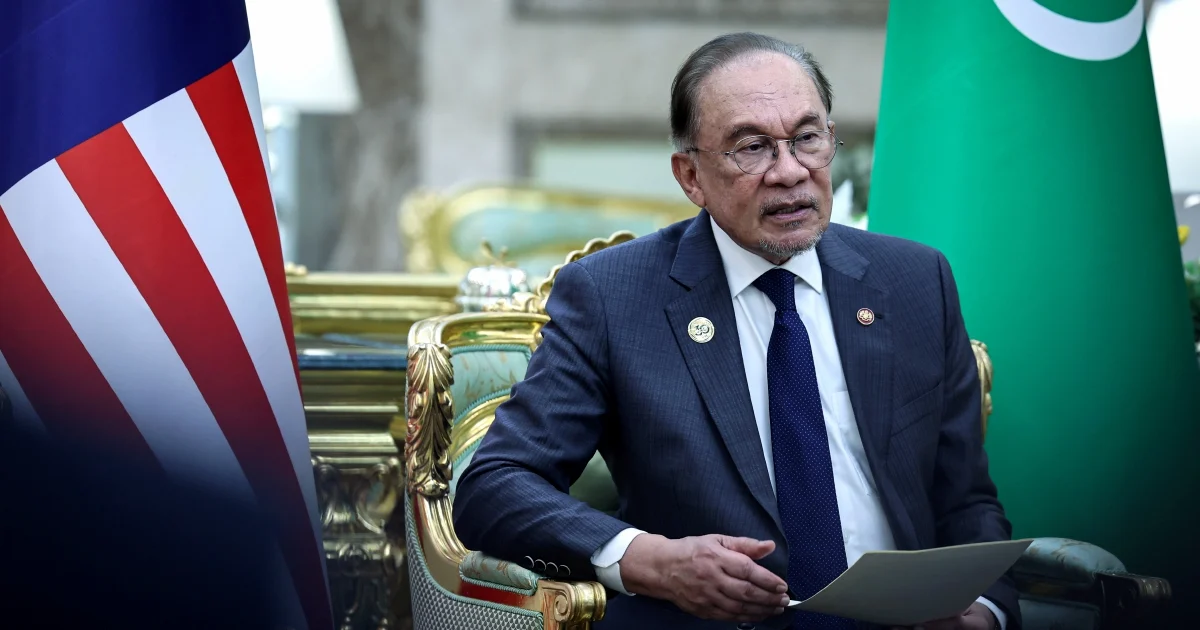
Prime Minister Datuk Seri Anwar Ibrahim has expressed cautious optimism regarding reports of an initial agreement framework between the United States and Iran, welcoming the apparent diplomatic movement as a significant step towards de-escalation in one of the world's most fraught geopolitical relationships. Speaking in Batu Kawan, Anwar described the reported accord as positive news with potential implications extending far beyond the bilateral relationship, signalling Malaysia's interest in the broader stabilisation of international tensions.
The development represents a notable diplomatic moment in a relationship characterised by decades of hostility, sanctions regimes, and mutual suspicion. Any agreement between Washington and Tehran carries ramifications for regional stability throughout the Middle East, particularly concerning ongoing conflicts in Iraq and Syria, the security of critical maritime trade routes, and the broader balance of power affecting nations across the Indian Ocean rim. Malaysia, as a maritime trading nation dependent on secure passage through multiple chokepoints and international commerce, has a tangible stake in reducing volatility emanating from US-Iran tensions.
Anwar's welcome of the reported breakthrough reflects Malaysia's diplomatic position as a nation committed to multilateralism and peaceful resolution of international disputes. The country has historically advocated for dialogue-based approaches to resolving conflicts, positioning itself as a bridge between the Islamic world and Western nations. Malaysia's own experience as a diverse, multi-religious democracy has informed its foreign policy orientation towards dialogue and mutual understanding, principles that inform the Prime Minister's response to developments in international relations.
The timing of Anwar's remarks carries significance given Malaysia's role in the Non-Aligned Movement and its participation in various regional forums where US-Iran tensions directly affect policy discussions and security arrangements. Southeast Asian nations have consistently called for de-escalation in the Middle East, recognising that regional conflicts generate instability affecting energy prices, maritime security, and counterterrorism operations throughout Asia. An easing of US-Iran hostilities would reduce pressure on Southeast Asian governments to take sides in what has often appeared a bipolar confrontation.
However, Anwar's emphasis on hopes for a "lasting peace" suggests awareness that initial agreements represent merely a foundation rather than a conclusive resolution. The history of US-Iran relations demonstrates that diplomatic breakthroughs face significant implementation hurdles, domestic political resistance in both countries, and the complex challenge of building trust after decades of mutual antagonism. Malaysian officials understand these dynamics well, given the country's experience mediating regional disputes where initial agreements require sustained commitment and careful management to translate into durable peace.
The statement also reflects Malaysia's broader commitment to international stability as essential for the country's development priorities. Economic growth, investment flows, and Malaysia's ambitions as a regional economic hub all depend on a predictable international environment. Excessive volatility emanating from unresolved Middle Eastern tensions disrupts markets, complicates trade relationships, and diverts attention from addressing transnational challenges like climate change, pandemic preparedness, and technological governance that demand global cooperation.
Anwar's response carries implicit recognition that Malaysia, while geographically distant from the Middle East, remains affected by outcomes of conflicts and tensions in that region. Malaysian energy security depends partly on Middle Eastern oil supplies, Malaysian companies operate throughout the region, and Malaysian Muslims maintain cultural and religious connections that make regional stability a legitimate national concern. The Prime Minister's careful framing of the breakthrough as positive news while emphasising hopes for lasting peace reflects this multifaceted interest.
From a diplomatic standpoint, Anwar's public welcome of the reported agreement positions Malaysia as a voice supporting international de-escalation and constructive engagement. This stance reinforces Malaysia's diplomatic brand as a nation favouring dialogue over confrontation, a positioning that enhances the country's credibility in regional forums and international negotiations where Malaysia seeks to exercise soft power influence. Southeast Asian nations collectively benefit when major powers reduce tension and focus on cooperative frameworks rather than zero-sum competition.
The breakthrough also carries implications for Malaysia's defence and security planning. Reduced US-Iran tensions potentially decrease pressure on regional allies to choose between competing security architectures, simplifying Malaysia's navigation of relationships with multiple security partners. ASEAN's traditional principle of non-interference and its desire to maintain equidistance from major powers becomes more sustainable in an environment where superpower competition does not force binary choices on regional states.
Yet implementing any US-Iran agreement will require overcoming substantial obstacles. Domestic political constituencies in both countries harbour deep reservations about rapprochement. Verification and compliance mechanisms must prove credible to sceptical audiences. Regional allies in the Middle East, particularly Gulf states, require reassurance that their security interests remain protected. These implementation challenges mean that Malaysia's hopes for lasting peace, while well-founded in principle, face a lengthy process of consolidation and confidence-building before yielding the region-stabilising benefits that Anwar's statement implicitly envisions.
For Malaysia specifically, a successful resolution of US-Iran tensions would remove a source of unpredictability from international relations and free diplomatic bandwidth for addressing issues directly relevant to Southeast Asian interests. Climate change, maritime security, trade facilitation, and countering transnational terrorism all demand international cooperation more easily pursued in a stable geopolitical environment. Anwar's welcome of the reported breakthrough thus reflects both humanitarian support for peace and clear calculation of Malaysia's national interests in a de-escalated international system.

