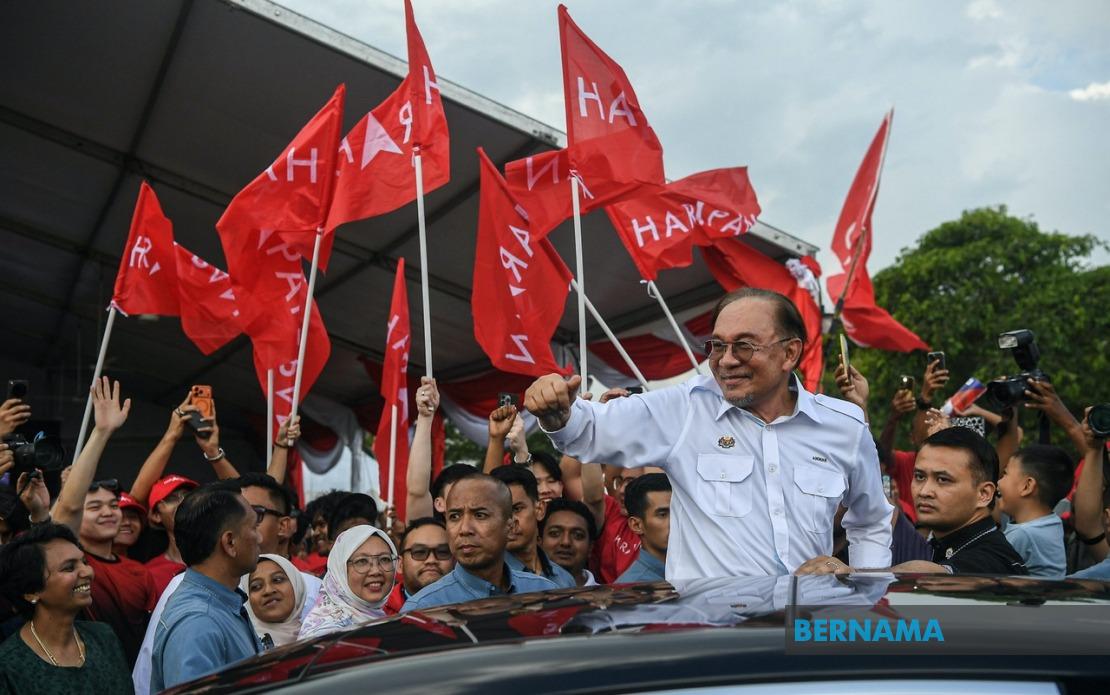
The arrival of Prime Minister Datuk Seri Anwar Ibrahim on the campaign trail has injected fresh momentum into Pakatan Harapan's push to consolidate its political position in Johor, with party strategists reporting an unexpectedly positive reception from voters across multiple constituencies. Communications Minister Datuk Fahmi Fadzil attributed the coalition's growing campaign energy to direct encounters between residents and the Prime Minister, describing the public response as both spontaneous and heartening during recent stops in the Batu Pahat district.
Fahmi's observations emerged following visits to campaign events in Senggarang and Semerah, where he witnessed firsthand the depth of community engagement with Anwar's political message. The minister highlighted an incident in which an elderly resident arranged for his wife to travel by trishaw specifically to meet the Prime Minister, illustrating the extraordinary appeal that Anwar's presence carries across demographic groups. Such anecdotal evidence, while difficult to quantify, reflects the narrative that Pakatan Harapan strategists are constructing around the state election campaign and the broader acceptance of the coalition's governance platform.
As the coalition's communications director, Fahmi framed the enthusiastic turnouts as validation of the political messaging that Pakatan Harapan has sustained throughout the election period. The minister suggested that public interest in meeting Anwar transcends mere curiosity, potentially translating into substantive electoral support for coalition candidates contesting the 56 State Legislative Assembly seats. This interpretation carries strategic weight for Pakatan Harapan's organisational planning and resource allocation during the final campaign phase.
Anwar's campaigning schedule over the previous weekend demonstrated the intensity of the coalition's efforts to mobilise voters in Johor. Between Saturday, July 4, and Sunday, July 5, the Prime Minister participated in 15 separate campaign programmes distributed across the state, combining his participation with concentrated efforts to energise party machinery and provide direct encouragement to candidates facing significant competition. The breadth of this schedule underscores the coalition's assessment that Anwar's personal involvement could prove decisive in swaying undecided voters and reinforcing commitment among party supporters.
The 16th Johor State Election represents a consequential contest for Pakatan Harapan's standing in a peninsula state where the coalition has invested considerable political capital. The coalition's decision to field candidates in all 56 seats signals confidence in its organisational capacity and electoral prospects, though it also reflects the competitive intensity of the race. A total of 172 candidates from multiple parties are contesting the available seats, indicating a fragmented political landscape where every vote carries amplified significance for the final outcome.
For Pakatan Harapan, the state election serves as a crucial test of voter sentiment beyond federal elections. Johor's economic importance and demographic diversity make it a bellwether for coalition performance across Malaysia's traditional strongholds and emerging political constituencies. Victory or significant seat gains would reinforce Anwar's leadership authority within the coalition and bolster his government's legitimacy heading into the latter stages of its parliamentary term.
The strategic deployment of Anwar on the campaign trail also addresses a longstanding coalition challenge: maintaining unified messaging and preventing candidate fragmentation across a sprawling state election. By centralising campaign energy around the Prime Minister's presence, Pakatan Harapan creates focal points for media coverage and voter attention, potentially offsetting resource advantages that opposition parties might possess in particular constituencies. This approach recognises that leadership visibility can compensate for organisational limitations in specific areas.
Early voting commenced on July 7, with the main polling day scheduled for July 11, allowing Pakatan Harapan only a compressed window to consolidate the momentum generated by Anwar's appearances. The coalition's campaign intensity during this final phase will likely determine whether the positive reception noted by Fahmi converts into electoral dividends or remains confined to anecdotal accounts of enthusiastic public engagement. The psychological dimension of Anwar's campaigning—creating visible momentum and narrative dominance—may prove as important as direct vote-winning mechanics in a competitive statewide contest.
Fahmi's emphasis on community interest and acceptance reflects a broader coalition strategy to reframe the state election as a referendum on Pakatan Harapan's governance record and future policy direction rather than allowing opposition narratives to dominate discourse. By highlighting spontaneous public enthusiasm, coalition communicators attempt to establish perceptual momentum that extends beyond their campaign machinery into broader voter consciousness. This information environment management constitutes a critical element of electoral competition alongside traditional voter mobilisation and ground-level organising.
For Malaysian political observers, the Johor contest illuminates the continuing importance of leadership visibility in state-level elections despite digital communication proliferation. Anwar's decision to commit significant personal time to intensive campaigning suggests that coalition strategists believe direct candidate-voter interactions and prime ministerial presence remain powerful electoral tools. The outcome in Johor will provide data on whether this assessment reflects contemporary Malaysian voting behaviour or represents institutional inertia in campaign methodology.
The coalition's campaign narrative emphasises continuity with federal governance initiatives and local responsiveness to Johor-specific concerns, using Anwar's presence to legitimise this dual messaging strategy. By appearing alongside state candidates and visiting multiple constituencies, the Prime Minister effectively endorses his coalition's local representatives while anchoring their campaigns to the broader federal agenda. This integration of state and federal campaign messaging characterises professional coalition strategy in Malaysia's federalised political system.

