Prime Minister Datuk Seri Anwar Ibrahim has shared a reflective message rooted in Malaysian cultural tradition, posting a four-line pantun on his official Facebook page that celebrates the enduring values of friendship, consensus and collective discipline. The poetic contribution, delivered in classical Malay verse form, resonates with a broader political moment in which Malaysia's federal leadership must balance competing pressures and coalition dynamics. The post generated substantial digital engagement, accumulating more than 11,500 likes within two hours and attracting over 1,700 comments, many of which were themselves composed in pantun, signalling appreciation for Anwar's invocation of traditional forms of expression.
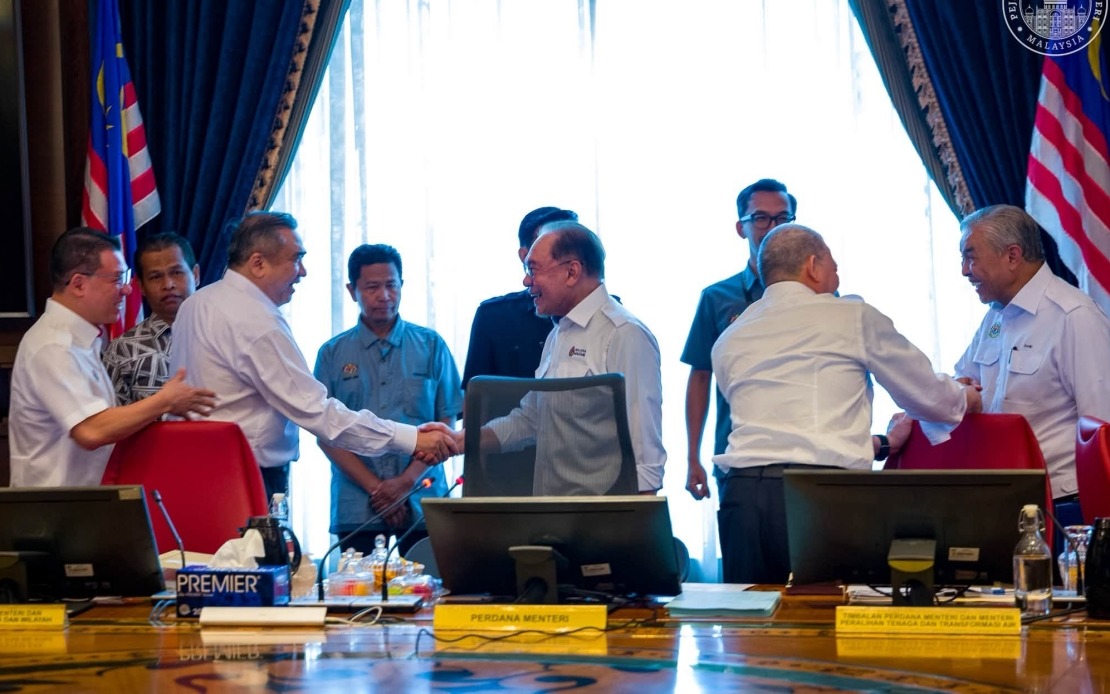
The Prime Minister accompanied his verse with photographs from a Cabinet session featuring Deputy Prime Minister Datuk Seri Dr Ahmad Zahid Hamidi and Transport Minister Anthony Loke, among others, captured in relaxed and convivial settings. The imagery underscores a narrative of collegial governance and institutional harmony, presenting senior ministers in settings that convey mutual respect and professional camaraderie. Such visual communication strategies serve an important function in Malaysian political discourse, offering reassurance about the functioning of government at moments when coalition relationships face public scrutiny and uncertainty.
Anwar's cultural gesture arrives amid a complex political configuration in which the Pakatan Harapan coalition, which he chairs, and the Barisan Nasional coalition, led by Ahmad Zahid, operate simultaneously as federal partners in the Unity Government and as direct competitors in state-level contests. This dual relationship creates inherent tensions that ripple through Malaysian political life, requiring careful management of messaging and symbolism. The pantun intervention appears calibrated to reinforce foundational principles of cooperation and solidarity that underpin the federal arrangement, particularly given intensifying campaign activity in the peninsular state.
Negeri Sembilan has emerged as a focal point for coalition positioning and electoral strategy. Pakatan Harapan is contesting all 36 state assembly seats under Anwar's chairmanship, while Barisan Nasional has fielded candidates in 25 constituencies and negotiated an electoral pact with Perikatan Nasional to avoid three-cornered contests. This configuration reflects broader calculations about which coalition can most effectively govern the state, even as both operate within the framework of federal unity arrangements that constrain their ability to wage purely adversarial campaigns.
The state election timeline has already begun accelerating toward its denouement. The Negeri Sembilan State Assembly was formally dissolved on June 5, and the Election Commission has scheduled early voting for July 28, with general polling set for August 1. This compressed schedule concentrates campaigning activity and media attention, intensifying the political temperature within a limited window. Anwar's measured, culturally anchored messaging appears designed to provide a counterbalance to the inevitable sharpening of partisan rhetoric that accompanies intensive electoral competition.
The online response to the Prime Minister's post reveals something significant about contemporary Malaysian political engagement. Beyond the quantitative metrics of engagement, the qualitative character of responses—with numerous commenters composing replies in pantun and many praising what observers characterised as a statesmanlike and conciliatory tone—indicates that substantial segments of the digital-savvy public respond positively to leadership communication that emphasises cultural authenticity and national cohesion. In an era of fractious coalition politics and frequent disputes over governance and policy direction, Anwar's invocation of traditional wisdom about unity and friendship seems to have touched a genuine public sentiment.
For Malaysia's federal power-sharing arrangement, such moments carry disproportionate significance. The Pakatan Harapan-Barisan Nasional unity government represents a historic departure from decades of two-coalition competition, and maintaining its coherence requires sustained effort to preserve working relationships across parties that hold fundamentally different ideological orientations and policy preferences. State elections like Negeri Sembilan's create flashpoints where underlying tensions can surface explosively, potentially destabilising the federal coalition if either partner perceives unfair treatment or political betrayal at the state level.
Anwar's approach—combining traditional cultural symbolism with visible evidence of Cabinet collegial harmony—reflects a sophisticated understanding of the communication challenges facing a unity government. By emphasising values rather than policy specifics, and by drawing on forms of expression deeply rooted in Malaysian culture, the Prime Minister seeks to remind all stakeholders of shared national interests that transcend temporary electoral competition. The positive public reception suggests this strategy resonates with at least significant portions of the Malaysian electorate who remain invested in political stability.
The implications for Negeri Sembilan's election remain uncertain, but Anwar's intervention establishes a baseline message that irrespective of which coalition performs better in state-level contests, the federal framework of cooperation should persist. This framing attempts to inoculate the federal government against the political fallout that might otherwise accompany victory by one coalition over its federal partner. Whether such messaging proves sufficient to contain tensions if election results prove divisive or controversial will be tested when votes are counted on August 1.
Looking ahead, the Negeri Sembilan election will serve as an important indicator of how effectively Malaysia's unity government can manage internal competition while preserving external cohesion. The results may influence calculations within both Pakatan Harapan and Barisan Nasional regarding the durability and desirability of continued federal cooperation. Anwar's pantun, in this context, represents an early signal that the Prime Minister views maintenance of the coalition framework as valuable enough to warrant explicit cultural and political investment, even at moments when electoral incentives might otherwise encourage more combative positioning.

