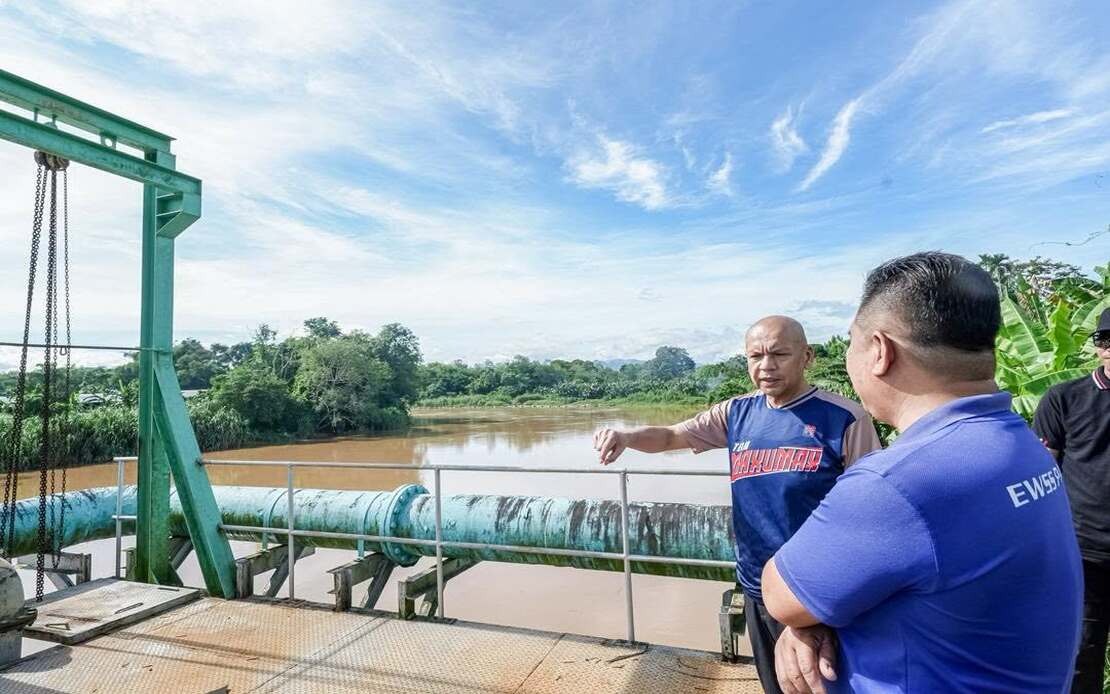
Domestic Trade and Cost of Living Minister Datuk Armizan Mohd Ali conducted an on-site inspection of water infrastructure projects in Papar on June 19, seeking to verify that ongoing water supply stabilisation efforts remain aligned with implementation schedules and effectively address chronic supply shortages affecting residents across the district. The ministerial visit followed a dedicated coordination meeting held on June 15 that examined the trajectory of these critical infrastructure initiatives and their capacity to resolve persistent water accessibility concerns.
Two major infrastructure initiatives currently in progress form the backbone of Papar's water security strategy. The first involves a significant capacity expansion at the Kogopon Water Treatment Plant, which is being upgraded from its present operational capacity of 40 million litres per day to a target of 80 million litres per day. Complementing this expansion, authorities are simultaneously undertaking improvements to the Kampung Kabang intake system, which supplies raw water to treatment facilities. Together, these complementary projects represent a strategic response to the region's growing water demand, as population growth and economic activity continue to strain existing supply infrastructure.
The need for these upgrades reflects deepening pressures on Papar's water system, which has struggled to keep pace with increasing consumption patterns across residential, commercial, and industrial sectors. The district's water supply challenges have prompted authorities to adopt a comprehensive modernisation approach rather than piecemeal repairs, recognising that sustained growth requires proportionate expansion of treatment and distribution capacity. This long-term planning stance suggests recognition among decision-makers that temporary fixes would prove inadequate for a region experiencing accelerating resource demands.
During his inspection, Armizan also assessed operational conditions at the EWSS Plant and JETAMA Limbahau Plant, two critical treatment facilities that have experienced significant disruptions during the preceding week. Both installations encountered severe complications arising from raw water turbidity problems, forcing temporary operational shutdowns as personnel worked to restore water quality to acceptable treatment standards. The turbidity challenges—measured through nephelometric turbidity unit (NTU) readings—indicate elevated sediment and particle concentrations in source water that compromise the efficacy of conventional treatment processes.
Raw water turbidity represents a recurring operational constraint for water utilities in Sabah and across Southeast Asia, particularly during monsoon periods and in regions where catchment areas experience erosion or construction activity. When NTU values exceed treatment plant thresholds, operators must halt processing to prevent contamination of treated supplies and damage to filtration systems. The temporary closures at both facilities during the inspection week underscored the vulnerability of Papar's water system to environmental variability and the critical importance of robust redundancy in treatment capacity.
Armizan's field-based oversight reflects a broader ministerial strategy emphasising direct engagement with infrastructure challenges rather than relying solely on administrative reports. By visiting treatment plants and observing operational dynamics firsthand, the minister gained direct insight into technical obstacles, workforce capability, equipment limitations, and coordination gaps that written assessments might obscure. This hands-on approach carries particular value in water management, where field conditions often diverge significantly from optimistic projections, and where real-time problem-solving frequently determines service reliability.
The Papar water situation holds broader implications for Sabah's infrastructure development trajectory and for policymakers across Malaysia grappling with regional water security. As urban and rural populations expand and climate variability intensifies, the mismatch between existing treatment capacity and actual demand has become a defining governance challenge. Papar exemplifies this pattern, where inadequate infrastructure investment during earlier development phases now constrains present-day service delivery and requires costly crash expansion programmes.
The turbidity incidents at both treatment plants also highlight the interconnected nature of water system challenges. Raw water quality depends on upstream catchment management, which involves forest conservation, erosion control, and land-use planning that extend far beyond water utility operations. Treating increasingly turbid water requires either advanced filtration technologies or source water protection investments. The temporary plant closures impose real hardship on consumers and demonstrate how environmental factors cascade through municipal systems to affect thousands of households.
For Malaysian observers, the Papar case illustrates why water security increasingly demands integrated resource management spanning multiple government agencies and extending upstream to catchment protection. The minister's focus on both demand-side capacity expansion through the Kogopon and Kampung Kabang upgrades and reactive management of turbidity problems suggests recognition that sustainable solutions require simultaneous attention to both infrastructure supply and source water quality. Neither approach alone can deliver reliable water services in a region experiencing rapid change.
Looking ahead, the success of Papar's water stabilisation programme depends not only on completing the planned Kogopon and intake upgrades but also on establishing robust protocols for managing turbidity events and maintaining system reliability during environmental variability. The temporary closures documented during the minister's visit underscore the distinction between design capacity and actual operational performance. For residents of Papar and for policymakers evaluating similar regional challenges, the coming months will prove instructive regarding whether infrastructure expansion, combined with improved operational management, can finally resolve water supply instability that has persisted across this Sabah district.

