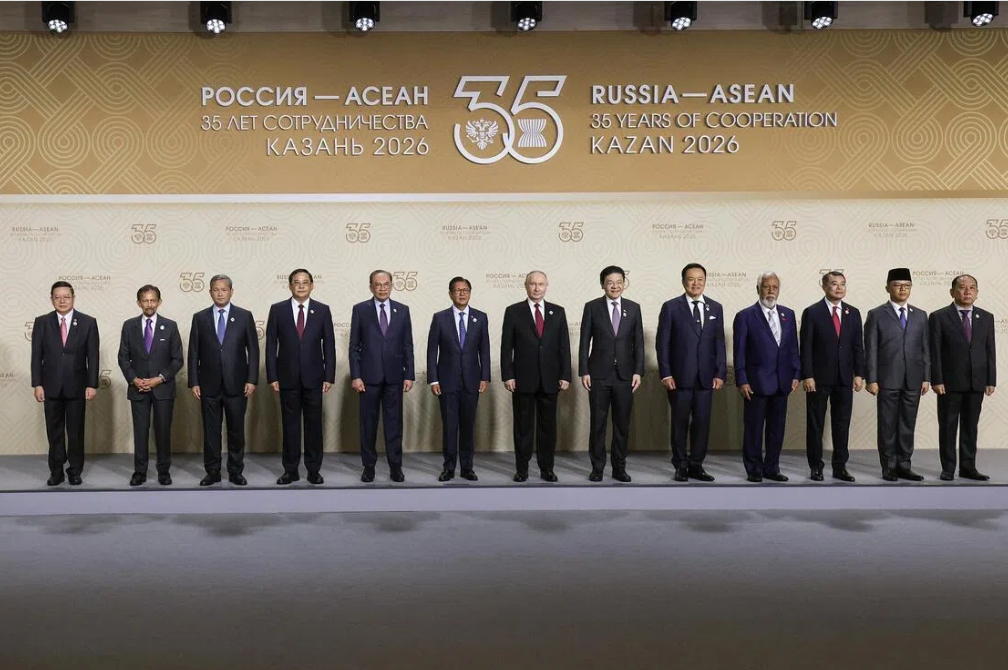
Asean and Russia have consolidated their diplomatic relationship through a series of formal agreements adopted at the Asean-Russia Commemorative Summit held in Kazan on June 17 and 18, reaffirming their intention to deepen cooperation across multiple domains despite broader geopolitical complexities. The summit, which took place in this southwestern Russian city and was hosted by President Vladimir Putin, commemorated both the 35th anniversary of bilateral relations and the 30th year of their formal dialogue partnership—a milestone reflecting the endurance of ties that predate the post-Cold War regional order that has shaped Southeast Asia's strategic architecture.
The centrepiece of the summit was the adoption of three principal documents designed to guide future engagement. The Kazan Declaration serves as the relationship's overarching statement of intent, reviewing three and a half decades of accumulated cooperation whilst simultaneously charting pathways for renewed emphasis in areas spanning maritime affairs, commercial ties and investment flows, energy collaboration, infrastructure connectivity, security cooperation, educational programming, and cultural initiatives. Complementing this broad framework, the signatories endorsed a Joint Statement on Cultural Cooperation that prioritizes deepening interpersonal connections and expanding cultural exchange mechanisms—acknowledging that durable state relationships require foundations built through people-to-people understanding. Most significantly for practical implementation, both sides agreed to the Asean-Russia Comprehensive Plan of Action covering 2026 through 2030, a detailed operational blueprint intended to translate diplomatic commitments into concrete cooperative activities across the enumerated sectors.
Prime Minister Lawrence Wong's address to the summit encapsulated Singapore's distinctive position as both an Asean member and a nation maintaining pragmatic engagement with Russia despite fundamental disagreements on international law and conduct. Wong articulated a framework distinguishing between areas of convergent interests—where cooperation could flourish—and matters of principle where Asean maintains consistent positions. He specifically identified disaster management and counter-narcotics efforts as domains where collaborative action serves mutual benefit, whilst simultaneously emphasizing that such cooperation occurs within the context of Asean's unwavering commitment to international law, sovereignty, and territorial integrity. This calibrated diplomatic approach reflects how Southeast Asian nations navigate relationships with major powers by compartmentalizing disagreements from opportunities for productive engagement.
The question of Asean centrality received particular emphasis throughout the summit, with Wong acknowledging Russia's longstanding participation in Asean-led multilateral mechanisms. He noted Russia's involvement in the Asean Regional Forum and East Asia Summit, positioning these institutions as critical venues for dialogue and confidence-building in a region where competing interests of major powers intersect. Looking forward, Wong indicated that Singapore—assuming Asean's rotating chairmanship in 2027—expects Russia's continued participation in these frameworks, underscoring how Asean leverage over the international engagement of major powers depends partly on their willingness to work through Asean's institutional structures rather than pursuing bilateral channels exclusively. This emphasis on institutional participation carries particular significance for Malaysia and other Southeast Asian nations concerned that great power competition might bypass Asean mechanisms.
Educational and civil service exchanges represent another dimension of Russia-Asean cooperation that Wong highlighted, with Russian officials regularly participating in training programmes across Asean member states including Singapore. These exchanges, though less visible than high-level diplomatic summits or defense agreements, constitute important mechanisms for building bureaucratic networks and mutual understanding. For Malaysian policymakers and citizens, such programmes offer opportunities for institutional learning and the cultivation of professional relationships that can influence policy outcomes across sectors ranging from environmental management to infrastructure development. The emphasis on this dimension suggests both sides view relationship-building as requiring sustained engagement at multiple governmental levels, not merely symbolic gestures from national leaders.
Wong's remarks on international conflict resolution revealed how Asean members calibrate their positions on major geopolitical disputes. On Ukraine, Singapore has maintained that its stance derives not from alignment with any particular side but from consistent principles regarding sovereignty and territorial integrity. This nuanced framing—rejecting both automatic Western alignment and Moscow's framing of opposition as anti-Russian bias—represents the diplomatic posture many Southeast Asian nations attempt to sustain. Wong reiterated Singapore's call for diplomatic resolution and compliance with international law, whilst acknowledging that Singapore has imposed and maintained sanctions on Russia since 2022. This demonstrates how Asean members balance maintaining channels of engagement with enforcement of their stated principles, a delicate equilibrium increasingly difficult to sustain as global polarization intensifies.
Wong's welcoming of the United States-Iran peace agreement and hope for reopening the Strait of Hormuz underscore Southeast Asian interests in maritime security and unimpeded commerce. The Strait of Hormuz's continued closure or disruption would ripple through the region's energy security and trade routes, directly affecting economic well-being across Asean. This concern positions regional countries as stakeholders in Middle Eastern stability not through choice of ideological alignment but through geographic and economic interdependence. Russia's role as a significant energy supplier and strategic actor means that its support for peace initiatives in the Middle East carries material consequences for the region, making the summit's implicit acknowledgment of shared interests in conflict resolution particularly relevant for Malaysian and other regional energy importers.
On the bilateral level, PM Wong's meeting with President Putin occurred at Russia's initiative, indicating Moscow's interest in maintaining direct engagement with Asean through its most strategically significant members. The substantive discussion encompassed both bilateral Singapore-Russia relations and broader regional and international developments, suggesting that major powers continue viewing bilateral meetings as opportunities for clarifying positions and testing alignment on emerging issues. Wong's subsequent meeting with the Rais of Tatarstan Rustam Minnikhanov illustrates how Asean engagement extends beyond federal Russian leadership to regional actors, a dynamic that reflects Russia's internal federalism and the commercial and cultural significance of regions like Tatarstan for regional engagement. The reference to then-Minister Mentor Lee Kuan Yew's 2007 visit to Tatarstan demonstrates the length of these connections, suggesting institutional memory and relationship continuity across decades.
The timing of this summit within a broader context of increasing geopolitical volatility lends significance to Asean's explicit reaffirmation of commitment to dialogue and multilateral engagement. Wong emphasized that Asean's twin priorities—deepening regional integration whilst expanding external partnerships—have become more salient precisely because the international environment has grown less predictable. This framing acknowledges that Asean members pursue diversified partnerships not from weakness but from rational assessment that reliance on any single major power creates vulnerability. The summit's outcomes, therefore, represent not capitulation to Russian interests but strategic maintenance of engagement channels that serve Asean's broader goal of preserving strategic autonomy and institutional relevance in an era of great power competition.
For Malaysian readers and policymakers, the Asean-Russia summit's outcomes carry implications extending beyond diplomatic protocol. The five-year cooperation plan encompasses domains directly affecting Malaysian interests, from maritime security and energy cooperation to education and cultural exchanges. Malaysia's own relationships with Russia, whilst less prominent in international discourse than Singapore's high-profile diplomacy, operate within this broader Asean framework. The emphasis on Asean centrality and institutionalized engagement suggests that regional nations collectively benefit from maintaining structured dialogue with major powers rather than allowing relationships to be determined by bilateral power dynamics alone. The summit demonstrates Asean's continued effort to position itself as a forum where even nations with fundamentally divergent positions on major international conflicts can engage in managed cooperation, a model increasingly tested by global polarization but still valued by Southeast Asian governments concerned about great power competition's destabilizing effects.

