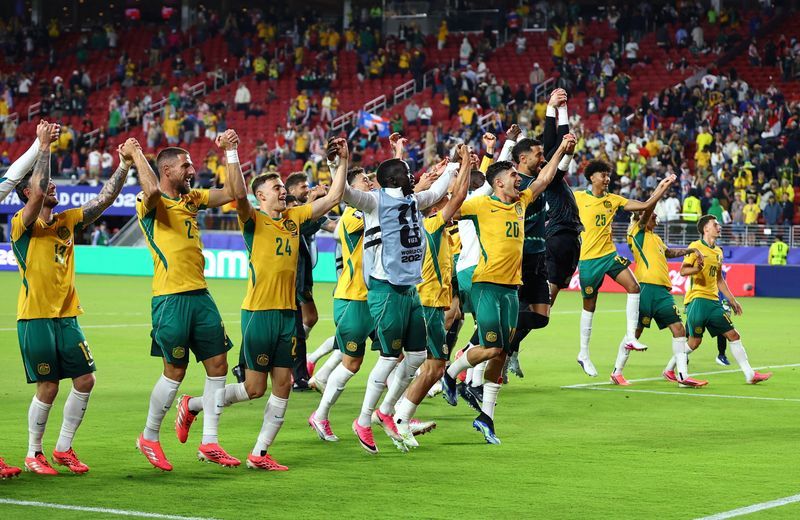
Australia booked their ticket to the knockout rounds of the Copa América on Thursday evening, grinding out a goalless stalemate against Paraguay in a tense encounter at San Francisco Bay Area Stadium in the Santa Clara region. The result sends the Socceroos through to the round of 32 for a third time in the tournament's history, building on their last knockout appearance four years earlier in Qatar. For Paraguay, however, the draw leaves their fate hanging in the balance as they await the outcome of subsequent group matches to determine whether they have accumulated enough points to progress as one of the competition's eight best-finishing third-place finishers.
Manager Tony Popovic orchestrated a significant overhaul of his starting lineup, introducing six fresh faces into the team sheet in a tactical gambit designed to inject attacking impetus. The Australian coach recalled the energetic Nestory Irankunda and incorporated Cristian Volpato into the forward configuration, signalling an intention to pursue a more aggressive approach. Alongside these changes, Jordan Bos shifted from his customary left-back berth to the right flank, a positional adjustment necessitated by the injury absence of Jacob Italiano. These alterations set the stage for an Australian side keen to impose themselves on the contest.
The opening exchanges favoured Australia's attacking ambitions, with the Socceroos fashioning several promising opportunities down their right corridor. Jackson Irvine found himself presented with an early opportunity when Volpato delivered him possession on the penalty area's flank, yet his angled strike lacked the required precision and sailed directly toward goalkeeper Orlando Gill. Subsequent efforts from Bos and Volpato generated saves from the Paraguayan shot-stopper as the first period progressed, though neither attempt genuinely stretched Gill's capabilities. Paraguay's attacking output during this opening 45 minutes proved remarkably muted, registering just a single attempt on goal as they struggled to gain a foothold in the match's rhythm.
Coach Gustavo Alfaro responded to Paraguay's sluggish first-half performance by introducing Mauricio at the interval, a Brazilian-born attacker who injected renewed energy into his side's attacking play. Within five minutes of the restart, Mauricio tested Australia's goalkeeper with an ambitious long-range effort that went astray, signalling Paraguay's intention to shift the momentum in their favour. The South Americans subsequently grew into the contest significantly, buoyed by the tireless pressing and creative work of midfielder Julio Enciso, whose constant forays through Australia's defensive lines created persistent problems for the Socceroos backline.
Enciso squandered one of Paraguay's most promising moments in the latter stages when he unleashed a low drive from promising territory that whistled well past the left post, a miss that might have altered the match's outcome. The Paraguayan midfielder's influence continued to grow as the contest progressed, his movement and incisiveness creating gaps that Australia found increasingly difficult to control. The match developed into an end-to-end affair as both teams traded attacks and transitions, with neither side capable of establishing dominance in the closing stages.
Australia's most threatening moment of the final quarter came when Bos embarked on a charging run down the right flank in the 89th minute, slipping past two defenders and driving into the penalty area before unleashing a shot that skimmed just beyond the far post. The effort nearly drew Australia's supporters to their feet, though it ultimately represented a frustratingly narrow miss. In the contest's dying moments, Mauricio threatened an equaliser when he carved out a sliver of space near the penalty box's edge, but his soft, low shot offered no genuine threat to Australian goalkeeper Thomas Beach.
Australia's passage to the knockout stage came through rather laboured execution rather than scintillating performance, a reflection of the match's overall defensive character and the caution both teams displayed throughout proceedings. The Socceroos' second-place finish in Group D positioned them against the runner-up from Group G, a section that remained genuinely open heading into Friday's deciding fixtures. Those final matches would determine whether Egypt, Iran, Belgium, and New Zealand would complete the stage's picture, with several combinations still mathematically possible.
Paraguay's position as a three-time Copa América quarter-finalist now depends on calculations extending far beyond their own performance, as their four-point haul leaves them vulnerable to elimination. The 2010 quarter-finalists must now monitor results from other groups to determine whether their tally proves sufficient to secure advancement as one of the tournament's best third-place finishers. This uncertainty stands in sharp contrast to Australia's secured progression, illustrating the precarious nature of group stage football where outcomes across multiple simultaneous encounters determine ultimate fates.
The physical, scrappy nature of Thursday's encounter reflected the high stakes at play, with neither side willing to take unnecessary risks as qualification hung in the balance. Popovic's tactical adjustments and the fresh personnel brought into his lineup indicated his confidence in pursuing victory, yet Paraguay's resolute defensive organisation ultimately frustrated Australia's attacking intentions. For Australian football supporters, the guarantee of knockout football provides relief and opportunity, though the manner of advancement suggests further refinement may be necessary if genuine progress toward the tournament's latter stages is to be achieved.

