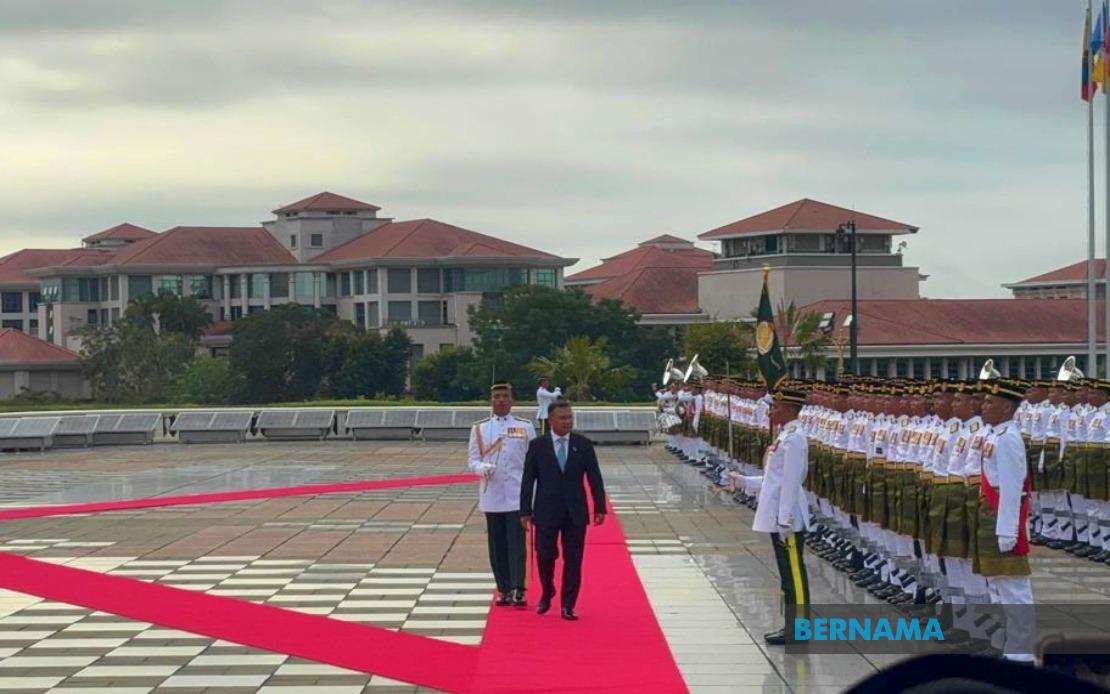
Bangladesh Prime Minister Tarique Rahman landed in Malaysia on June 22 for a two-day official state visit, arriving at Perdana Putra to a full ceremonial reception befitting his position as head of government of a major South Asian neighbour. The welcome at the Perdana Putra Complex marked the beginning of high-level engagement between two nations with deepening economic and strategic interests in the region.
Prime Minister Datuk Seri Anwar Ibrahim personally greeted Tarique upon his 9 am arrival, with both nations' national anthems performed in succession. The formality of the occasion was underscored by the inspection of a guard of honour comprising three officers and 103 personnel from the First Battalion of the Royal Ranger Regiment, commanded by Major Nur Ahmad Zaim Zahari. This ceremonial display reflected Malaysia's commitment to strengthening bilateral relations with Dhaka at the highest political level.
The reception drew Malaysia's senior political leadership, demonstrating the significance accorded to the visit. Deputy Prime Minister Datuk Seri Dr Ahmad Zahid Hamidi, Foreign Minister Datuk Seri Mohamad Hasan, Home Minister Datuk Seri Saifuddin Nasution Ismail, and Communications Minister Datuk Fahmi Fadzil were among the cabinet-level officials present. The attendance of foreign diplomats and senior government representatives further underscored the diplomatic weight of the occasion and Malaysia's positioning of Bangladesh as a priority partner within Southeast Asia's broader engagement with South Asia.
Following the ceremonial reception, Tarique signed the guest book before proceeding into substantive bilateral discussions with Anwar in a private meeting format. This one-on-one session provided space for candid discussion of bilateral priorities before the formal multilateral talks involving senior ministers and officials from both delegations. The structured progression from ceremonial formality to strategic dialogue reflects standard diplomatic protocol for state visits of this calibre.
The bilateral agenda encompasses multiple sectors reflecting the complexity and breadth of modern interstate economic relations. Trade and investment feature prominently, given Bangladesh's significance as a manufacturing and export hub. Semiconductor cooperation represents an emerging priority as both nations position themselves within global technology supply chains reshaping post-pandemic economic geography. Energy cooperation holds particular relevance given Malaysia's established hydrocarbon sector and Bangladesh's growing energy demands. Agricultural collaboration addresses food security concerns increasingly prominent in regional strategic thinking, while education partnerships build human capital and people-to-people connections essential for sustained partnership.
Trade figures illuminate the economic foundation undergirding diplomatic engagement. In 2025, bilateral commerce reached RM12.18 billion, positioning Bangladesh as Malaysia's 28th largest trading partner globally and second-largest partner within South Asia after India. This distinction reflects both the scale of Bangladesh's economy and Malaysia's pivotal role as a regional trading hub. Malaysia's exports to Bangladesh totalled RM10.08 billion, dominated by petroleum products reflecting Malaysia's competitive advantage in energy commodities and Bangladesh's substantial energy import requirements. The asymmetry in trade flow—with Malaysian exports more than four times larger than imports—suggests opportunities for Malaysian investors to deepen engagement across manufacturing and services sectors where Bangladesh offers cost advantages and expanding markets.
Bangladeshi imports to Malaysia, valued at RM2.10 billion, centre on textiles, apparel and footwear, sectors where Bangladesh possesses substantial comparative advantage through its established manufacturing infrastructure and labour-intensive production capabilities. This complementarity in bilateral trade patterns indicates natural economic synergies that could expand through targeted investment and supply chain integration. For Malaysian consumers and businesses, Bangladeshi textiles and garments represent important sourcing options within regional trade networks.
The exchange of formal agreements signals commitment to deepening institutional cooperation beyond traditional trade channels. A Memorandum of Understanding on Cultural Cooperation acknowledges the importance of people-to-people engagement and soft power dimensions of bilateral relations. Exchanges of Notes addressing counter-terrorism research and investment promotion reflect evolving security concerns and efforts to create institutional frameworks facilitating capital flows. Counter-terrorism cooperation reflects mutual interest in combating transnational security threats, while investment facilitation frameworks address practical obstacles to business engagement.
Tarique's delegation composition reveals priorities shaping the visit's substance. The presence of Dr Zubaida Rahman, his spouse, suggests importance attached to cultural and humanitarian dimensions alongside formal diplomacy. Foreign Minister Dr Khalilur Rahman's attendance indicates Bangladesh's emphasis on diplomatic coordination, while senior government officials represent sectoral expertise ranging from commerce to infrastructure. This delegation structure mirrors Malaysia's receipt protocols and reflects preparation for detailed technical discussions across government agencies.
For Malaysia and Southeast Asia, Bangladesh's trajectory carries significant implications. As South Asia's second-largest economy and home to over 170 million people, Bangladesh represents both market opportunity and competitive challenge. Its growing manufacturing capabilities particularly in textiles and readymade garments compete directly with some Malaysian industries while creating partnership possibilities in integrated supply chains. For ASEAN, Bangladesh's Observer status and deepening engagement with Southeast Asian economies positions it as an important partner in regional architecture evolution. Malaysia's cultivation of strong bilateral relations reflects recognition of Bangladesh's demographic weight, economic dynamism and strategic location at the intersection of South Asian and Southeast Asian geopolitical zones.
The visit occurs within context of broader regional recalibration following pandemic disruptions and geopolitical tensions affecting traditional trade patterns and investment flows. Both nations share interest in diversifying partnerships, reducing dependency on historical power blocs, and building resilience through expanded South-South cooperation. For Malaysian policymakers, strengthening Bangladesh ties represents diversification of Southeast Asian external engagement while creating commercial opportunities across multiple sectors aligned with Malaysia's economic transformation agenda.

