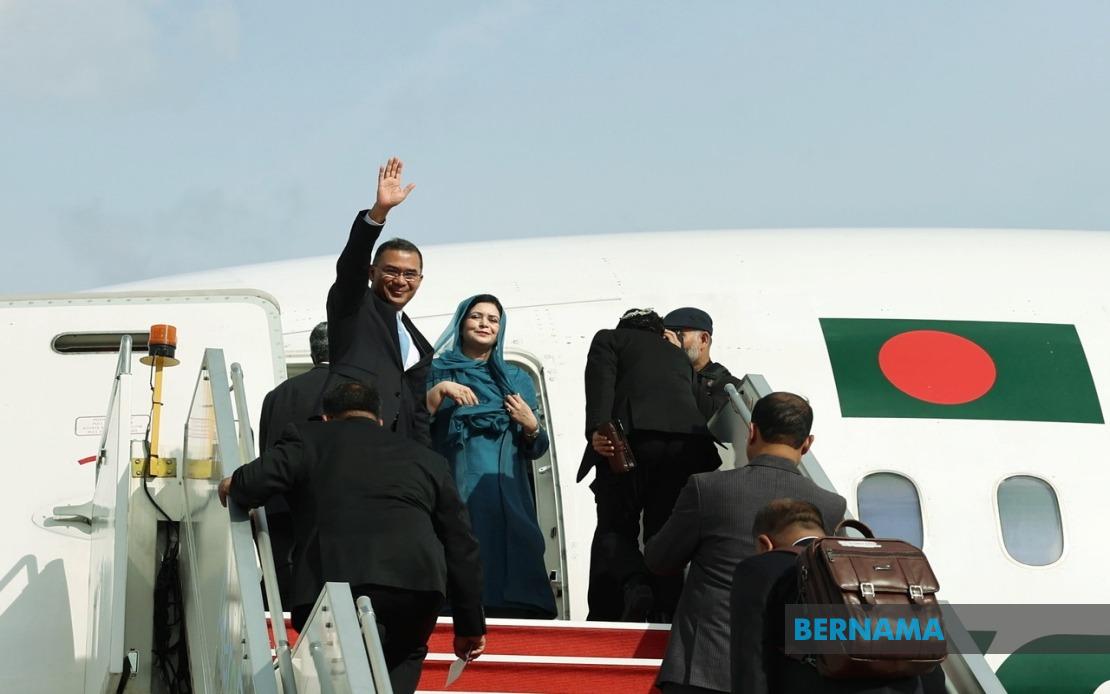
Bangladesh Prime Minister Tarique Rahman boarded a special aircraft at Kuala Lumpur International Airport on Saturday evening, concluding a landmark two-day official visit to Malaysia before continuing to China. The departure, which took place at 5 pm from the Bunga Raya Complex at KLIA, was marked by formal ceremonial honours including a 28-member guard of honour from the First Battalion of the Royal Ranger Regiment. Minister in the Prime Minister's Department Dr Zulkifli Hasan attended the farewell ceremony alongside Tarique's spouse Dr Zubaida Rahman and members of the Bangladeshi delegation.
The visit represented Tarique's first bilateral official journey abroad since taking office in February 2026, underscoring Malaysia's strategic importance to Bangladesh's new administration. During his stay, Tarique held substantive discussions with Prime Minister Datuk Seri Anwar Ibrahim at the Perdana Putra Complex, where the two leaders examined pressing regional and global matters affecting their respective nations and the wider Indo-Pacific region. These conversations reflected an effort to align positions on interconnected challenges while identifying fresh opportunities for mutual benefit.
Economic partnership emerged as a centrepiece of the bilateral engagement. Both governments have committed to accelerating negotiations on a fast-track free trade agreement, a significant step that signals intention to deepen commercial ties beyond existing frameworks. The discussions encompassed critical growth sectors including semiconductors, energy production, agriculture, human resource development and education, reflecting recognition that Malaysia and Bangladesh possess complementary economic strengths. Malaysia's technological and manufacturing capabilities align well with Bangladesh's emerging industrial ambitions, while Bangladesh offers Malaysia access to a large consumer base and labour pool in South Asia.
The nations formalised several cooperative frameworks during the visit. A Memorandum of Understanding on Cultural Cooperation was signed, establishing mechanisms for deeper people-to-people engagement through academic, artistic and cultural exchanges. Additionally, two Exchanges of Notes were concluded addressing Counter-Terrorism Research and Investment Promotion and Facilitation, areas critical to both nations' security and economic development agendas. These instruments provide structured pathways for sustained collaboration rather than one-off initiatives.
Bangladesh's regional aspirations featured prominently in discussions. Tarique restated his country's determination to achieve ASEAN Sectoral Dialogue Partner status, a classification that would grant Dhaka enhanced voice in regional decision-making forums without full membership obligations. Bangladesh has also signalled strong interest in joining the Regional Comprehensive Economic Partnership, positioning itself within the expansive trade architecture reshaping Asian commerce. Malaysia, as an established ASEAN member and RCEP signatory, can facilitate these ambitions through its diplomatic channels and institutional knowledge.
The halal industry represents an emerging economic frontier for both nations. Malaysia's well-developed halal certification, logistics and branding ecosystem contrasts with Bangladesh's status as a major producer of halal-compliant goods and agricultural inputs. Strategic cooperation in this sector could position both countries as anchors within global halal supply chains, a market growing at double-digit rates annually. Energy sector collaboration similarly holds promise, with Bangladesh seeking to diversify its energy sources and Malaysia possessing experience in petroleum refining, liquefied natural gas operations and renewable energy development.
On the geopolitical stage, Anwar and Tarique discovered substantial alignment regarding global crises. Both nations reiterated unwavering support for the Palestinian cause and expressed grave concern over humanitarian conditions in Gaza. They pledged to pursue diplomatic efforts aimed at achieving durable peace in the Persian Gulf and broader Middle East, reflecting shared Muslim majority nation perspectives on regional security architecture. This convergence on global issues suggests potential for coordinated advocacy within the United Nations and other multilateral bodies.
The Rohingya refugee situation, which directly affects both nations, emerged as an area requiring sustained multilateral engagement. Malaysia hosts the world's largest displaced Rohingya population, numbering over 900,000 individuals, while Bangladesh shelters approximately 900,000 additional refugees, predominantly in sprawling camps in Cox's Bazar. Both leaders acknowledged that resolution demands sustained dialogue with Myanmar authorities through ASEAN mechanisms, though such efforts have yielded limited progress given Myanmar's current political circumstances. The commitment to strengthen cooperation through regional architecture suggests both nations recognise that unilateral approaches have reached their limits.
Bilateral trade statistics underline the growing commercial relationship's significance. During 2025, two-way commerce totalled RM12.18 billion, with Malaysian exports accounting for RM10.08 billion and predominantly comprising petroleum products. Bangladesh contributed RM2.10 billion in imports, primarily textiles, apparel and footwear that reflect its manufacturing strengths. Within the South Asian context, Bangladesh ranks as Malaysia's second-largest trading partner after India, indicating the relationship's maturity and potential for expansion through the proposed free trade agreement.
The timing of Tarique's visit carries strategic weight within broader regional dynamics. His government has signalled orientation toward constructive engagement with neighbouring nations and enhanced integration within Asian economic frameworks. Malaysia, similarly positioned as a bridge between Southeast Asia and South Asia, sees in Bangladesh a valuable partner for expanding its commercial footprint southwestward. The proposed fast-track free trade agreement would likely accelerate this process, potentially establishing bilateral commerce as a model for ASEAN-South Asia engagement.
Looking forward, the substantive nature of commitments made during this visit suggests that bilateral relations have moved beyond ceremonial diplomacy into pragmatic cooperation addressing concrete economic and security concerns. The scheduled fast-track free trade agreement negotiations should commence within defined timeframes, while the cultural cooperation framework and counter-terrorism research exchanges provide immediate mechanisms for deepening ties. Bangladesh's pursuit of enhanced ASEAN engagement aligns with Malaysia's interest in strengthening the association's connectivity with South Asia, creating complementary objectives.

