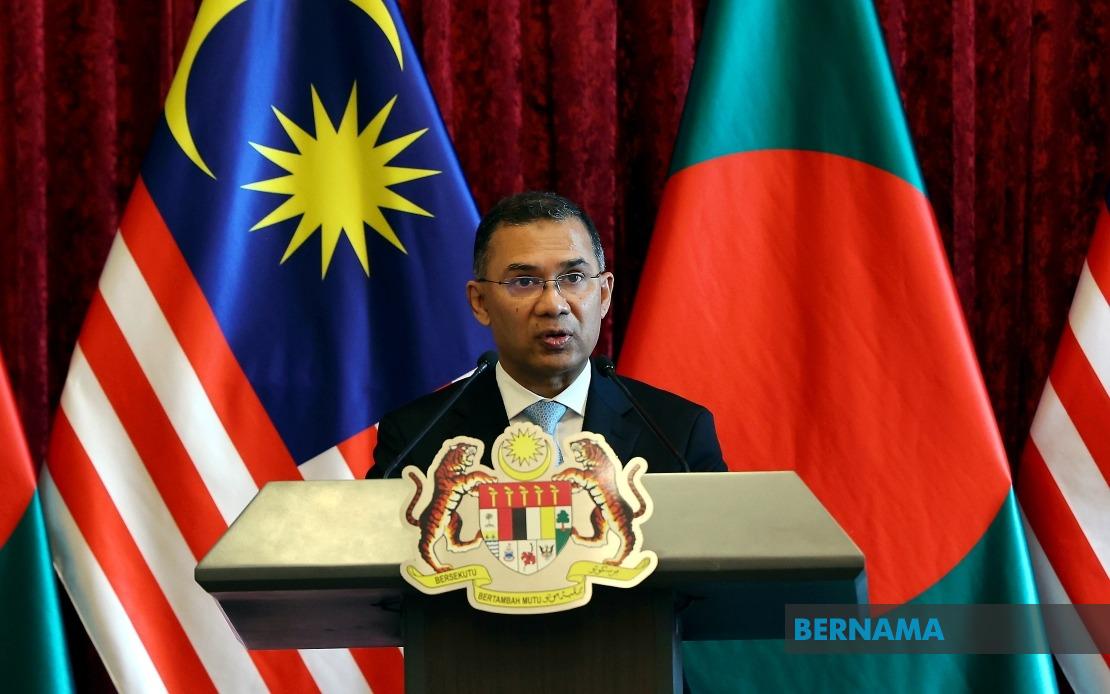
Bangladesh Prime Minister Tarique Rahman used his first overseas bilateral visit since taking office in February to reaffirm his country's commitment to strengthening relations with Malaysia, signalling that regional partnerships remain a priority for Dhaka's new administration. Speaking alongside Malaysian Prime Minister Datuk Seri Anwar Ibrahim at a joint press conference in Putrajaya on Monday, Tarique outlined plans to intensify engagement through established diplomatic channels and new frameworks of cooperation, underscoring the strategic importance both nations attach to their bilateral relationship.
The two leaders witnessed the formal signing of three key agreements designed to broaden the scope of partnership beyond traditional trade and investment channels. A Memorandum of Understanding on Cultural Cooperation was exchanged, alongside two Exchanges of Notes addressing Counter-Terrorism Research and Investment Promotion and Facilitation. These instruments reflect a deliberate effort by both governments to anchor their relationship across multiple dimensions, moving beyond transactional dealings to build institutional foundations that can withstand political transitions and external pressures.
Tarique's two-day visit, undertaken at Anwar's invitation, carries particular significance as his first official bilateral journey abroad following his assumption of the prime ministerial office. The choice to visit Malaysia demonstrates Dhaka's recognition that ties with a major Southeast Asian economy and fellow Muslim-majority nation warrant immediate diplomatic attention. For Malaysia, the visit represents an opportunity to deepen engagement with a South Asian partner at a moment when regional geopolitics are shifting, particularly regarding China's expanding influence and India's continued regional assertiveness.
Both leaders committed to leveraging existing institutional mechanisms to sustain momentum in their bilateral relationship. Tarique and Anwar agreed to enhance consultations through joint commission meetings and regular dialogue between their foreign ministers, recognising that formalised channels are essential for managing the complexities of a multi-faceted partnership. Such mechanisms provide structured opportunities for senior officials to address irritants, coordinate positions on shared concerns, and identify new areas of mutual benefit without requiring high-level political intervention for routine matters.
The bilateral economic relationship has expanded substantially in recent years, with two-way trade reaching RM12.18 billion in 2025, equivalent to approximately US$2.84 billion. This volume reflects Bangladesh's growing economic weight and Malaysia's position as a significant source of raw materials and energy products for South Asian markets. Malaysian exports to Bangladesh totalled RM10.08 billion, driven predominantly by petroleum products that supply Bangladesh's energy-intensive industries and growing power generation sector. The composition of Malaysian shipments underscores Bangladesh's reliance on fossil fuel imports to fuel its manufacturing-led development model.
For Malaysia, Bangladesh represents an increasingly important market within South Asia, ranking as the nation's second-largest trading partner in the region after India, with a significantly smaller overall trade footprint than New Delhi but representing vital market diversification opportunities. Malaysian imports from Bangladesh amounted to RM2.10 billion in 2025, comprised mainly of textiles, apparel, and footwear products that reflect Bangladesh's specialisation in labour-intensive manufacturing. These sectors employ millions of Bangladeshi workers and generate substantial foreign exchange, making market access and trade facilitation critical priorities for the Dhaka government.
At the global level, Bangladesh occupies the position of Malaysia's 28th largest trading partner, a ranking that understates the importance of the relationship for Bangladesh given Malaysia's superior economic weight and its role as a developed Southeast Asian economy. The disparity in relative importance—significant for Bangladesh but more modest for Malaysia—suggests scope for Malaysian businesses to expand their presence in Bangladesh's growing consumer market, where rising incomes and demographic dividends are creating new commercial opportunities across multiple sectors.
The two leaders also discussed global developments, particularly the ongoing situation in West Asia, where both Muslim-majority nations have significant stakes in regional stability and the Israeli-Palestinian question. By exchanging views on these sensitive matters, both governments demonstrated their desire to coordinate diplomatic approaches on issues where Islamic bloc consensus can amplify policy impact within international forums. Such consultations are particularly valuable for smaller economies seeking to punch above their weight through coalition-building and coordinated messaging.
Tarique specifically acknowledged Malaysia's support for Bangladesh's candidature for the presidency of the 81st session of the United Nations General Assembly, a position that rotates annually and represents recognition and prestige within the international community. Malaysia's backing carries weight within ASEAN and among Islamic Conference members, lending credibility to Bangladesh's candidacy and demonstrating substantive support beyond mere diplomatic courtesy. This gesture reflects the depth of bilateral understanding and mutual respect between the two governments.
The emphasis on United Nations cooperation and international engagement suggests both countries view their bilateral relationship as a platform for advancing broader regional and global objectives. By working together within multilateral institutions, Bangladesh and Malaysia can amplify their voices on development financing, climate action, migration management, and security challenges that affect both nations. The commitment to enhanced cooperation on shared interests signals an understanding that bilateral relations are strengthened when anchored to larger strategic purposes.
For Southeast Asia and South Asia more broadly, the deepening of Bangladesh-Malaysia ties carries implications for regional balance and connectivity. Bangladesh, as the world's most populous Muslim-majority nation after Indonesia and Pakistan, brings significant diplomatic weight and demographic influence to its partnerships. Malaysia's position as a developed ASEAN member and gateway to Southeast Asian markets makes it an attractive partner for Bangladesh's economic engagement strategy and regional diplomatic ambitions.
The visit also reflects the broader pattern of enhanced South Asia-Southeast Asia engagement, sometimes termed BIMSTEC (Bangladesh, India, Myanmar, Sri Lanka, Thailand, Bhutan, Nepal) cooperation, though bilateral channels often prove more productive than multilateral frameworks. As Bangladesh manages complex relationships with India, Myanmar, and China, cultivating strong ties with ASEAN members like Malaysia provides strategic flexibility and diversified partnerships that reduce dependence on any single regional power.

