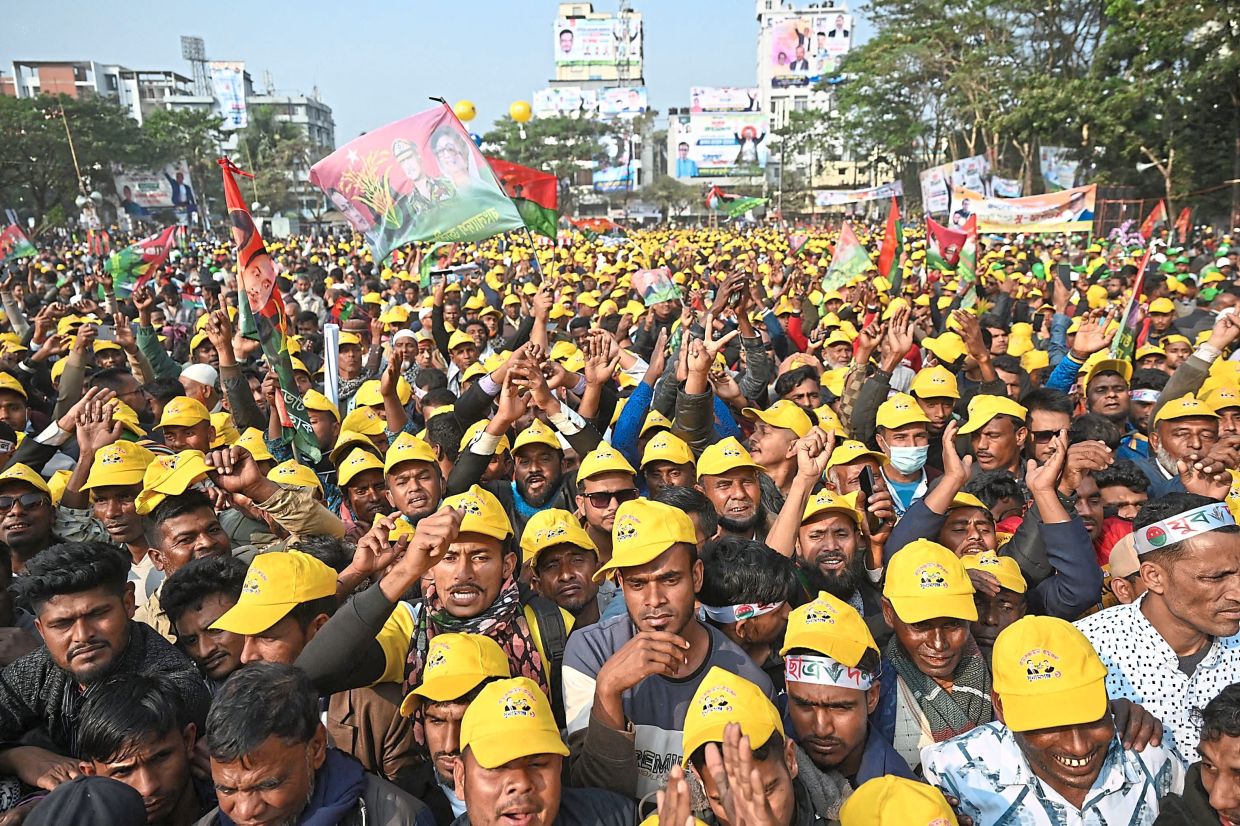
Bangladesh's parliament will formally elect a new president on Thursday afternoon, with the ruling Bangladesh Nationalist Party's Mirza Fakhrul Islam Alamgir widely expected to secure the largely ceremonial role unopposed in practical terms. At 78 years old, Alamgir serves as both the BNP's secretary general and local government minister, positioning him as Prime Minister Tarique Rahman's favoured successor to the presidency, a five-year post that traditionally carries significant symbolic weight despite limited executive powers in Bangladesh's parliamentary system.
Alamgir has expressed humility about his impending elevation, telling reporters that the nomination represents "the infinite grace of the party and almighty Allah". His statement reflects the custom in Bangladeshi politics of combining religious acknowledgment with expressions of party loyalty. Beyond assuming the presidency, Alamgir has signalled his intention to maintain connection with ordinary citizens, pledging to continue serving the people despite his move to a more elevated constitutional position. This rhetoric echoes the populist language that has characterised much of Bangladesh's recent political discourse, particularly as the nation attempts to rebuild institutional trust following significant upheaval.
The presidential election takes place within a transformed political landscape in Bangladesh. Prime Minister Rahman's BNP achieved a decisive electoral victory in February of this year, marking the first competitive national polling since the revolution that swept away Sheikh Hasina's government in 2024. That electoral triumph provides Rahman's administration with substantial legitimacy and political capital as it consolidates power across state institutions. The BNP's landslide result reflected public dissatisfaction with Hasina's governance and signalled voter appetite for the party's promised vision of renewal and democratic governance.
Alamgir's ascension to the presidency represents continuity within BNP ranks and rewards his instrumental role in maintaining the party's organisational coherence during the extraordinarily difficult period when Hasina's administration wielded near-absolute power. While BNP leader Khaleda Zia languished in prison and her son Rahman lived in exile during the Hasina years, Alamgir managed to preserve the party's institutional structures and political relevance. This sustained organisational work, even in severely constrained circumstances, has earned him recognition within BNP circles as a keeper of the party flame during its darkest hours.
The previous president, Mohammed Shahabuddin, stepped down in July after serving only one year of his expected five-year term. Shahabuddin, a 76-year-old close associate of Hasina, had come under mounting pressure to resign, ultimately citing deteriorating health as his justification for abandoning his presidential duties. His early departure cleared the path for the BNP to install one of its own in the position, fundamentally altering the institutional balance that Hasina had carefully constructed during her lengthy tenure in office. The pressure on Shahabuddin reflected broader demands from multiple constituencies that figures closely identified with the previous administration should yield to representatives of the new political order.
Almostir's primary opponent in Thursday's parliamentary vote is Oli Ahmed, the opposition candidate nominated by an 11-party alliance spearheaded by Jamaat-e-Islami. While Ahmed's nomination ensures the presidential election retains a formal competitive element, political observers widely anticipate that Alamgir will command overwhelming parliamentary support given the BNP's commanding legislative majority. The parliamentary voting mechanism means that Alamgir's victory is substantively predetermined, though the ceremonial aspects of the electoral process will proceed as scheduled, likely commencing around 2pm Bangladesh Standard Time.
Alamgir's political biography reflects the trajectory of many senior figures in South Asian politics who came of age during moments of acute national struggle. Born in January 1948, he first entered political consciousness as a student leader during the 1969 uprising against Pakistan's military rule, participating in the mass movements that ultimately created space for Bangladesh's independence struggle in 1971. After completing his economics studies at Dhaka University, he initially pursued an academic career, teaching the discipline before transitioning into government service and subsequently into elected politics. His ministerial experience encompassed portfolios as diverse as agriculture, aviation, and tourism, providing him with administrative exposure across multiple policy domains.
However, Alamgir's greatest prominence emerged through his opposition work during Hasina's authoritarian interregnum, when institutional power became highly concentrated. With Khaleda Zia incarcerated and unable to lead the party directly, and with Rahman barred from operating within Bangladesh, Alamgir emerged as a visible and resilient BNP representative who maintained the party's public presence despite relentless harassment. He endured repeated arrests on charges that observers widely characterised as politically motivated and without genuine legal foundation. This sustained persecution, paradoxically, elevated Alamgir's stature within anti-Hasina circles and among those who viewed the BNP as victims of systematic state oppression.
The broader significance of Alamgir's election extends beyond the ceremonial trappings of the presidency itself. His assumption of the role signals that Bangladesh's transitional leadership is consciously integrating figures who personified resistance to the previous regime. For Malaysian and other Southeast Asian observers, Alamgir's elevation illustrates how regional democracies rebuild institutional legitimacy following systemic crises by promoting individuals identified with accountability movements and with institutional continuity amidst upheaval. The BNP's strategic choice to elevate Alamgir reflects calculated decisions about how to consolidate power while maintaining appearances of broad stakeholder engagement across the political spectrum.
Alamgir's personal circumstances reveal the marked pragmatism of contemporary Bangladeshi politics. He is married to Rahat Ara Begum, a retired financial administrator, and they have two daughters. His family background in professional and administrative service provides some counterweight to the armed struggle narratives that dominate Bengali political mythology. This relatively modest biographical profile, combined with his longevity within party structures and his visible endurance of persecution, positions Alamgir as an acceptable compromise candidate across different BNP constituencies and potentially reassuring to broader publics concerned about how far the party intends to advance ideologically ambitious agendas.
The timing of Alamgir's election also reflects Bangladesh's broader institutional calendar and the BNP's desire to consolidate symbolic authority across all branches of government. By securing the presidency through parliamentary mechanisms, the Rahman administration extends its control over the ceremonial apparatus of state power while simultaneously neutralising any potential independent platform that a rival-party president might have provided. For Southeast Asian analysts monitoring Bangladesh's democratic trajectory, Alamgir's election represents one indicator among many of how rapidly the BNP intends to translate its February electoral victory into comprehensive institutional dominance, raising ongoing questions about whether space remains for meaningful political competition and contestation in coming years.

