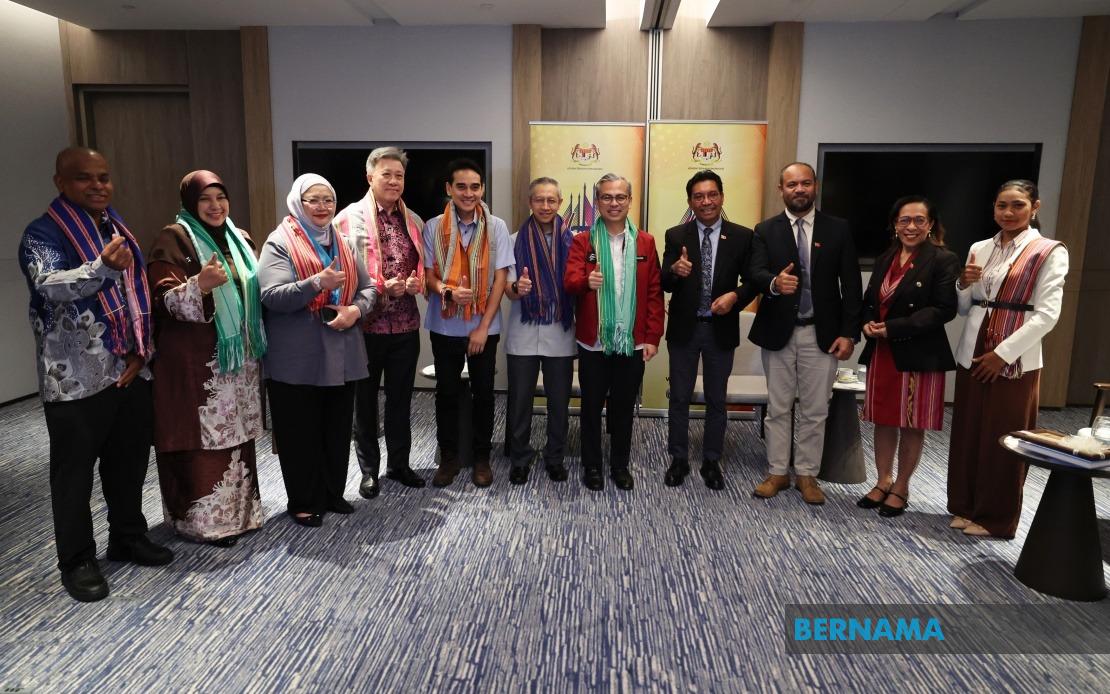
Malaysia's Bernama and Timor-Leste's national news agency TATOLI have cemented their commitment to regional media collaboration through a memorandum of understanding signed at the National Journalists' Day celebration in Butterworth on June 20. The agreement represents a significant step in fostering deeper ties between the two ASEAN member states, with implications for how news and information flow throughout Southeast Asia's media landscape. By establishing formal channels for content exchange and professional development, both agencies are positioning themselves to play a more influential role in shaping regional narratives and ensuring that voices from smaller nations are amplified on larger platforms.
The partnership encompasses several key dimensions that extend beyond simple news sharing. Bernama will distribute its reporting across TATOLI's platforms in four languages—Tetum, Portuguese, Bahasa Indonesia, and English—ensuring that Timorese audiences gain direct exposure to Malaysian perspectives and developments. This multilingual approach acknowledges the linguistic diversity of Timor-Leste's population and the broader Portuguese-speaking communities that remain culturally significant following the nation's independence from Indonesia. The arrangement also creates a reciprocal benefit, as Bernama intends to expand its own language offerings to include Portuguese, thereby reaching diaspora communities and Portuguese-speaking regions globally.
Datin Paduka Nur-ul Afida Kamaludin, Bernama's Chief Executive Officer, emphasised that the collaboration strengthens the agency's regional and global standing while ensuring that ASEAN's collective voice remains shaped by its own media institutions rather than external actors. In an era when international news agencies have traditionally dominated global information flows, this commitment to intra-regional cooperation takes on heightened importance. By pooling resources and sharing content, smaller and emerging news agencies like TATOLI gain capacity and reach they might otherwise struggle to achieve independently, while established agencies like Bernama benefit from expanded influence and relevance across the region.
A crucial element of the partnership involves professional capacity building. Bernama has committed to conducting training programmes for TATOLI journalists before the end of the year, drawing on more than two decades of experience in journalism education. The Malaysian agency operates the Bernama School of Journalism and maintains the Bernama Excellence Centre, institutions that have developed expertise across multiple platforms including online news, television, digital media, radio, and photography. This transfer of knowledge represents a tangible investment in raising professional standards across the region's news organisations, directly addressing quality and credibility concerns that affect public trust in media throughout Southeast Asia.
The timing of this agreement carries particular significance given that Timor-Leste officially joined ASEAN in October 2025, making it the bloc's eleventh member state. Bernama's willingness to engage in this partnership reflects a strategic recognition that Timor-Leste's integration into ASEAN creates new opportunities for regional media development and coordination. The Southeast Asian bloc has long grappled with questions about how to project unified messaging while respecting national sovereignty and editorial independence—a delicate balance that bilateral agreements like this one help navigate.
TATOLI President Noémio Mateus Soares Falcão articulated a vision of cooperation grounded in shared professional values. He emphasised that partnership between news agencies can strengthen journalists' professional capacity, drive innovation in media sectors, and contribute to the development of media environments characterised by freedom, responsibility, and public benefit. Falcão's remarks underscore a growing recognition across Southeast Asia that media cooperation need not compromise editorial independence when built on foundations of mutual respect and shared commitment to journalistic principles.
A critical theme underlying this partnership is the challenge of combating misinformation in an age of rapid digital dissemination. Both Bernama and TATOLI leaders acknowledged that information now travels instantly across multiple platforms, creating unprecedented challenges for maintaining accuracy and professional standards. When news flows through multiple agencies and reaches audiences via diverse channels, the responsibility for verification and factual reporting becomes distributed across a network of institutions. This partnership suggests that regional news agencies recognise they must work collaboratively to establish and maintain professional standards that can compete with the speed and reach of unverified social media content.
The ceremonial aspects of the agreement signing underscore its political importance. Communication Minister Datuk Fahmi Fadzil and Timor-Leste's Secretary of State for Social Communication Expedito Loro Dias Ximenes officiated the exchange, while Prime Minister Datuk Seri Anwar Ibrahim witnessed the occasion. This high-level participation signals that media cooperation forms part of broader bilateral relations between Malaysia and Timor-Leste, and that ASEAN governments recognise media development as central to regional stability and integration.
Bernama itself carries significant historical weight as Malaysia's national news agency, established under parliamentary act in 1967 and formally launched during the nation's tenth independence anniversary. The agency has evolved over five decades to serve as a primary conduit for official Malaysian narratives globally. TATOLI, established much more recently in 2016, carries the responsibility of disseminating official government information for a young nation still consolidating its post-independence institutions. The partnership thus brings together agencies operating at different scales and stages of institutional maturity, creating opportunities for mentorship and knowledge transfer.
The multilingual dimension of this cooperation reflects practical realities about how information circulates in Southeast Asia. Bernama currently reports in six languages—Bahasa Melayu, English, Tamil, Mandarin, Arabic, and Spanish—reaching audiences far beyond Malaysia's borders. The addition of Portuguese through this partnership represents a conscious expansion into linguistic communities historically connected to the region but often underserved by contemporary Southeast Asian media. This linguistic strategy recognises that effective regional communication requires meeting audiences where they are, linguistically and culturally.
The presence of representatives from Cambodia and Laos at the HAWANA 2026 celebration indicates that the Bernama-TATOLI partnership exists within a broader framework of ASEAN media cooperation. Regional forums that bring together media practitioners, government officials, and news agency leaders create opportunities for identifying common challenges and developing collective solutions. The annual National Journalists' Day celebration provides an institutional platform for advancing these conversations and formalising arrangements that might otherwise remain informal or ad hoc.
For Malaysian readers and media professionals, this partnership offers both competitive and collaborative implications. Domestically, it positions Bernama as a regional leader in journalism training and news production, enhancing its profile and influence. For Malaysian journalists, it creates potential opportunities for professional development and exposure to colleagues across ASEAN. The partnership also signals Malaysia's continued commitment to regional leadership in media development and professional standards, reinforcing its position as a media hub within Southeast Asia.
Looking forward, the success of this partnership will depend on consistent implementation and genuine commitment from both agencies to knowledge sharing and mutual benefit. Initial training programmes scheduled for TATOLI journalists will provide an important test of whether institutional cooperation translates into measurable improvements in journalistic capacity and news quality. As ASEAN continues to deepen integration across multiple sectors, media cooperation arrangements like this one may serve as models for expanding professional networks and standards throughout the region, ultimately contributing to a more credible and regionally-centred information ecosystem.

