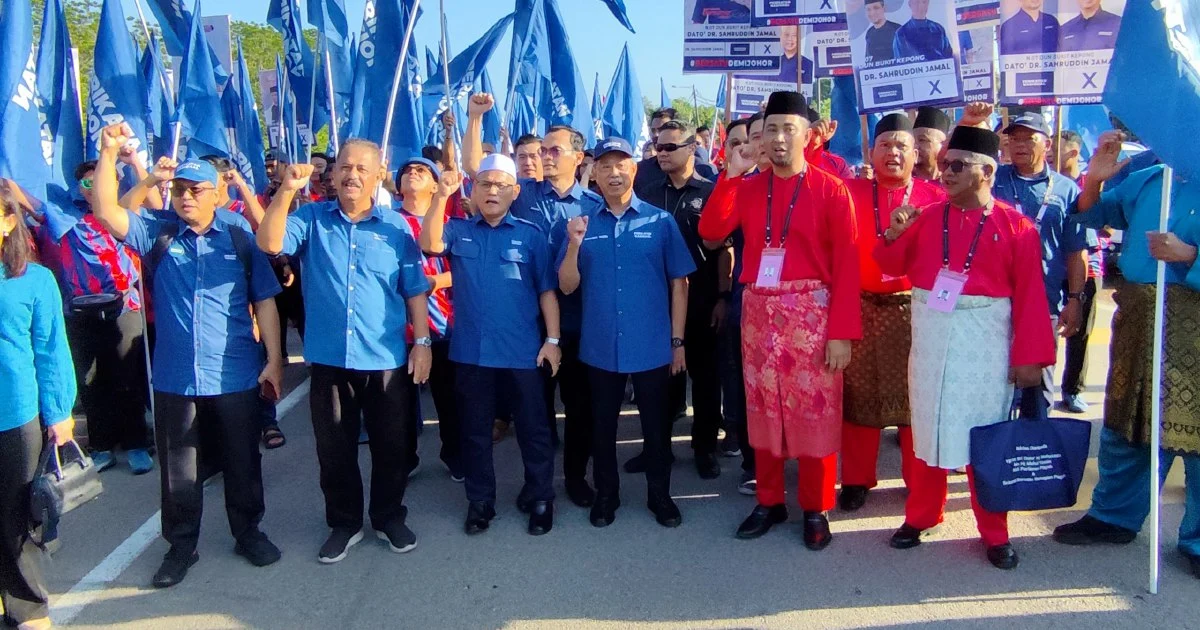
Bersatu president Tan Sri Muhyiddin Yassin made an early appearance at the nomination centre in Pagoh on Tuesday morning, arriving at 8.45 am to accompany his party's candidate Sahruddin in the crucial Bukit Kepong contest during the ongoing Johor state election. The timing and presence of the party president underscores the significance Bersatu places on this particular contest, with senior leadership mobilising to ensure smooth proceedings and demonstrate party unity ahead of voting day.
The Pagoh Sports Complex Hall served as the official nomination venue, drawing party representatives, supporters, and media attention as candidates formally registered their candidacy. Muhyiddin's physical presence alongside Sahruddin signals the internal party backing the contender enjoys, a critical indicator in Malaysian state elections where leadership endorsement can influence voter perception and grassroots momentum.
Bukit Kepong represents a strategically important battleground in the broader Johor electoral landscape. The constituency's composition and voting patterns have traditionally reflected the state's political dynamics, making it a bellwether seat that analysts monitor closely. Bersatu's determination to field a competitive candidate and marshal senior party figures suggests the party views this seat as winnable, despite the intensely competitive nature of Johor politics where multiple coalitions vie for dominance.
Muhyiddin's active involvement in candidate nomination events reflects his hands-on approach to party management since assuming the Bersatu presidency. Rather than delegating nomination-day activities to party machinery alone, the former Prime Minister has frequently appeared at nomination centres across contested seats, a strategy designed to energise party members and project confidence in the party's electoral prospects to the voting public.
The Johor state election itself represents a significant political contest within Malaysia's broader political calendar. As the country's second-most populous state and a traditional bastion of Umno support, Johor's electoral outcome carries ripple effects beyond state-level governance, influencing national coalition dynamics and shifting power balances between competing political blocs. Bersatu's performance in Johor will substantially affect the party's positioning within the broader political ecosystem.
Sahruddin's candidacy in Bukit Kepong places the party's electoral strategy under scrutiny. The choice of candidates in each constituency reflects party leadership's assessment of viable winning combinations, factoring in local political dynamics, incumbent performance, and community sentiment. Muhyiddin's accompaniment on nomination day serves as a confidence signal to party machinery that central leadership is invested in this particular contest's success.
The election itself occurs within a fluid political environment where coalition alliances continue evolving. Bersatu's positioning within the Perikatan Nasional coalition and its strategic calculations regarding cooperation with other opposition parties shapes how the party approaches individual contests. Bukit Kepong therefore represents not merely a local election but a microcosm of larger coalition politics playing out across the state.
For Malaysian observers and political analysts, nomination-day activities provide crucial intelligence about party strategy, resource allocation, and leadership priorities. The prominence of high-ranking figures at specific nomination centres indicates which seats party strategists consider must-win constituencies, where either defending an existing seat or capturing opposition-held territory aligns with broader electoral objectives.
The Pagoh nomination centre's significance extends beyond its administrative function. As a major population and commercial centre in Johor, Pagoh commands media attention and serves as a focal point for political reporting. Muhyiddin's presence there guarantees media coverage amplifying the nomination message to broader audiences, extending political messaging beyond the immediate venue to voters throughout the constituency.
Bersatu's electoral fortunes in Johor carry particular weight given the party's relatively recent formation and ongoing efforts to establish itself as a significant political force. Each state election provides opportunities for the party to demonstrate viability and build electoral credibility. Strong performances boost party morale and attract new supporters, while disappointing results test party cohesion and member confidence in leadership direction.
The dynamics of Johor electoral contests have historically proven unpredictable, with voter sentiment shifting based on personality factors, local governance performance, and national political currents. Bersatu's navigation of these complexities demonstrates the party's recognition that systematic engagement with constituency-level campaigns, evidenced by leadership participation in nomination proceedings, remains essential for competitive electoral performance.
As voting approaches, the intensity of campaign activities will escalate across Johor. Muhyiddin's early mobilisation suggests Bersatu intends to maintain momentum through nomination and into the campaign phase, ensuring consistent party presence and candidate visibility throughout the electoral contest. The outcome in Bukit Kepong and across Johor will substantially influence Bersatu's political trajectory and coalition positioning in Malaysian politics.

