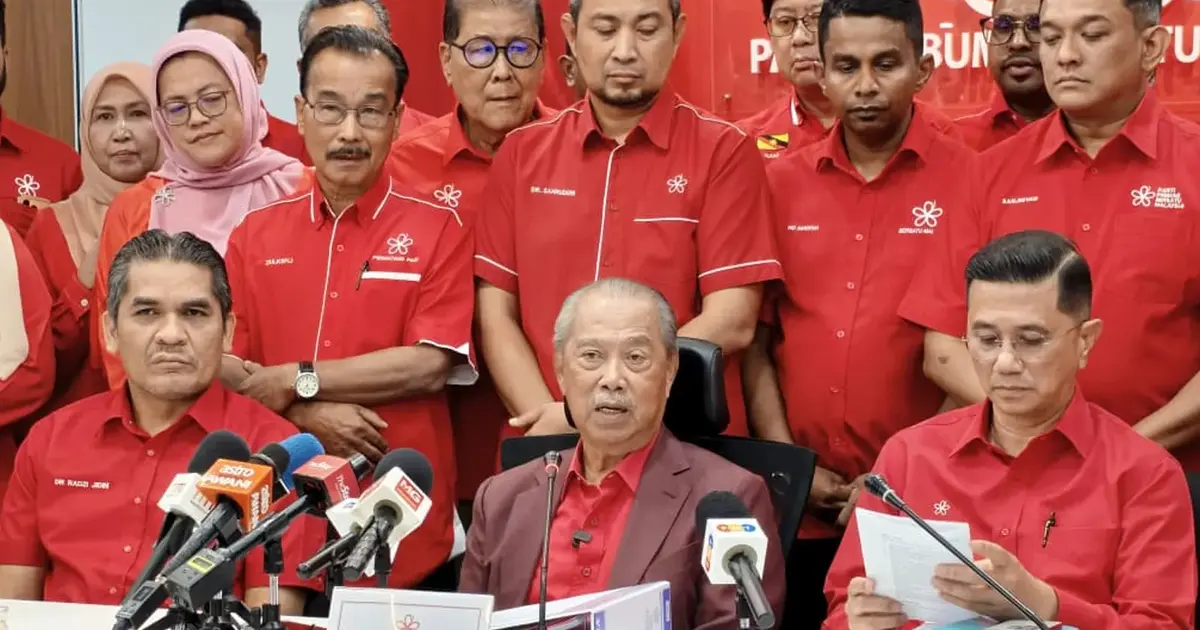
Bersatu president Muhyiddin Yassin has reaffirmed the party's unwavering commitment to the Perikatan Nasional coalition, signalling stability within an alliance that has faced considerable scrutiny since the 2022 general election. The declaration comes as speculation swirls about potential shifts in Malaysia's fractious political landscape, with various parties reassessing their alliances and positioning ahead of what observers believe could be significant electoral changes in the coming years.
Muhyiddin grounded his assertion in what he characterises as substantial public acceptance of the Perikatan Nasional framework. This rationale reflects a broader strategic calculation: that Bersatu's electoral fortunes and political viability are best served by remaining embedded within the coalition rather than pursuing an independent path or exploring alternative alignments. The statement serves as both an internal signal to party members and an external message to coalition partners about Bersatu's stability and reliability.
The timing of this reaffirmation is significant. Malaysia's political environment has grown increasingly fluid since the 2022 elections, with shifting dynamics between Barisan Nasional, Perikatan Nasional, Pakatan Harapan, and various independent factions creating multiple permutations for future government formations. Within this context, explicit commitments from coalition partners become crucial anchors for political planning and electoral strategy.
Bersatu's position within Perikatan Nasional carries particular weight given the party's outsized influence relative to its parliamentary representation. As a relatively newer political entity formed in 2016, Bersatu has nonetheless punched above its weight through its appeal to Malay-Muslim voters and its ability to negotiate for ministerial positions and political leverage. The party's decision to remain committed to Perikatan Nasional therefore carries implications for the entire coalition's cohesion and electoral prospects.
The invocation of public acceptance as a justification for remaining in the coalition reflects a broader trend in Malaysian politics: the increasing importance of populist legitimacy claims alongside institutional party politics. Muhyiddin's framing suggests that Bersatu views its coalition membership not merely as a transactional political arrangement but as an expression of voter preferences and public sentiment. This rhetorical strategy attempts to elevate the coalition beyond its sometimes opportunistic origins and rebrand it as a legitimate expression of the electorate's will.
For Perikatan Nasional itself, Bersatu's confirmation provides crucial reassurance to other members and supporters. The coalition, which includes PAS and various Sabah and Sarawak parties, depends on its perceived stability to maintain voter confidence and internal discipline. Any suggestion that major coalition members were reconsidering their commitments could trigger cascading defections and undermine the alliance's credibility as a potential government-in-waiting.
Regionally, Bersatu's decision resonates across Southeast Asia's broader political landscape. Malaysia's coalition politics remain closely watched by observers in Singapore, Thailand, Indonesia, and the Philippines, where comparable questions about political alliances, party loyalty, and democratic stability generate intense domestic debates. Bersatu's commitment to Perikatan Nasional thus contributes to narratives about whether centrist political arrangements can survive in Southeast Asia's increasingly polarised environment.
The statement also carries implications for Malaysian governance dynamics and the balance of power between competing political forces. Should Perikatan Nasional eventually return to federal power, Bersatu's early reaffirmation of commitment strengthens its position for negotiating cabinet portfolios, ministerial appointments, and policy priorities. Conversely, this explicit loyalty also constrains the party's negotiating flexibility and could expose it to criticism from voters who perceive it as lacking independence or principled conviction.
Bersatu's base, particularly in rural Malay-Muslim communities and among grassroots party organisations, will likely interpret Muhyiddin's statement as a sign of strong leadership and strategic clarity. However, the party also faces potential criticism from more reform-oriented supporters who may view Perikatan Nasional's association with PAS as ideologically incompatible with Bersatu's earlier positioning as a progressive-leaning alternative. Managing these internal expectations while maintaining coalition unity represents an ongoing challenge for party leadership.
Looking forward, Muhyiddin's commitment suggests that Bersatu has calculated its electoral prospects are stronger within Perikatan Nasional than outside it. This assessment likely reflects polling data, feedback from grassroots organisers, and strategic analysis of voter distribution across Malaysian constituencies. Whether this calculation proves accurate will become clearer as Malaysia approaches its next round of state elections and eventually federal polls, which observers expect could occur within the next two to three years.
The broader significance of Bersatu's stance extends to questions about Malaysian democracy's structural stability. Coalition politics, while often criticised as opportunistic, actually provide essential mechanisms for building governing majorities and forcing parties toward compromise and negotiation. Bersatu's commitment to Perikatan Nasional, framed around public acceptance and democratic legitimacy, contributes to this broader democratic architecture by creating predictability and encouraging voters to make informed choices based on relatively stable political alignments.