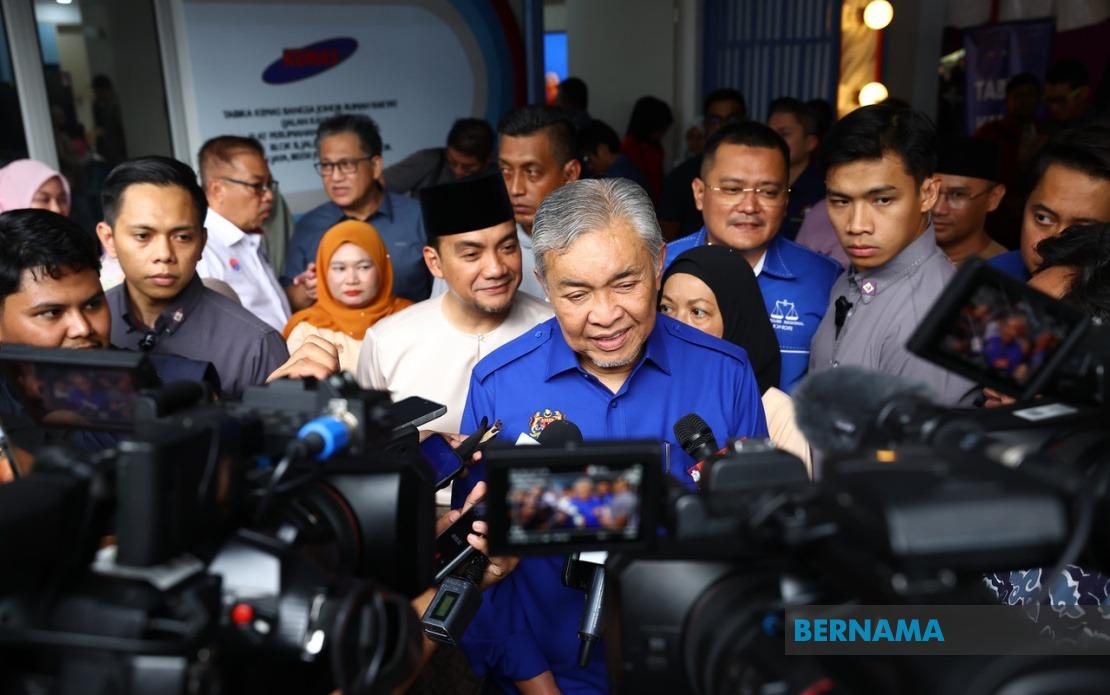
Barisan Nasional has signalled its openness to rival proposals as campaigning intensifies for the Johor state election, with BN Chairman Datuk Seri Dr Ahmad Zahid Hamidi acknowledging Pakatan Harapan's manifesto while reasserting his coalition's commitment to voters. Speaking in Johor Bahru on July 3, Ahmad Zahid described the democratic process as one where all parties should welcome fresh ideas from their opponents, even as they make their own case to voters. His measured response came during a campaign appearance in support of a BN candidate in the Larkin constituency, where he engaged with residents at the Larkin Court 1 flats.
Pakatan Harapan unveiled its election platform with ten concrete policy offerings designed to appeal to diverse voter interests across the state. The proposals ranged from establishing a Johor Health Scheme to providing financial assistance for first-time homebuyers navigating Malaysia's competitive property market. The opposition coalition additionally pledged to create a RM500 million dedicated fund targeting youth empowerment and skills development, recognising the demographic group as crucial to the state's future economic competitiveness. Education sector strengthening featured prominently in their manifesto, reflecting broader national concerns about school quality and accessibility.
Ahmad Zahid, who holds the portfolio of Rural and Regional Development Minister at the federal level, positioned Barisan Nasional's campaign around proven governance rather than aspirational promises. He asserted that BN's manifesto rests on a substantial foundation of accomplishment, noting that the outgoing state government delivered on more than 90 per cent of its previous electoral commitments. This emphasis on delivery represents a strategic counter to opposition claims that BN fails to follow through on election pledges. The figure, if accurate, provides BN with measurable evidence to present to voters concerned about whether politicians honour their campaign commitments.
The BN manifesto itself was characterised by Ahmad Zahid as comprehensive and deliberately inclusive, designed to serve citizens across all demographic boundaries without favouring any particular ethnic or social group. This framing addresses a persistent political tension in Malaysian elections, where concerns about equitable treatment across communities remain significant. Ahmad Zahid's explicit assertion that benefits would reach all Johor residents regardless of ethnic background reflected the need to maintain the multiethnic coalition's appeal during competitive elections.
The scope of BN's proposed benefits, according to Ahmad Zahid's presentation, encompasses the entire lifecycle of residents. Support would extend from expectant mothers through early childhood, school years, tertiary education, and into adulthood, with particular attention to vulnerable populations including single mothers and fathers. This lifecycle approach suggests BN's strategy to position itself as addressing needs across generational divides rather than focusing narrowly on particular age groups or family structures. Such breadth indicates an attempt to build broad-based electoral support by demonstrating relevance to voters at different life stages.
Ahmad Zahid further pledged continued ministerial commitment to advancing Johor's development agenda, framing his personal leadership as integral to the state's progress. Such assurances carry weight in Malaysian politics, where personalities often matter significantly in voters' calculations alongside party platforms. His statement essentially positioned support for BN candidates in the Johor election as inseparable from backing his broader vision for the state.
The election itself represents a significant political contest in one of Malaysia's most economically important states. With 172 candidates competing across 56 state seats, the campaign embodies the broader national political competition between BN and the opposition coalitions. The presence of Johor Menteri Besar Datuk Onn Hafiz Ghazi alongside Ahmad Zahid highlighted the coordination between federal and state BN leadership in prosecuting the campaign. The campaign appearance at Larkin, where BN fielded candidate Mohd Hairi Mad Shah, demonstrated how party leaders mobilise to support individual seat contests within the broader state-level effort.
The timing of the Johor election carries implications beyond the state itself. As Malaysia's second-largest state by population and a critical economic hub, Johor's political direction influences national coalition mathematics and regional influence. An election outcome here reverberates through Malaysian politics and shapes calculations for future national-level contests. PH's manifesto launch and BN's counter-campaign represent the contemporary intensity of Malaysian electoral competition, where detailed policy platforms increasingly feature alongside traditional campaign strategies.
The electoral calendar for the Johor election proceeded swiftly, with early voting scheduled for July 7 and polling day set for July 11. This compressed timeframe concentrated campaigning intensity, making efficient communication of policy platforms crucial for both BN and opposition parties. Ahmad Zahid's Johor engagement reflected the high-profile nature of the contest, with senior federal leadership actively supporting state-level campaigns.
The respective manifestos revealed differing strategic emphases between the governing coalition and opposition. While PH concentrated on specific service delivery schemes and youth empowerment, BN emphasised proven track records and lifecycle-spanning support networks. This divergence reflected broader governing philosophies, with BN projecting incumbent stability and delivery capacity, while PH offered fresh policy directions and targeted interventions in areas like housing and health.
For Malaysian voters in Johor, the election presented a choice between continuity under BN governance and change represented by opposition alternatives. The manifestos provided substance for evaluating these competing visions, moving beyond personality-driven politics toward measurable policy content. Ahmad Zahid's respectful acknowledgement of PH's proposals, even while asserting BN's superiority, maintained the appearance of democratic civility required in contemporary Malaysian campaigns.

