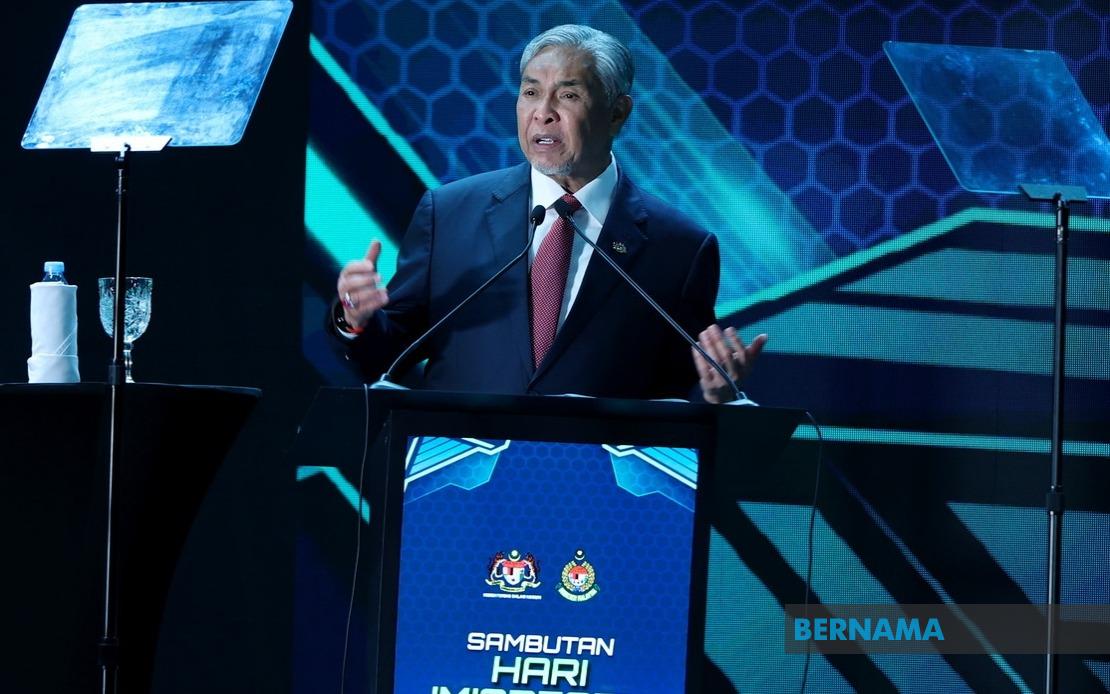
Barisan Nasional will maintain its place within Malaysia's Unity Government coalition, party chairman Datuk Seri Dr Ahmad Zahid Hamidi announced on Sunday, stating the commitment stems from a formal resolution adopted at UMNO's recent General Assembly. Speaking after the 2026 Immigration Day celebration in Cyberjaya, Ahmad Zahid, who also serves as UMNO president and Deputy Prime Minister, underscored that the decision represents the party's considered position on its continued participation in the ruling arrangement.
The confirmation arrives as the coalition navigates ongoing questions about ministerial conduct during state-level election campaigns. Ahmad Zahid appealed to all stakeholders to respect the determination reached through UMNO's institutional processes, emphasising that no higher authority exists within the party structure than the General Assembly itself. This framing suggests BN views the assembly's endorsement as settling internal debate on the coalition's future direction, at least in the near term.
The broader context involves Prime Minister Datuk Seri Anwar Ibrahim's recent directive warning government officials against using their positions to attack Unity Government partners during state electoral contests. The Prime Minister indicated that those flouting this guidance would face removal from their roles, signalling a push for disciplined coalition conduct. Ahmad Zahid's statement appears designed to reinforce party discipline and reaffirm BN's institutional commitment despite potential tensions between coalition members.
Ahmad Zahid carefully delineated between party-level decisions and executive prerogatives, noting that the Prime Minister possesses absolute authority over ministerial appointments and dismissals. This distinction matters significantly for Malaysian governance, as it clarifies the separation between coalition politics and Cabinet administration. By acknowledging the Prime Minister's unfettered right to make personnel decisions, Ahmad Zahid avoided suggesting BN could challenge any Cabinet reshuffles that might result from breaches of campaign conduct rules.
The Unity Government represents an unprecedented coalition arrangement in recent Malaysian politics, bringing together previously antagonistic parties under a common governance framework. BN's explicit recommitment reflects the stakes involved in maintaining this arrangement, which has proven fragile at various junctures. The UMNO General Assembly's formal resolution provides political cover for the party's leadership to resist any faction pushing for coalition withdrawal, grounding their position in democratic party procedure rather than mere executive decision.
For Malaysian readers, this development carries implications extending beyond high-level political theatre. The coalition's stability affects policy implementation across multiple sectors, from economic management to social programmes. Continued internal strains could compromise the government's ability to advance priority initiatives or maintain legislative coherence. Conversely, reinforced commitment may enable more focused execution of developmental objectives during the remainder of the current parliamentary term.
The timing of Ahmad Zahid's statement also warrants attention, coming as state elections approach in several Malaysian territories. These contests typically generate inter-party friction within coalitions, as constituent groups advance localised interests that may diverge from central coalition strategy. By issuing this preemptive affirmation of BN's commitment, party leadership appears intent on preventing campaign-period tensions from metastasising into structural coalition breakdown.
From a Southeast Asian perspective, Malaysia's coalition government experiment holds relevance for the region's other democracies grappling with fragmented parliaments and multi-party systems. The difficulties involved in sustaining such arrangements—balancing partner interests, maintaining discipline, managing personality-driven conflicts—mirror challenges faced elsewhere in the region. BN's repeated public recommitments to the coalition suggest these difficulties require active, ongoing management rather than passive institutional design.
Looking forward, Ahmad Zahid's emphasis on the General Assembly's authority as the party's supreme body may establish precedent for future coalition-related decisions. Should questions arise regarding BN's continued participation or specific policy matters affecting Unity Government coherence, party leadership can invoke similar procedural grounds, embedding coalition commitment within UMNO's organisational structure. This approach potentially insulates major coalition decisions from individual leader prerogatives, creating more durable institutional frameworks.
The Prime Minister's authority over ministerial conduct remains paramount, however. Ahmad Zahid's acknowledgement of this reality indicates BN accepts that maintaining coalition discipline falls partly to executive enforcement rather than relying solely on party-level voluntary compliance. This acceptance suggests realistic understanding that coalition governance requires multiple reinforcing mechanisms operating across both party and state machinery to function effectively.

