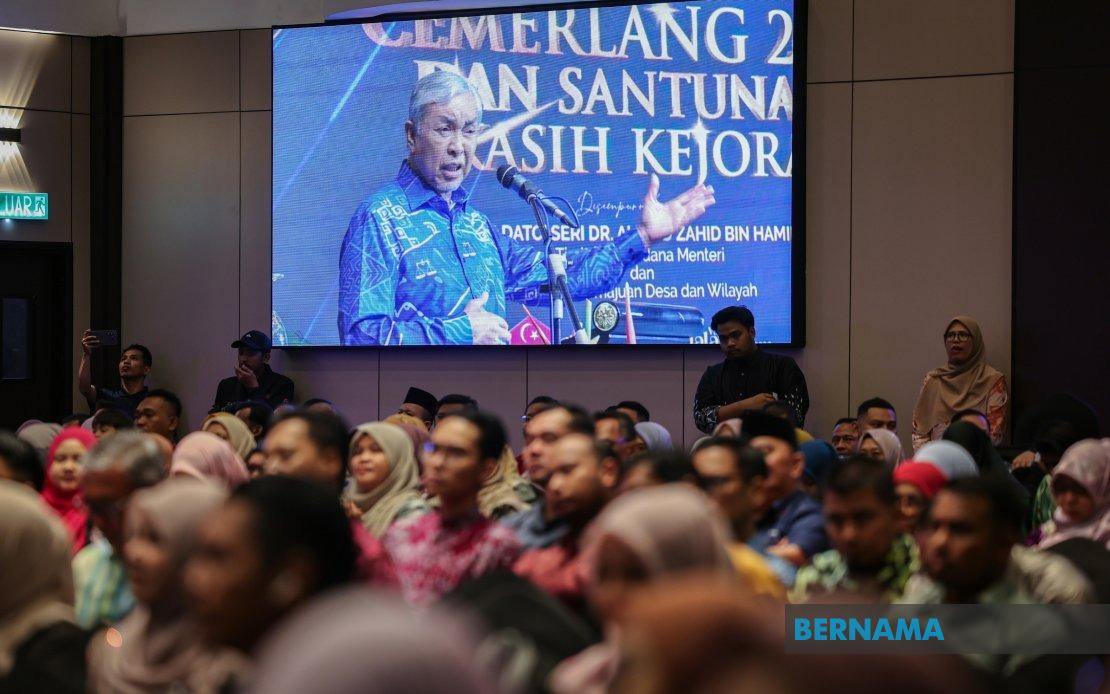
Barisan Nasional's campaign machinery in Johor is operating at full capacity and performing effectively on the ground, according to party chairman Datuk Seri Dr Ahmad Zahid Hamidi, who rejected recent claims that the coalition's election push has been tepid. Speaking in Kota Tinggi after launching development awards, Zahid emphasised that BN's sustained campaign effort contradicts external characterisations, and that competing coalitions are naturally entitled to their own assessments of campaign intensity. The statement comes as the coalition enters the critical final stretch before voters head to the polls on July 11 to elect the 56-member Johor state assembly.
Zahid framed the "lacklustre" criticism as a matter of political perception rather than observable reality, a distinction that reflects broader campaign messaging strategies in Malaysian electoral contests. He acknowledged that rival coalitions—principally Pakatan Harapan and Perikatan Nasional—may offer differing interpretations of BN's ground performance, but suggested such commentary reflects their own organisational interests rather than objective conditions. The BN chairman expressed confidence that the coalition's internal assessment of campaign momentum aligns with voter sentiment, positioning the July 11 outcome as the definitive test of campaign claims by all competing parties.
The remarks emerge amid broader concerns about potential voter confusion resulting from BN and Pakatan Harapan's federal-level cooperation through the Unity Government. Some analysts have suggested that traditional Barisan supporters in Johor might face difficulty reconciling their historical party loyalty with BN's collaborative stance with PKR, DAP, and Amanah at the national level. Zahid directly addressed this tension, arguing that Johor occupies a distinct political position because the state government was already constituted before the federal Unity Government took shape in 2023. This temporal sequencing allows BN to present state and federal cooperation as separate phenomena rather than as a unified political realignment.
The Deputy Prime Minister characterised inter-governmental relations within the Unity Government framework as professional and functional, emphasising that working relationships between state and federal administrations do not inherently create voter alienation. Zahid's argument essentially suggests that Johor voters can maintain support for a BN state government while accepting BN's role in a broader federal coalition without experiencing cognitive dissonance. The framing attempts to neutralise a potential vulnerability for the coalition, particularly among voters aged 60 and above who traditionally constitute BN's most reliable base.
BN is contesting all 56 Johor state seats, signalling ambitions for a commanding electoral mandate rather than a narrow majority. Zahid linked this comprehensive candidacy strategy to the performance record of state Menteri Besar Datuk Onn Hafiz Ghazi, whose administration he credited with generating RM2.26 billion in state revenue during the previous fiscal year—a figure he claimed represents the highest performance among Peninsular Malaysian states. This emphasis on fiscal achievement reflects BN's broader campaign strategy of emphasising economic management and development delivery as the primary basis for electoral support, a positioning that appeals particularly to urban and suburban constituencies concerned with infrastructure quality and public service efficiency.
The revenue figure serves multiple rhetorical purposes within BN's campaign narrative. It demonstrates fiscal competence and suggests that the state government has accumulated resources for continued infrastructure investment and service provision over the next five-year term. For Malaysian voters accustomed to evaluating political performance through the lens of economic outcomes and visible development, such metrics carry substantial persuasive weight. Zahid explicitly linked electoral victory to the capacity to sustain development programming outlined in the coalition's manifesto, positioning the July 11 vote as a choice between continuity of performance and uncertainty under alternative governance.
The eight-candidate field competing across the 56 seats reflects Johor's fragmented political landscape. Beyond BN and Pakatan Harapan, each fielding 56 candidates, Perikatan Nasional presents 33 candidates while smaller parties and coalitions fill remaining positions. Bersama fields 15 candidates, MUDA four, and individual seats are contested by representatives from Parti Orang Asli Malaysia, Parti Sosialis Malaysia, and six independent candidates. This proliferation of contenders suggests that vote splitting, rather than consolidated two-coalition competition, may characterise numerous constituencies, potentially advantaging parties with concentrated support bases.
Zahid's characterisation of rival campaign rhetoric as representing their "professional approach" stands in marked contrast to his description of BN's own methodology. The BN chairman indicated that his coalition maintains focus on candidate quality and voter outreach rather than engaging in direct attacks on competing parties, a strategic posture designed to position BN as the more measured and governance-focused option. This distinction attempts to elevate BN above the political fray whilst remaining competitive, a delicate balance that requires constant calibration during intensive campaign periods.
PAS president Tan Sri Abdul Hadi Awang's recent call for voters to reject Pakatan Harapan outright, even in constituencies featuring direct BN-PH contests, introduces additional complexity to the electoral arithmetic. If PAS supporters follow Hadi's directive in BN-held seats, this could substantially amplify BN's victory margins. Zahid's measured response—suggesting that any additional support would be welcomed but that BN's primary focus remains on its own candidates—reflects electoral pragmatism. The statement implicitly acknowledges PAS's potential influence while avoiding any appearance of coalition negotiations that might undermine BN's claims of running an independent campaign based on internal party strength.
Early voting is scheduled for July 7, providing a preview of turnout patterns and voting preferences that may influence final campaign messaging during the intervening days. Johor's electoral history suggests relatively high turnout compared to other Malaysian states, reflecting the state's demographics and political culture. Early voting trends often correlate with final election results, making the July 7 data points significant for all competing coalitions as they finalise ground-level campaign strategies.
For Malaysian political observers, the Johor contest represents a critical test of whether federal-level political realignment through the Unity Government fundamentally alters state-level electoral dynamics. The result will offer instructive insights into voter behaviour regarding the separation of state and federal political decisions, and whether BN's traditional Johor dominance remains intact in the post-2023 political environment. The outcome will also shape expectations for other state elections scheduled in coming months, including potential contests in Selangor and Negeri Sembilan that may determine the trajectory of Malaysian politics through the remainder of this parliamentary term.

