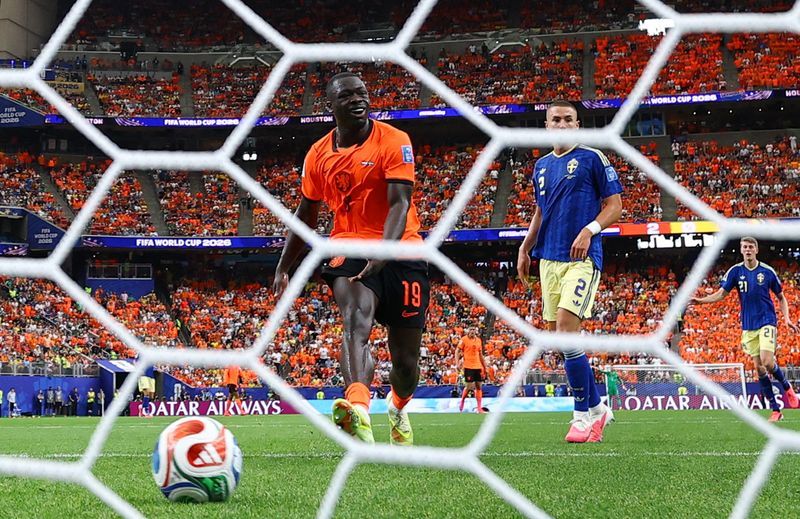
Ronald Koeman's tactical gamble to deploy Brian Brobbey as his lead attacker proved spectacularly vindicated as the Netherlands dismantled Sweden 5-1 in their second group match, a result that starkly contrasted with the criticism the Dutch coach had faced following a disappointing 2-2 draw with Japan just days earlier. The stark swing in fortunes—from widespread condemnation of Koeman's in-game substitutions to universal praise for his lineup choices—underscores the volatility of football management, where perceptions can shift entirely within the span of a single 90-minute performance.
Koeman himself acknowledged that his alterations during the Japan encounter in Dallas had misfired, leaving the Netherlands searching for answers as they pursued their opening victory of the tournament in their Group F campaign. That display had generated genuine concern about the team's attacking potency and the manager's ability to read the game's demands. However, the transformation on Saturday silenced critics, with the Netherlands' emphatic demolition of the Swedes serving as an empathetic response to those doubters and a resounding statement about the squad's genuine capabilities.
At the heart of this revival stood Brobbey, who announced his credentials for a sustained role in the side through a brace completed within the opening 17 minutes. The 24-year-old's devastating early impact set the tone for a dominant display, immediately establishing a commanding position that Sweden could never subsequently challenge. His ability to finish with clinical precision in those early exchanges demonstrated the kind of ruthless efficiency that has been lacking in the Netherlands' attack and raised fundamental questions about where Koeman's search for an elite marksman should conclude.
The trajectory of Brobbey's international career makes his emergence as a serious contender particularly intriguing. Having occupied a marginal position within the squad during 2026 World Cup qualifying, he disappeared from the squad entirely for over a year before receiving a recall this March. This extended exile suggested that his pathway to regular inclusion remained heavily obstructed, with others seemingly preferred for the role he now increasingly appears positioned to claim. His resurrection reflects both Koeman's evolving assessment of available options and Brobbey's own tactical and technical development during his absence from the international stage.
Crucially, Brobbey's elevation comes as the Netherlands confront the uncomfortable reality that Memphis Depay's tenure as their primary attacking protagonist is approaching its natural conclusion. While Depay remains the nation's record goalscorer and carries immense symbolic importance, extended injury absences have undermined his sharpness, and his advancing years mean that succession planning can no longer be postponed indefinitely. The midfield general and attacking lynchpin who has defined Dutch football for over a decade now faces the prospect of gradual diminishment, forcing selectors to identify his eventual replacement before circumstances render the choice moot.
Brobbey himself has credited his season-long loan at Sunderland in the Premier League with catalyzing a significant upgrade in his overall performance level and tactical understanding. In conversations with reporters at the Dutch training camp, he articulated how the English football environment had expanded his technical repertoire beyond the direct, physical confrontation with opposing defenders in which he had previously specialised. His enhanced capacity to manufacture space through intelligent running patterns, find teammates through positional adjustments, and operate effectively in deeper attacking positions represents a maturation that makes him a more dangerous and versatile proposition than he had previously demonstrated.
The quality of service being delivered to whichever Netherlands attacker leads the line has also improved markedly, with Cody Gakpo's menacing play down the left flank combining effectively with Denzel Dumfries' explosive overlapping runs from fullback on the opposite wing. The introduction of Crysencio Summerville as an additional creative force further augments the attacking infrastructure supporting the centre-forward position, creating a multiplicity of opportunities that reward clinical finishing and intelligent movement. This rich attacking architecture means that any striker integrated into the side benefits from exceptional surrounding circumstances that can amplify individual effectiveness.
Brobbey's demonstration against Sweden proved definitively that he possesses the finishing capability that has periodically eluded other candidates for the role. More significantly, the efficiency and composure he displayed in those opening moments suggested an attacker operating with considerable confidence and tactical clarity about his role and responsibilities within the system. The absence of any apparent hesitation or uncertainty in his movements indicated a player psychologically prepared for the demands of leading his nation's attack at a major tournament, a readiness that cannot always be assumed when selecting players for elevated responsibilities.
The broader narrative surrounding Brobbey's emergence encompasses fundamental questions about generational transition within the Dutch squad. As the side operates under the stewardship of an experienced manager overseeing a reconfigured lineup, the identification and establishment of young talent in crucial positions becomes essential for sustained competitive ambition. Brobbey's Saturday performance suggested that Koeman may have located precisely the type of attacking lead the Netherlands require as they project themselves forward into the tournament. The double strike against Sweden constituted far more than mere statistics; it represented a statement of intent from a previously marginalised player demanding recognition and opportunity within the competition's demanding environment.
Looking ahead, Brobbey's capacity to maintain the explosive form he demonstrated against weaker opposition will determine whether his World Cup emergence proves a temporary flourish or the beginning of a genuine transformation in his international standing. The Netherlands now occupy top position in Group F following this commanding victory, while Brobbey has positioned himself as a genuine contender for sustained selection as their primary attacking option going forward into the tournament's knockout phases.

