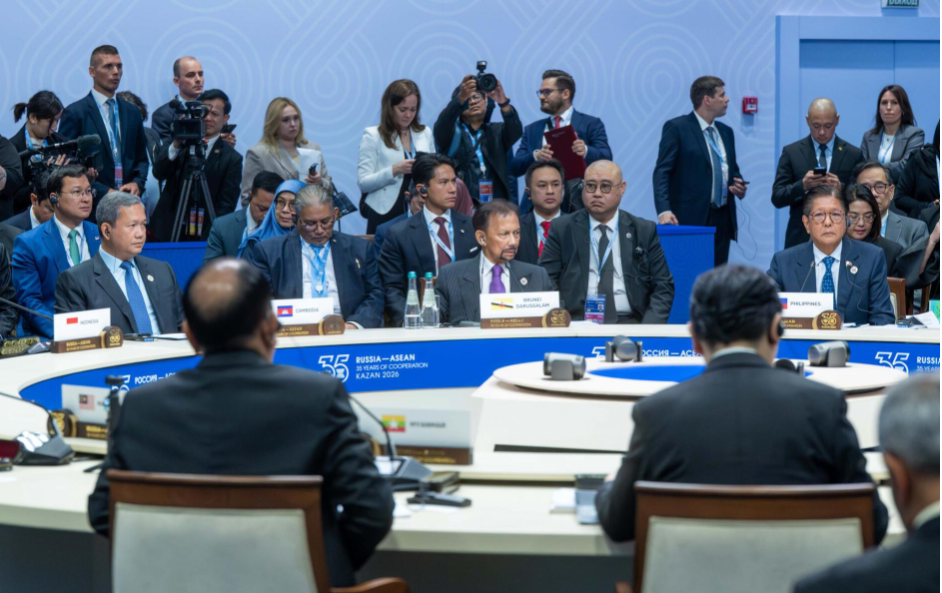
Sultan Hassanal Bolkiah travelled to Kazan, Russia on Thursday, June 18, to attend the Asean-Russia Commemorative Summit, where he delivered remarks emphasizing the need for closer ties between Southeast Asia and Moscow at a time of mounting global instability. The Brunei monarch, who was accompanied by Foreign Affairs Minister Prince 'Abdul Mateen, used the occasion to praise Russian President Vladimir Putin's hospitality and to acknowledge the generous reception extended by the local authorities in Tatarstan and Kazan.
The timing of the summit carried special significance, occurring three decades and a half after Asean and Russia first formalised their dialogue relationship. In his remarks, the Sultan traced the arc of this partnership, noting how it had not only endured through shifts in the international system but had actually grown more consequential as traditional geopolitical alignments became increasingly unstable. This resilience, he suggested, reflected a fundamental compatibility of interests and a shared commitment to multilateral cooperation despite the pressures that have tested the international order.
At the core of the Sultan's message lay a vision of partnership extending across all three pillars of the Asean Community framework—the political-security pillar, the economic pillar, and the socio-cultural pillar. Rather than treating these domains separately, he framed them as interconnected elements of a holistic relationship designed to generate tangible benefits for both peoples. The concrete outcomes of this cooperation, he argued, had already manifested in stronger connections between societies and in collaborative efforts toward shared objectives of stability, prosperity and peace.
Looking ahead to Asean's Vision 2045 agenda, the Sultan identified several domains where Russian partnership would prove increasingly critical. Climate change, he noted, represents a challenge that transcends borders and demands coordinated action; political tensions, whether regional or global, require mechanisms for dialogue and de-escalation; economic fragmentation threatens the interconnected prosperity both regions depend upon; and the accelerating pace of technological change creates both opportunities and vulnerabilities that must be managed jointly. This framing positioned Russia not as a distant actor but as a natural partner for Southeast Asia in navigating the complexities ahead.
Energy security emerged as a particular focus in the Sultan's remarks, reflecting the strategic importance of Russian hydrocarbon supplies and expertise to Asean economies facing rising demand and shifting supply chains. Food security received equivalent emphasis, given regional concerns about agricultural productivity and global supply chain disruptions. Beyond these material concerns, the Sultan highlighted the intangible but equally vital challenges of climate action, disaster management and non-traditional security threats—from transnational crime to cyber threats—that no single nation can adequately address alone.
The sultanate's particular emphasis on human capital development reflected a forward-looking orientation toward sustaining the partnership across generational change. Education exchanges, training programmes and people-to-people connectivity, the Sultan argued, would equip younger cohorts with the skills, knowledge networks and personal relationships needed to deepen cooperation. This approach recognises that formal government relationships, while essential, gain durability when supported by broad constituencies across universities, businesses and civil society.
The summit's adoption of the Kazan Declaration 2026 marked a milestone in institutional terms. Beyond this overarching declaration, participants approved a Comprehensive Plan of Action extending through 2030 that would operationalise the strategic partnership with specific initiatives and benchmarks. Separate joint statements on energy cooperation and cultural exchange provided sectoral focus, signalling that the relationship would proceed not through grand rhetoric alone but through targeted programmes with measurable components.
The second plenary session, organised around the theme of integration processes across Eurasia, widened the conceptual frame beyond bilateral Asean-Russia dynamics. Inputs from the Asean secretariat, the Shanghai Cooperation Organisation and the Eurasian Economic Commission enabled participants to position their partnership within broader patterns of regional integration occurring across the vast Eurasian landmass. This perspective resonated particularly with Southeast Asian capitals seeking to balance multiple partnerships and to avoid the perception of choosing sides in broader geopolitical competitions.
Paralleling the diplomatic proceedings, the Asean-Russia Business Forum held on June 17 sought to ground the relationship in commercial reality. By bringing together entrepreneurs, investors and corporate leaders, the forum aimed to identify concrete opportunities for trade expansion, joint ventures and sectoral collaboration. The leaders' welcome of these business outcomes indicated that they viewed economic integration as essential to sustaining political cooperation.
For Malaysia and other Southeast Asian nations observing the summit, the proceedings offered instructive lessons about balancing engagement with major powers. Brunei's approach—emphasising multilateralism, mutual benefit, shared challenges and people-to-people ties rather than alignment or strategic choice—reflected a diplomatic philosophy increasingly central to Asean's regional strategy. As Southeast Asia navigates rising tensions between Washington and Beijing, the demonstrated willingness to deepen Moscow's role in regional cooperation signals the region's interest in maintaining multiple partnerships rather than consolidating into exclusive blocs.
The Sultan's address also carried implicit messages about Asean's own cohesion and agency. By speaking of collective resilience and shared prosperity, he was positioning Southeast Asia as more than a passive arena for great power competition but rather as an active region with its own agenda. The emphasis on Asean Community pillars and Vision 2045, rather than on external alignments, reinforced this assertion of Southeast Asian identity and self-determination in an era of heightened global tensions.

