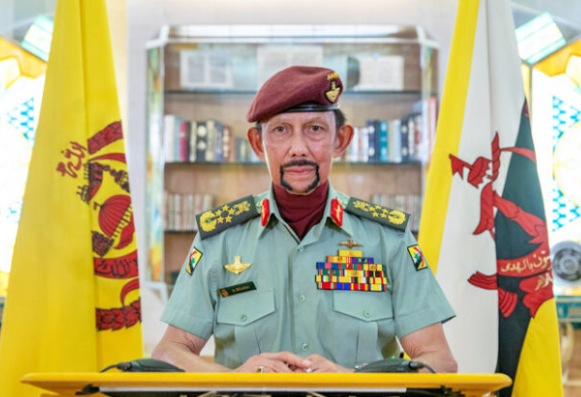
Sultan Hassanal Bolkiah of Brunei has used the occasion of the Islamic New Year 1448 Hijrah to deliver a message centered on national cohesion, personal discipline, and collective responsibility in addressing societal challenges. In remarks marking the calendar milestone, the monarch articulated a vision where Brunei's continued stability depends on citizens renewing their dedication to both worldly advancement and spiritual fulfillment, framing the new year not merely as a temporal boundary but as a deliberate moment for recommitting to established values and purpose.
The Sultan's perspective on progress encompasses a dual framework that distinguishes between material and spiritual development. On the material dimension, he referenced economic growth and infrastructure expansion as ongoing imperatives for the nation. The spiritual dimension, by contrast, encompasses educational advancement, religious instruction, and dakwah—the propagation of Islamic teachings—suggesting that Brunei's trajectory hinges equally on strengthening knowledge systems and deepening faith commitments. This framing reflects a governance philosophy viewing national development as inseparable from moral and religious foundations, a perspective increasingly resonant across Southeast Asia as Muslim-majority nations grapple with balancing modernization against cultural preservation.
Crucially, the Sultan cautioned against mistaking the arrival of a new calendar year as a signal to commence efforts. Instead, he positioned the Hijrah New Year as an opportunity to reaffirm and intensify commitments already undertaken. This distinction carries practical significance: it suggests that sustainable progress emerges not from episodic bursts of activity but from the consistent reinforcement of discipline and intention. For Malaysian observers, this message carries relevance given ongoing regional debates about national productivity and whether development strategies adequately integrate spiritual and moral dimensions alongside economic targets.
The monarch openly acknowledged the turbulent international environment, noting that conflict and warfare persist globally with devastating humanitarian consequences. His observation that no nation remains insulated from the ripple effects of international instability implicitly positions Brunei's own peace and security as contingent outcomes rather than guaranteed conditions. This acknowledgment carries weight particularly for Southeast Asian states, where regional tensions around maritime boundaries, trade routes, and geopolitical influence create underlying anxieties about stability. By explicitly recognizing global challenges while simultaneously distinguishing Brunei's fortunate position, the Sultan balanced realism with gratitude.
Brunei's exemption from major natural disasters and its sustained internal stability, according to the Sultan, flows from collective spiritual observance—prayer, remembrance of Allah, and Quranic recitation woven into national life. This attribution frames stability as earned through religious practice rather than as accident or geographic fortune. The claim that spiritual discipline generates material security represents a theologically grounded explanation for what might otherwise be attributed to economic management, geographic positioning, or institutional design. For a small nation like Brunei with limited geographic expanse and resource diversity, attributing stability to religious foundations may reinforce social cohesion by connecting individual piety to collective wellbeing.
However, the Sultan did not portray Brunei as problem-free. He identified crime—particularly drug offences and theft—as issues requiring urgent, coordinated action. His characterization of criminal activity as tarnishing national standing and violating Islamic principles positioned crime control not merely as a law-and-order matter but as a religious and national dignity issue. This framing proves significant for regional security discussions, where Southeast Asian governments increasingly recognize drug trafficking and organized crime as transnational challenges demanding cooperation beyond traditional bilateral channels.
The Sultan specifically directed security and religious agencies to intensify efforts against criminal behavior, assigning particular responsibility to the religious sector to strengthen Islamic education and outreach campaigns that build societal rejection of drugs and criminality. This delegation reflects a governance model leveraging religious institutions as partners in social regulation and moral instruction. In the Malaysian context, where Islamic religious authorities operate alongside secular law enforcement, such coordinated approaches to crime prevention represent ongoing policy experiments with variable results. The Sultan's explicit call for religious education to address drug prevention suggests viewing substance abuse not primarily as individual moral failing but as a social pathology requiring community-level educational intervention.
The concept of shared responsibility emerged as central to the Sultan's message. He framed safeguarding both the Muslim community and the nation as collective obligations transcending individual agency. This formulation potentially strengthens social solidarity by positioning security as a communal achievement rather than solely a state function. For Malaysia and other regional nations with diverse populations and competing interests, such appeals to shared national destiny carry strategic value in maintaining social cohesion, though their effectiveness depends on whether citizens actually perceive such unity as achievable.
The Sultan's emphasis on remaining vigilant without complacency, coupled with intensified spiritual practice, presents an interesting paradox: heightened awareness coupled with trust in divine protection. This balance between human agency and spiritual reliance characterizes much Islamic governance rhetoric in Southeast Asia. Rather than viewing vigilance and prayer as contradictory, the Sultan positioned them as complementary—humans must act responsibly while simultaneously trusting in Allah's guardianship. This perspective may resonate differently across Brunei's diverse population and professional classes, with security personnel potentially interpreting the message as legitimizing expanded surveillance capabilities, while others emphasize the spiritual rather than institutional dimensions.
The royal well-wishes extended to all citizens and residents marked an inclusionary gesture acknowledging Brunei's non-Muslim populations and migrant communities. This framing of Islamic observance as a national rather than exclusively religious matter reflects the reality that Brunei's constitutional framework positions Islam as the official religion while extending protection to other faiths. For Malaysia, where similar tensions between Islamic nationalism and religious pluralism persist, Brunei's approach to Islamic New Year messaging offers comparative lessons in balancing religious significance with national inclusivity.
Looking forward, the Sultan's address establishes an implicit accountability framework wherein citizens' collective discipline and spiritual commitment directly influence national security and prosperity. Whether Brunei's institutions can effectively mobilize religious education and law enforcement coordination against crime remains an open question, but the Sultan's articulation of these priorities signals elite concern about rising criminal activity potentially undermining the stability narrative. For the broader Southeast Asian region watching Brunei's small-nation governance model, the address underscores how Islamic calendrical observances provide occasion for leaders to reconnect populations to shared values while simultaneously addressing concrete policy challenges.