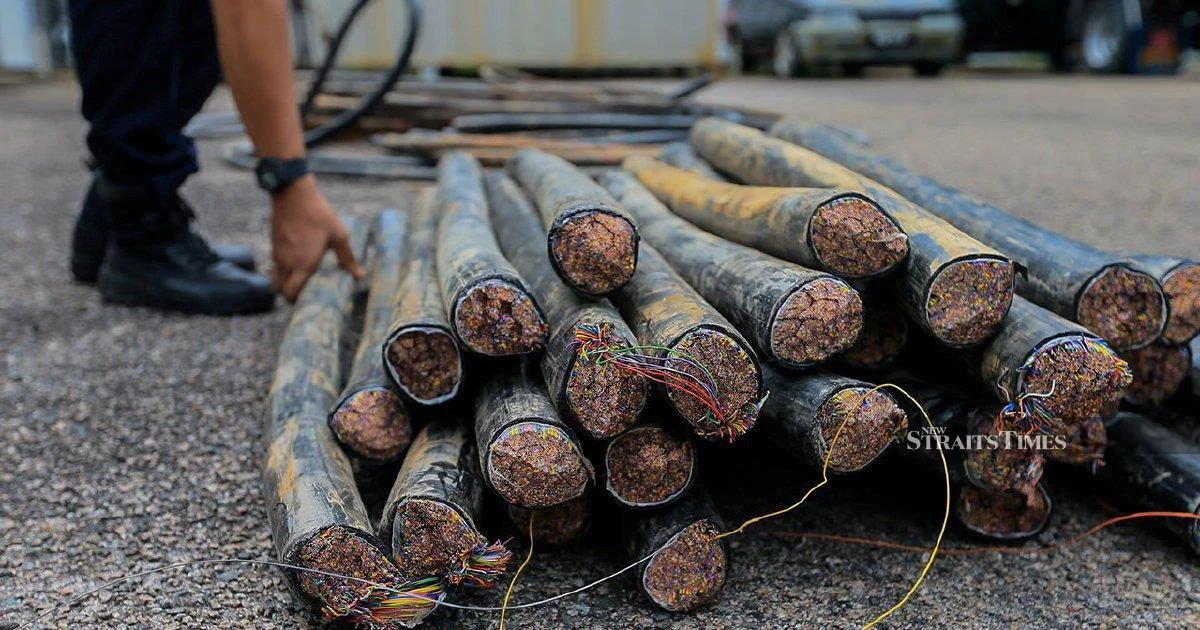
Police authorities in Kuala Lumpur are celebrating a significant downturn in cable theft cases, with crime statistics revealing a dramatic 65 percent reduction in incidents during the first five months of 2025. The drop represents a marked shift in the battle against this persistent form of property crime that has long plagued the capital's infrastructure and residents. Between January and May this year, police recorded 71 cable theft reports, a stark contrast to the 205 cases documented across the entirety of 2025, underscoring the effectiveness of recent enforcement strategies and collaborative policing efforts aimed at curbing organised metal scavenging operations throughout the city.
The significant decline in cable theft incidents reflects the outcomes of sustained law enforcement campaigns that have targeted both perpetrators and their operational networks. Police have successfully apprehended 85 suspects so far this year in connection with cable theft activities, indicating that investigative work has begun dismantling supply chains that feed the black market for stolen copper and aluminium. These arrests represent crucial steps in disrupting the criminal ecosystem that transforms stolen telecommunications and electrical infrastructure into quick cash for organised groups, a problem that has previously affected service delivery across multiple sectors.
Cable theft in urban environments like Kuala Lumpur has historically created cascading problems beyond immediate financial loss. When thieves target telecommunications cables, internet and phone services are disrupted for residents and businesses across entire neighbourhoods. Stolen electrical cables compromise power distribution networks, creating safety hazards and necessitating costly emergency repairs. The criminal activity disproportionately impacts low-income communities where service restoration takes longer and infrastructure redundancy is minimal, making the reduction in these crimes particularly beneficial for marginalised areas throughout the capital.
The surge in arrests and corresponding drop in incidents suggests police have shifted from reactive patrols to proactive intelligence-gathering and targeted operations. This change in methodology likely reflects training in identifying networks of receivers, scrapyard operators, and logistics intermediaries who enable the supply chain connecting street-level thieves to end markets. By identifying and pursuing these facilitators, authorities address root causes rather than simply catching individual offenders, creating stronger deterrent effects and more permanent disruptions to organised crime structures.
Organised cable theft rings typically operate with military precision, often striking multiple sites in coordinated operations during specific hours when surveillance is lightest. The sophistication of these operations—including use of cutting equipment, lookouts, getaway vehicles, and predetermined drop-off points—suggests they function as small businesses rather than opportunistic crimes. Police success in reducing incidents indicates they have successfully counter-mapped these operational patterns and positioned enforcement assets accordingly, likely through intelligence sharing between municipal services, telecommunications companies, and law enforcement agencies.
The implications of declining cable theft extend beyond simple crime statistics. Infrastructure providers can now allocate resources more efficiently toward network expansion and service quality rather than constant emergency repairs. Telecommunications companies can invest in customer service improvements and technological upgrades rather than weathering the financial burden of repeated cable replacement. For ordinary Malaysians, particularly in suburban and outlying areas, the reduction in service outages means greater reliability in connectivity for work, education, and emergency communications—services increasingly essential in modern urban life.
From a broader public safety perspective, the 85 arrests represent individuals removed from street-level crime roles, many of whom may have graduated to more serious offences or recruited others into criminal activity. Cable theft serves as a gateway crime for many offenders, particularly those struggling with substance addiction who target infrastructure for rapid cash conversion. Breaking this cycle through arrests and, ideally, rehabilitation interventions addresses both immediate crime concerns and longer-term community stability.
The success documented in these first five months of 2025 will likely be attributed to coordination between Kuala Lumpur City Hall, utility providers, and the Royal Malaysian Police. Such inter-agency collaboration has proven effective in other jurisdictions, where bundled approaches combining better cable infrastructure protection, improved surveillance systems, and rapid-response enforcement teams have achieved similar reductions. The key advantage of this integrated model is that it addresses vulnerabilities across multiple points simultaneously, making cable theft progressively less lucrative and more risky for criminals.
However, the sustained nature of this reduction will depend on maintaining enforcement momentum and continuing the resource allocation supporting these policing strategies. Experience from other cities shows that cable theft can resurface quickly if police attention wanes, as new criminal networks emerge to replace dismantled ones. Additionally, economic conditions influencing the scrap metal market and availability of alternative criminal opportunities will affect long-term theft trends. Police and city authorities must therefore institutionalise successful practices and ensure that anti-cable-theft operations remain prioritised despite competing demands on law enforcement resources and attention.

