Cambodia's economic transformation ambitions took concrete shape this month when Deputy Prime Minister Sun Chanthol led a high-level delegation to South Korea, signalling the kingdom's determination to attract capital and expertise in sectors far removed from the labour-intensive garment factories that have long dominated its industrial base. The investment promotion mission, centred on a roadshow in Incheon on June 16, reflects a strategic shift toward manufacturing that generates higher margins, creates more skilled employment and integrates Cambodia more deeply into sophisticated regional supply chains, particularly in the rapidly expanding electric vehicle ecosystem.
Chanthol, also first vice-chairman of the Council for the Development of Cambodia, the government's lead agency for investment policy, used direct engagement with major Korean industrial groups to press home a message: Cambodia is ready to host complex manufacturing operations and provide the stability, incentives and infrastructure that multinational investors demand. The framing was unmistakable. Speaking at the 2026 Incheon-Cambodia Investment Roadshow, he pledged that "the Royal Government of Cambodia is firmly committed and fully prepared to welcome and provide all kinds of facilitation to Korean investors." This language, combined with the government's recent overhaul of its investment law, signals a deliberate effort to compete for the types of factories and technology partnerships that are migrating across Asia as global automotive and electronics firms reshape their supply chains in response to the energy transition.
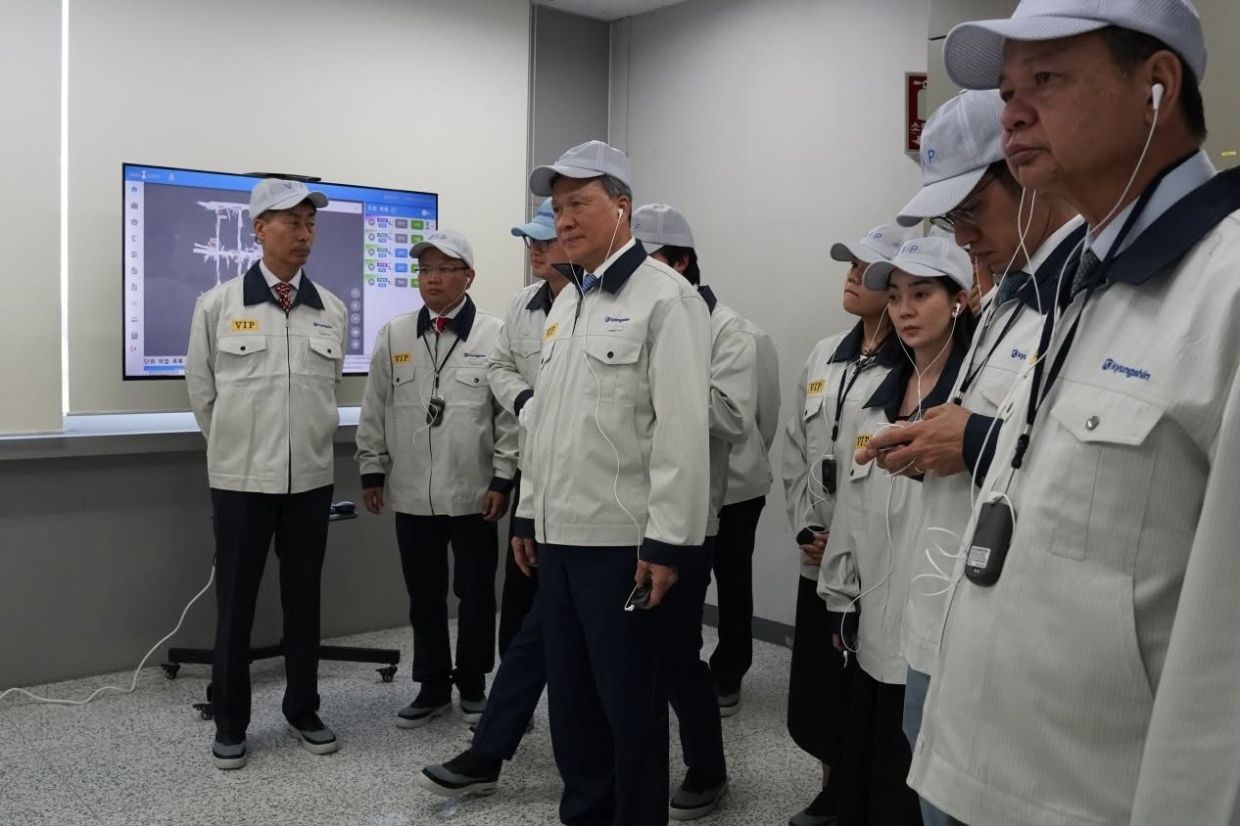
The delegation's itinerary was carefully constructed to address Cambodia's specific industrial ambitions. Visits to Daejoo KC Group, a diversified conglomerate with deep roots in the kingdom, and Kyungshin Co., Ltd., a specialist in automotive electronics and wire harness manufacturing, were not ceremonial courtesy calls but strategic positioning exercises. These companies already operate in Cambodia, giving the government leverage to deepen relationships and expand their footprint. Daejoo KC operates through two Cambodian subsidiaries, including Camko Motor, which assembles Hyundai vehicles for domestic consumption and produces automotive wire harnesses for regional export while generating nearly 500 jobs. The factory footprint demonstrates to other Korean manufacturers that Cambodia can handle assembly operations and component production at scale.
Kyungshin's established presence in Cambodia since 2012 provides even stronger evidence of the kingdom's capacity to support precision manufacturing. The company's wire harness factory in Kandal province, capitalised at approximately US$20 million and employing 1,467 workers, produces components for electric vehicles—precisely the technology space Cambodia aims to expand. By highlighting such operations, the delegation showcased not just historical presence but active participation in the global automotive supply chain. As traditional internal combustion engine production declines and EV manufacturing accelerates across Asia, Cambodia positions itself as a logical location for companies seeking to establish or expand wire harness and electrical systems production. The region's geographic proximity to Vietnam and Thailand, both emerging EV manufacturing hubs, enhances Cambodia's strategic value.
The roadshow's focus extended beyond factory floors into the future of mobility systems. Chanthol's engagement with Kyungshin centred partly on the company's advanced technologies for electric vehicle electronic components and its research into future mobility solutions. This emphasis on innovation transfer and technology partnerships, rather than simply offering cheap labour, represents a maturation of Cambodia's investment pitch. The government is signalling that it no longer seeks only assembly lines but the design and engineering capabilities that accompany higher-value manufacturing. For Korean firms, this opens possibilities to establish regional technical centres and engineering operations that feed supply chains across Southeast Asia rather than merely serving the Cambodian market.
The visit to Incheon Baek Hospital represented a deliberate broadening of Cambodia's investment narrative. By positioning healthcare and digital medical technology as key priorities, the delegation underscored that economic diversification extends beyond manufacturing. Chanthol specifically requested technical assistance and knowledge transfer in advanced medical technologies, proposing exchange programmes for medical specialists between Cambodia and South Korea. This framing transforms Cambodia from a source of low-cost production into a market for premium services and technology. International-standard hospitals with Korean management and technology transfers would serve not only wealthy Cambodian and regional patients but also demonstrate Cambodia's capacity to host complex service-sector operations that require sophisticated infrastructure and skilled personnel.
The institutional architecture supporting the mission reflected the government's comprehensive approach to investment promotion. Participation from the Cambodian ambassador to South Korea, officials from the Council for the Development of Cambodia, the Ministry of Commerce, the Korean Chamber of Commerce in Cambodia, and private-sector organisations like the Cambodian Oknha Association underscored that investment attraction is treated as a whole-of-government endeavour aligning diplomatic channels, policy frameworks and business-community networks. This coordination suggests that commitments made during the roadshow carry weight beyond rhetoric, with multiple government agencies responsible for implementation and problem-solving.
Cambodia's economic dependence on garments and footwear remains substantial. These sectors continue generating crucial export revenues and employment, particularly for semi-skilled workers in rural areas who have migrated to industrial zones. However, this concentration creates vulnerabilities. Demographic shifts, rising wages in competitor countries and shifting consumer preferences toward automation and nearshoring have constrained growth in traditional apparel production. Policymakers have long recognised that sustainable development requires economic diversification into sectors offering steeper productivity gains and higher value-added content. The South Korea mission sits squarely within this strategic imperative.
The timing of the investment push carries geopolitical weight. As the global automotive industry undergoes the most significant transition in a century—from internal combustion to electric powertrains—manufacturers are reconsidering supply-chain geography. Companies seek locations offering labour cost advantages, political stability, reasonable infrastructure and proximity to growing EV markets. Cambodia, coupled with its membership in the ASEAN economic community, positions itself as part of a broader Southeast Asian manufacturing ecosystem. Korean companies already deeply embedded in Vietnam and Thailand can use Cambodia as a complementary production location or consolidation hub, reducing their exposure to any single country's regulatory changes or labour-market tightening.
The investment law reforms cited by Chanthol during the roadshow merit examination. The government has restructured incentive packages, fiscal benefits and investment protection mechanisms to compete more aggressively for foreign direct investment. These frameworks typically include corporate tax holidays, exemptions from import duties on machinery and raw materials, and streamlined business registration processes. Whether these incentives prove sufficient to overcome Cambodia's infrastructure limitations—inconsistent electricity supply, port congestion and telecommunications reliability—remains an open question. Korean manufacturers accustomed to world-class infrastructure in South Korea may demand substantial public investment before committing capital.
The diplomatic dimension of the mission should not be overlooked. Deepening economic ties with South Korea also advances Cambodia's strategic interests within ASEAN and vis-à-vis larger regional powers. South Korea represents a technology partner and investor alternative that offers benefits distinct from those associated with investment from China, Vietnam or Thailand. Diversifying Cambodia's investor base reduces economic dependence on any single partner while increasing the kingdom's diplomatic manoeuvre room. The careful scheduling of high-level engagement, media coverage and institutional participation suggests the government views the South Korea relationship as politically significant beyond pure economic metrics.
Looking forward, the success of the investment mission will depend on execution. Roadshows generate interest, but sustained capital flows require follow-through on promised infrastructure investments, regulatory stability and protection of intellectual property. Korean companies considering expanded operations in Cambodia will scrutinise the government's commitment to the reforms articulated during the delegation's visit. Whether Cambodia can sustain the governance improvements and infrastructure investment necessary to support high-value manufacturing remains the crucial test. If successful, the transformation from low-cost garment production toward automotive components, EV systems and healthcare technology could reposition Cambodia within Southeast Asia's industrial hierarchy, creating opportunities for skills development, wage growth and increased tax revenues that broaden the kingdom's economic base.