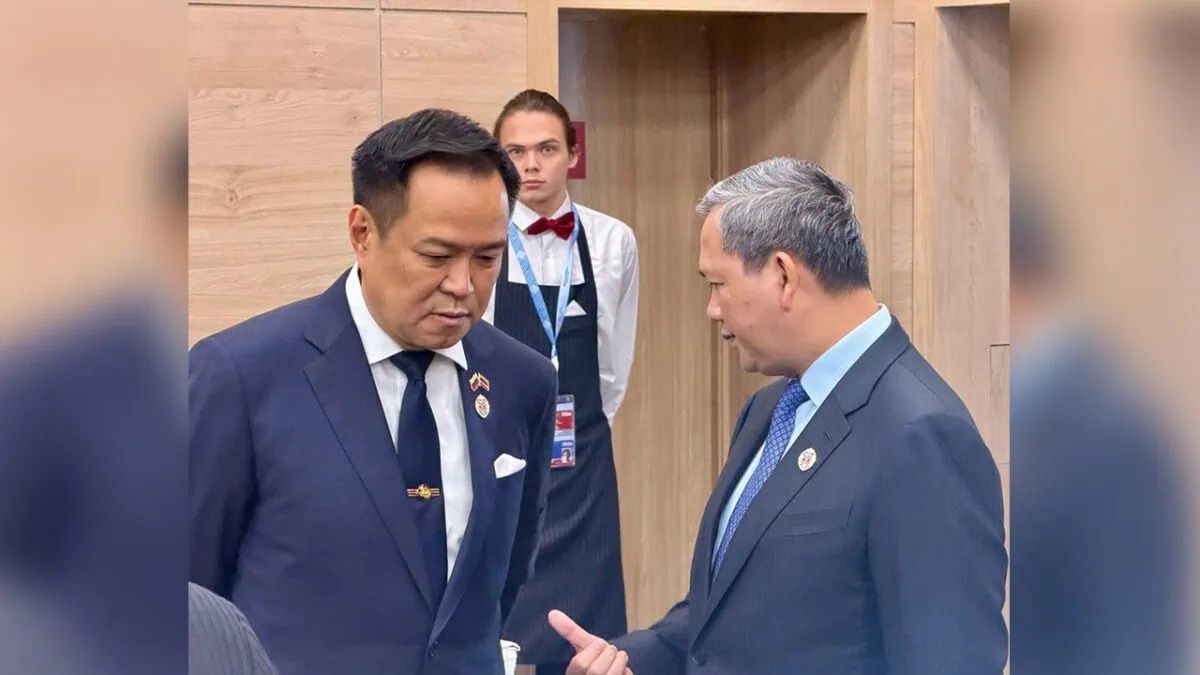
Cambodia's Prime Minister Hun Manet has made a direct appeal to Thailand to fill the vacancy in its Joint Boundary Commission leadership and resume stalled border survey operations, signalling Phnom Penh's intention to move forward with long-pending territorial demarcation work despite years of diplomatic gridlock. The Cambodian leader raised the matter during an informal exchange with Thai Prime Minister Anutin Charnvirakul at an Asean-Russia engagement forum in Kazan, Russia, emphasising that both nations must accelerate efforts to implement existing bilateral agreements on border management.
The conversation between the two Southeast Asian leaders, though brief and conducted in passing, offered a window into how Cambodia and Thailand are currently approaching their complex and sensitive maritime and terrestrial boundary disputes. Hun Manet's subsequent social media statement made clear that Cambodia sees the appointment of a Thai JBC chief as essential to breaking a deadlock that has hindered progress on demarcation activities. This push reflects growing frustration in Phnom Penh over Thailand's failure to fill the position, which has effectively stalled joint survey work that both countries committed to undertake.
Cambodia's position rests on a framework established through a joint statement signed on December 27, 2025, which outlined Point Three—the requirement for both sides to conduct joint boundary surveys and demarcation work. Hun Manet's references to this agreement suggest Cambodia views it as a binding commitment that Thailand should honour without further delay. By publicly calling on Thailand to appoint its JBC chief, the Cambodian leader is applying diplomatic pressure while maintaining the rhetoric of peaceful resolution and respect for international law.
The broader context of Cambodia-Thailand border tensions extends beyond land demarcation. The two countries are simultaneously engaged in a compulsory conciliation process under the United Nations Convention on the Law of the Sea (UNCLOS), which governs their maritime boundary disputes. Hun Manet explicitly stated that Cambodia remains committed to this UN-backed mechanism, indicating that Phnom Penh intends to pursue maritime issues through international legal channels while pressing for bilateral progress on terrestrial matters. This dual-track approach allows Cambodia to leverage different forums—the JBC for land boundaries and UNCLOS for maritime zones—to address overlapping territorial claims.
Thai Prime Minister Anutin's characterisation of the encounter as casual—he described it as "pulling each other aside by the elbow"—offers a different tone but ultimately conveys similar substance. Anutin told Thai media that both sides affirmed their commitment to avoiding conflict and to utilising established mechanisms including UNCLOS, the JBC, and the General Border Committee (GBC) for managing disputes. Thailand's emphasis on multiple institutional channels suggests Bangkok wants to preserve flexibility and avoid locking itself into any single negotiating framework that might constrain future options.
However, Anutin's reluctance to discuss reopening border checkpoints provides insight into domestic political sensitivities in Thailand. His comment that "Thai people would be furious" reveals the electoral costs of perceived concessions to Cambodia on border matters. This domestic political calculus likely explains Thailand's measured pace on appointing a JBC chief and resuming demarcation work—such activities carry symbolic weight suggesting territorial adjustments that Thai public opinion may resist. For Malaysian and other Southeast Asian observers, this dynamic illustrates how border disputes remain entwined with nationalist sentiments and domestic political vulnerabilities across the region.
The divergent emphases in the two leaders' public statements merit careful reading. Hun Manet stressed Cambodia's preference for bilateral mechanisms and specifically referenced the JBC as the appropriate venue for land boundary resolution. He also notably stated that Cambodia saw no need to discuss border checkpoint reopenings at present, suggesting he wanted to avoid any impression that Cambodia was making concessions on sovereignty or encouraging population movements across contested areas. This positioning allows Cambodia to maintain nationalist credibility at home while pursuing practical progress through established channels.
For regional stability, the Kazan meeting represents a positive signal that Cambodia and Thailand remain committed to dialogue rather than confrontation over their boundary disputes. Both nations explicitly rejected conflict and reaffirmed reliance on peaceful mechanisms. Yet the meeting also underscores persistent obstacles: Thailand's vacant JBC chief position remains unfilled, and broader territorial disagreements continue to simmer beneath the surface of formal diplomatic engagement. The slow pace of progress reflects the difficulty of resolving boundary questions that carry profound implications for national sovereignty and domestic political sentiment in both countries.
Cambodia's strategy of combining UNCLOS pressure on maritime issues with bilateral JBC negotiations on land boundaries offers a degree of leverage, yet Thailand's foot-dragging suggests Bangkok is in no rush to demarcate boundaries that might require territorial concessions. The appointment of a Thai JBC chief thus becomes a crucial test of whether Anutin's government genuinely intends to move forward or prefers to manage the boundary question through indefinite low-level engagement. For Myanmar, Laos, and Vietnam—all of which share complex border relationships with both Cambodia and Thailand—the trajectory of this dispute carries implications for regional border management practices and the credibility of multilateral mechanisms.
The management of Cambodia-Thailand boundary disputes remains a delicate balancing act in Southeast Asian geopolitics. Both nations must navigate the tension between demonstrating resolve on territorial matters to domestic audiences and maintaining the diplomatic consensus that prevents border disputes from escalating into armed confrontation. Hun Manet's call for Thailand to appoint a JBC chief represents a measured escalation of pressure—public, specific, and grounded in existing commitments rather than new demands. Whether Anutin's government will respond remains uncertain, but the informal nature of the Kazan conversation suggests neither side views the other as an imminent threat, even as fundamental disagreements over boundary demarcation persist.

