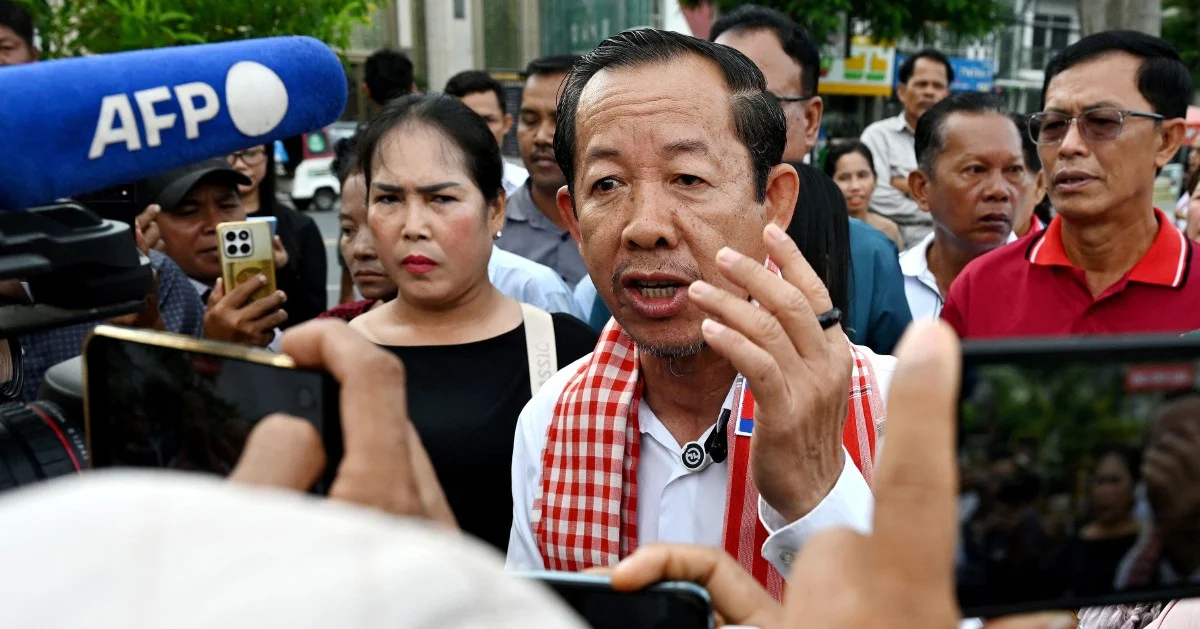
In a decision that typifies Cambodia's fraught political landscape, the country's highest court has taken a middle path in the case of opposition figure Rong Chhun, choosing to suspend his imprisonment while preserving restrictions that effectively sideline him from electoral competition. The ruling, delivered by the Supreme Court on Friday, maintains a controversial prohibition that prevents the activist and politician from standing for public office, despite granting relief on the custodial aspect of his original sentence.
Rong Chhun, who has emerged as a prominent voice in Cambodia's civil society and opposition spaces, has faced mounting legal challenges over recent years as authorities have pursued various cases against him. His lawyer disclosed the Supreme Court's decision, noting that while the court opted not to enforce the jail term, it declined to reverse the election ban that represents perhaps the most consequential aspect of his legal troubles. The decision underscores the selective application of judicial discretion in Cambodia's court system, where political considerations often intersect with formal legal proceedings.
The election prohibition carries particular significance in Cambodia's electoral context, where opposition participation remains constrained despite the country's ostensible embrace of democratic institutions. By maintaining this ban, the Supreme Court has effectively barred Rong Chhun from direct electoral involvement indefinitely, a restriction that extends far beyond the typical duration of most criminal sentences. For those monitoring Cambodia's democratic trajectory, such rulings reveal how judicial mechanisms can function to limit opposition influence even when other sanctions are moderated.
Rong Chhun has built considerable standing as an organizer and advocate for workers' rights and social justice across Cambodia. His detention and subsequent legal troubles have been viewed by international observers and human rights organizations as emblematic of broader patterns whereby authorities employ the justice system to neutralize potential political challengers. The suspension of his prison sentence may suggest some recognition within the judiciary that the case warranted recalibration, yet the concurrent preservation of electoral restrictions indicates that constraints on his political participation remain central to the authorities' objectives.
Cambodia's Supreme Court decision illustrates a phenomenon increasingly evident throughout Southeast Asia, where judicial systems sometimes accommodate surface-level concessions while reinforcing structural barriers against opposition forces. The suspended sentence offers a symbolic gesture that might moderate international criticism regarding judicial fairness, while the sustained election ban preserves the practical effect of sidelining a high-profile opposition figure from meaningful electoral competition. Such calibrated approaches allow governments to maintain deniability regarding suppression while achieving substantive political outcomes.
The timing of this ruling arrives amid broader regional discussions about democratic governance and the rule of law in Southeast Asia. Cambodia, which has long struggled with concerns regarding judicial independence and political space for opposition movements, continues to face scrutiny from international organizations and democratic advocates. Rong Chhun's situation reflects wider anxieties about whether Cambodia's institutions can deliver genuinely impartial justice or whether they remain instruments through which incumbent authorities manage political competition.
For Malaysia and other Southeast Asian nations observing Cambodia's institutional evolution, the case presents instructive lessons about how electoral regulations and criminal justice systems can be weaponized to achieve political purposes. The apparent moderation—suspending rather than implementing a prison sentence—may create the appearance of judicial restraint, yet the substantive barrier to electoral participation demonstrates how such appearances can coexist with considerable practical restrictions on opposition activity. This disconnect between form and substance warrants careful attention from regional observers concerned with democratic standards.
The response from international human rights organizations is likely to emphasize that while the suspended sentence represents a minor positive development, the maintained election ban perpetuates the fundamental problem of constraining opposition voices through legal mechanisms. Such mixed outcomes can obscure the underlying reality that opposition figures like Rong Chhun face cumulative barriers designed to exclude them from competitive electoral processes. The ruling exemplifies how courts can engineer outcomes that seem moderate on surface examination while substantively preserving restrictions on political opposition.
Rong Chhun's case also illuminates the strategic calculations facing opposition politicians throughout Cambodia. Even suspension of a sentence leaves a conviction in place, and the election ban removes any pathway for direct electoral rehabilitation. This combination pressures opposition figures toward either political quiescence or continued activism outside formal electoral channels, neither of which represents genuine democratic space. For regional advocates of democratic governance, such circumstances raise fundamental questions about the meaning of electoral choice when opposition candidates face systematic legal barriers to participation.
Cambodia's judicial handling of high-profile opposition figures continues to draw scrutiny from international bodies monitoring democratic standards and rule of law commitments. The Supreme Court's decision regarding Rong Chhun, balancing a suspended sentence against a preserved election ban, exemplifies the complex strategies through which authorities manage opposition while maintaining legal facades of impartiality. As Southeast Asia navigates ongoing debates about democratic consolidation and institutional integrity, cases like this serve as important indicators of whether the region's judiciaries function as genuinely independent arbiters or as instruments of incumbent power management.

