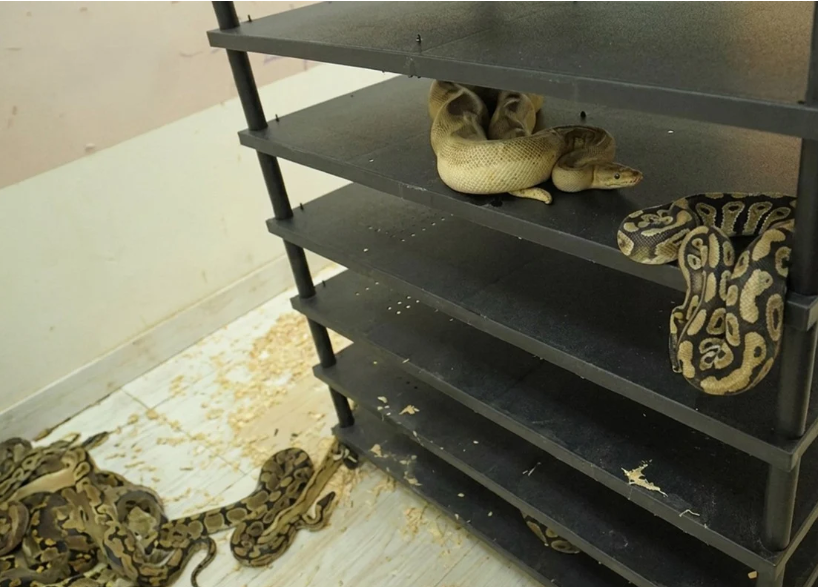
A court in Taizhou, Zhejiang province, has sentenced a man surnamed Guo to jail for operating an extensive illegal python breeding operation from his residential flat in eastern China. The case, highlighted by state broadcaster CCTV in late June, illustrates how wildlife protection enforcement extends into surprising corners of domestic life. Authorities discovered 309 pythons crammed into plastic boxes throughout Guo's home after his electricity consumption patterns triggered an investigation that would ultimately dismantle what investigators described as a serious breach of wildlife protection laws.
The operation came to light in March 2024 when an elderly resident of Taizhou discovered a large python at the base of a nearby mountain. The snake, described as being as thick as an adult's arm, was not native to the region, prompting the senior citizen to alert local authorities. Police theorised that the reptile had escaped from a breeder's facility, noting that pythons would be naturally dormant during that time of year and could not have survived wild in the temperate climate of Zhejiang without human assistance. This single escaped snake became the thread that, when pulled, would unravel a sophisticated breeding network operating under the radar of law enforcement.
Detectives consulted with professional herpetologists who provided crucial insight into the case. They explained that pythons require carefully controlled environments maintained between 20 and 30 degrees Celsius, along with specific humidity levels, to survive and reproduce successfully. This meant that whoever was breeding these animals would necessarily be consuming significant quantities of electricity to run heating and humidity control systems continuously. Operating on this principle, police began examining electricity consumption records for residents in the vicinity of where the snake was found, systematically identifying properties with usage patterns inconsistent with normal household needs.
Guo emerged as the primary suspect following this analysis. Living alone in his flat, unemployed and unmarried, Guo showed electricity consumption levels far exceeding what would be typical for a single resident. Once police began surveillance, they noticed another individual, surnamed Di, making frequent visits to Guo's residence. These visits coincided with Di collecting parcels from courier stations, which the investigation revealed contained live white mice purchased through online marketplaces. When authorities contacted the sellers, they confirmed that such bulk purchases of mice are characteristically made by people maintaining reptile collections intended for feeding purposes.
Further investigation uncovered a digital footprint implicating Guo in his own crimes. The suspect had shared photographs of snakes on social media platforms, occasionally posting cryptic references to the sale of his pythons. Transaction records revealed that Di had facilitated the sale of at least two pythons to another buyer for 1,000 yuan, approximately US$150 per animal. This evidence suggested not merely a hobbyist's private collection but a deliberate commercial enterprise generating revenue from protected wildlife. The combination of physical evidence, digital traces, and financial records gave police sufficient grounds to move forward with arrests.
When officers executed a search warrant at Guo's residence, they encountered a scene that dramatically illustrated the scale of the operation. Plastic storage boxes, stacked throughout the flat, each contained one or more pythons. Guo had compressed his own living space into a single bedroom, surrendering the other two bedrooms and the entire living room to his reptile collection. This arrangement revealed not casual breeding but a deliberate prioritisation of the operation above his own comfort and normal residential life. The 309 pythons discovered at Guo's address were subsequently transferred to a local zoo for care, representing the largest single seizure from his location.
Guo's fascination with snakes, authorities determined, dated back a decade. He acquired his first four pythons in 2014 and had since devoted himself to mastering the technical aspects of breeding. During police questioning, Guo displayed enthusiasm for his work, describing himself as a kind of creator, capable of producing pythons in various colours through selective breeding practices. His interest, while perhaps genuine from an enthusiast's perspective, had crossed definitively into illegal territory. The purchase of breeding stock, the development of infrastructure to maintain populations, and the sale of offspring constituted a sustained violation of Chinese wildlife protection regulations.
The investigation expanded beyond Guo to implicate two additional individuals. Di, the associate who transported mice and facilitated sales, faced charges related to his role in the operation. A third suspect, surnamed Deng, emerged as a supplier in the network. Deng, who had sold four pythons to Guo in 2014 and profited from that initial transaction, was discovered operating his own breeding facility containing 47 pythons. The interconnected nature of this network suggested that illegal python breeding, while operating in the shadows, had developed its own ecosystem of suppliers, breeders, and dealers.
The total scope of the operation exceeded even the pythons found at Guo's address. Across all three individuals arrested, authorities seized 436 pythons collectively valued at more than 30 million yuan, equivalent to approximately US$4.4 million. This valuation underscores a critical reality: illegal wildlife trafficking often flourishes because the financial incentives are substantial. A single python can command significant prices in black markets where legitimate acquisition requires government permits and documentation. For someone willing to accept the legal risk, the profit margins could be attractive, particularly when operating from modest residential spaces with minimal overhead beyond utilities.
China's Criminal Law provides a framework for prosecuting such violations. Grade Two protected animals, the classification assigned to pythons, carry penalties up to a maximum of five years imprisonment for illegal breeding, trading, or transport without official authorisation. The Taizhou court sentenced Guo, Di, and Deng accordingly, though specific sentence lengths were not disclosed in official reports. The penalties reflect Beijing's commitment to wildlife protection, particularly for species designated as endangered or vulnerable to over-harvesting.
This case carries broader implications for Southeast Asia, where python populations and related reptile species face mounting pressure from trafficking and illegal collection for the pet trade. Malaysia, as a megadiverse nation with significant reptile populations, has observed similar patterns of illegal breeding and smuggling networks. The Chinese investigation methodology, particularly the use of utility consumption analysis to identify suspects, offers a template that enforcement agencies across the region might adapt. The case also demonstrates how a single incident—one escaped snake—can unravel criminal enterprises operating with relative impunity, provided authorities possess the investigative resources and wildlife expertise to follow leads effectively. For Malaysian authorities monitoring illegal wildlife trade, the takeaway is clear: sophisticated networks can operate within urban residential areas, concealed from public view through carefully managed logistics and utilising multiple intermediaries to distance principals from direct sales.

