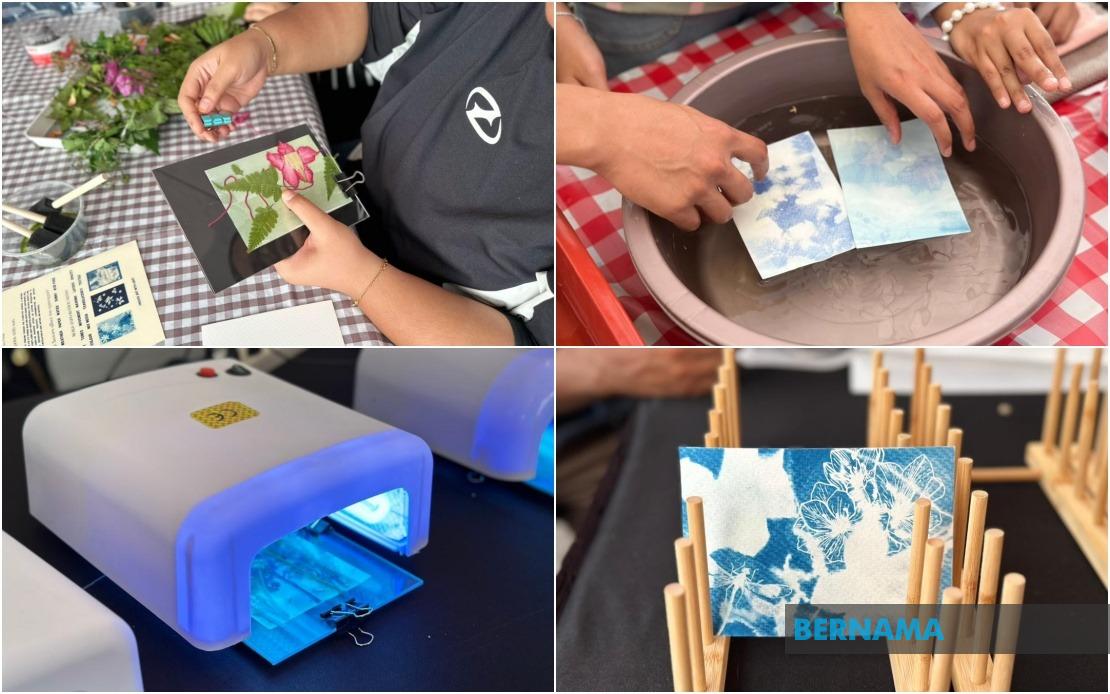
Sunlight shapes the creative process in unexpected ways for cyanotype artist Puteri Mas Aishah Ramyusnali. The 24-year-old Penang native has spent the past three years harnessing the sun's energy as her primary creative tool, transforming an 19th-century photographic technique into a contemporary medium that reveals deeper truths about humanity's relationship with the natural world. Her journey through this luminous art form has fundamentally altered how she perceives the environment and its influence on artistic expression.
At its core, cyanotype is a deceptively simple yet profoundly rewarding process that depends entirely on nature's cooperation. Puteri Mas Aishah arranges leaves, flowers, or other objects atop paper treated with a light-sensitive chemical compound, then exposes the composition to direct sunlight for approximately 10 to 15 minutes. The exposure period is crucial—during this brief window, ultraviolet radiation initiates a chemical reaction that will later produce the artwork's characteristic prussian blue tones. Once this solar exposure concludes, she removes the organic materials and submerges the paper in a sequence of water baths with varying acidity levels, revealing the ghostly cyan-coloured impressions that define the finished piece.
What distinguishes Puteri Mas Aishah's approach is her acute awareness that successful cyanotype creation demands intimate knowledge of atmospheric conditions. Weather patterns, cloud coverage, and daily UV intensity fluctuations directly influence the depth and vibrancy of the final blue hue. She maintains meticulous records of meteorological data, understanding that overcast skies produce subtler, more delicate impressions while clear skies with intense solar radiation generate bold, saturated blues. This necessity to monitor environmental variables has transformed her practice into an exercise in environmental observation, requiring her to develop a relationship with weather that most urban dwellers barely consider.
Currently pursuing a Master's degree in Fine Arts and Technology at Universiti Teknologi MARA, Puteri Mas Aishah originally discovered cyanotype during industrial training, a period that proved pivotal in her artistic trajectory. She was tasked with introducing the technique to workshop participants—a responsibility that initially triggered considerable anxiety given her inexperience and the absence of direct faculty supervision. Rather than retreat into uncertainty, she channeled her apprehension into engagement, facilitating hands-on sessions that demystified the process for the public. This early teaching experience catalysed her commitment to the discipline and established her as an educator within Malaysia's emerging contemporary art community.
Since those formative workshop experiences, Puteri Mas Aishah has expanded her pedagogical reach considerably, conducting regular cyanotype sessions and collaborating with art studios and galleries throughout the Selangor region, particularly in Shah Alam. These collaborations extend beyond simple technical instruction; they function as platforms for participants to confront their own assumptions about art's relevance and purpose. Through hands-on engagement with the process, workshop attendees develop appreciation for how natural phenomena—phenomena they ordinarily ignore—can become generative forces in creative work. The democratic nature of cyanotype, requiring no expensive equipment or specialised facilities, makes it particularly accessible to communities with limited resources.
Beyond the technical accomplishments of her artistic practice, Puteri Mas Aishah articulates a philosophical conviction about art's potential to reshape how society engages with environmental consciousness. She challenges the persistent perception that art constitutes a frivolous luxury divorced from everyday existence and social necessity. Instead, she positions artistic practice as integral to how humans understand and relate to their surroundings. By working with cyanotype, she models an approach to creativity that cannot proceed without environmental attentiveness—one cannot produce a cyanotype without acknowledging weather, sunlight, water quality, and seasonal variations. This makes the medium itself a pedagogical tool for environmental literacy.
For younger generations in Malaysia navigating an increasingly urbanised existence, Puteri Mas Aishah's vision offers an alternative framework for artistic engagement. Rather than viewing art-making as an escape from the material world, she demonstrates how creative practice can deepen connection to environmental realities and interdependence. The cyanotype process demands that artists become attuned to solar cycles, precipitation patterns, and atmospheric conditions—elements of nature that city dwellers often experience as mere backdrop rather than active force. Her workshops, conducted recently at the RIUH Pi HAWANA Carnival at the PICCA Convention Centre in Butterworth, introduce participants to this reconnection through tactile, immediate experience rather than theoretical instruction.
The implications of Puteri Mas Aishah's work extend beyond individual artistic practice into broader conversations about environmental education and cultural engagement in Southeast Asia. As Malaysia continues rapid urbanisation and faces mounting environmental pressures, art forms that cultivate attentiveness to natural cycles offer valuable counterbalance to extractive approaches to nature. Her insistence that artists and participants alike develop detailed knowledge of weather and UV exposure patterns, seemingly technical concerns, actually represents a form of environmental activism. By making nature's variables visible and consequential within the creative process, cyanotype artists position themselves at the intersection of ecological awareness and cultural production.
Moving forward, Puteri Mas Aishah expresses determination to expand cyanotype's footprint within Malaysian artistic discourse and to foster recognition of art's genuine social value. She seeks to cultivate a generation of young people who regard creative practice not as peripheral entertainment but as meaningful engagement with fundamental questions of human-environmental relationship. Her conviction that art constitutes an essential dimension of everyday existence, rather than a luxury commodity, challenges entrenched hierarchies that privilege technical and commercial disciplines over cultural and artistic ones. Through patient teaching, rigorous personal practice, and thoughtful articulation of cyanotype's possibilities, she continues building a constituency for art that strengthens rather than diminishes our connection to the living world.

